
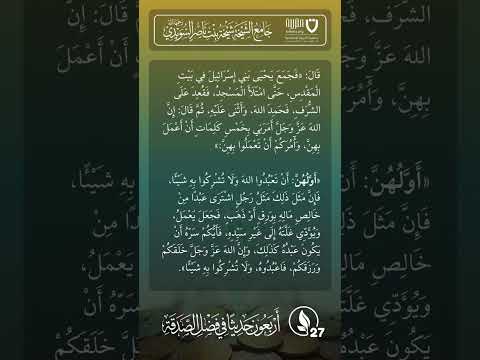
Forty hadiths on the virtue of charity | Hadith No. (27)
Lesson summary
The sheikh explains the hadith of al-Harith al-Ash'ari (may Allah be pleased with him), in which the Prophet ﷺ relates that Allah commanded Yahya ibn Zakariya (peace be upon them both) with five words to act upon and to command the Children of Israel to act upon. Yahya gathered them in Bayt al-Maqdis, praised Allah, and explained the five: worshipping Allah without associating anything with Him, prayer, fasting, charity, and frequent remembrance of Allah. The Prophet ﷺ then said he too is commanded with five: the community, listening and obeying, emigration, and jihad in the way of Allah, warning against leaving the community and against the call of jahiliyyah.
Key takeaways
- Tawhid is the foundation of worship; associating nothing with Allah is likened to a slave toiling for someone other than his master.
- In prayer, Allah turns His face toward His servant as long as he does not turn away, so one should avoid turning while praying.
- Fasting has a great reward, and the odor from the mouth of the fasting person is more pleasant to Allah than the scent of musk.
- Charity is a ransom for the soul, likened to a captive who redeems himself with little or much until he frees himself.
- Frequent remembrance of Allah is a strong fortress that protects the servant from Satan.
- Adhering to the community and obedience: whoever leaves the community by a span has removed the bond of Islam from his neck, unless he returns.
- A warning against the call of jahiliyyah, and that Muslims should be addressed by the names Allah gave them: the Muslims, the believers, the servants of Allah.
Questions & answers
What are the five words Allah commanded Yahya (peace be upon him) with?
According to the hadith, they are: worshipping Allah without associating anything with Him, prayer, fasting, charity, and remembering Allah often.
Why did the Prophet ﷺ compare charity to ransoming a captive?
Because the one who gives charity redeems himself from the enemy, just as a captive redeems himself with little or much until he frees himself, as the hadith states.
What protects the servant from Satan according to the hadith?
The remembrance of Allah. The servant is at his most protected from Satan when he is engaged in remembering Allah, likened to a man sheltered in a strong fortress.
What does the hadith say about leaving the community?
The hadith states that whoever leaves the community by a span has removed the bond of Islam from his neck, unless he returns.
Auto-generated from the lesson transcript; the lesson itself is the reference.