
Transcript
Machine translation — may contain errors
0:00
An-Nawawi's Forty Hadiths.
0:06
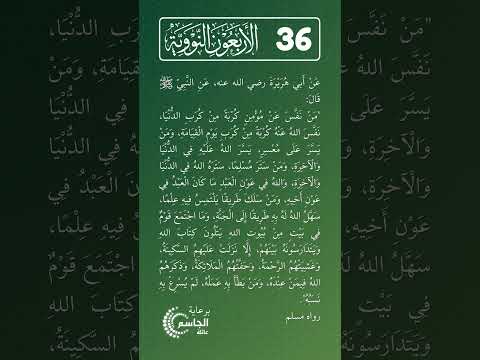
On the authority of Abu Hurayrah (may Allah be pleased with him),
0:09
from the Prophet (peace and blessings of Allah be upon him), who said:
0:13
"Whoever relieves a believer of one of the hardships of this world,
0:18
Allah will relieve him of one of the hardships of the Day of Resurrection.
0:23
Whoever eases the hardship of one in distress,
0:26
Allah will ease his hardship in this world and the Hereafter.
0:30
Whoever conceals the faults of a Muslim, Allah will conceal his faults in this world and the Hereafter.
0:36
Allah continues to aid His servant as long as the servant aids his brother.
0:42
Whoever traverses a path seeking sacred knowledge,
0:46
Allah will make easy for him thereby a path to Paradise. No people gather in one of the houses of Allah,
0:55
reciting the Book of Allah and studying it together, except that tranquility descends upon them, mercy envelops them, the angels surround them, and Allah mentions them to those who are with Him.
1:12
And whoever is slowed down by his deeds will not be hastened forward by his lineage." Reported by Muslim.
1:21
This hadith teaches us that the recompense corresponds to the nature of the deed: whoever helps people and dispels their anxieties, Allah will ease his affairs in this world and the Hereafter.
1:33
It also urges us to conceal the faults of fellow Muslims, to facilitate matters for those in need, and to gather for the pursuit of knowledge,
1:41
for mutual cooperation and mercy are means of attaining Allah’s love and His support for His servants.
1:47
Furthermore, the hadith makes clear that a person’s worth in the sight of Allah is determined by righteous deeds, not by noble lineage or social standing.
1:56
Thus, whoever falls short in his deeds will not be benefited by his status or ancestry; salvation lies solely in obedience and righteous action.