budoorzahera launched in 2026 to carry the light of knowledge to every heart, in every language. Every lesson is available in the original audio with a full synced transcript, translated into fifteen other languages, with translated-audio listening available for a number of them.
You can copy any line of the transcript while listening, download the full text in multiple formats (TXT · SRT · VTT), or share a lesson with someone you care about in one tap. We ask God to make this work beneficial.
4192audio lessons
59complete series
16world languages
Error log
An automatic log of the most recent errors the app ran into on your device — copying and sending it to us helps a lot when troubleshooting a problem.
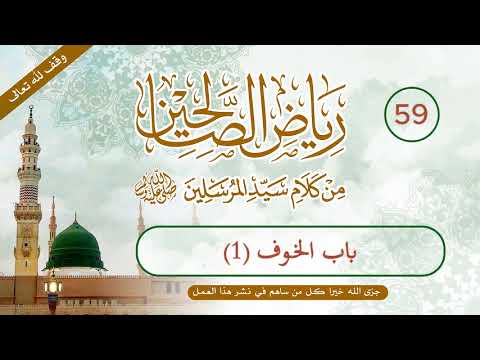
This lesson explains the chapter on fear (باب الخوف) from Riyad as-Salihin, beginning with Qur'anic verses that encourage fear of Allah and describe the terrors of the Day of Judgment. It then presents hadiths on divine decree and the outcome of a person's deeds, on the description of Hell and the varying degrees of its punishment, and on the terror of the Day of Resurrection. It closes with a hadith on what the Prophet ﷺ knew of the unseen that others did not, and on the Companions' weeping and fear when admonished. This is the first lesson of the chapter, and with it the series is complete.
Key takeaways
Fear of Allah the Exalted motivates obedience, and the lesson cites verses such as: "And fear Me alone."
What matters is the final outcome, so a person should not be deceived by a deed he has done, and should ask Allah for a good ending and seek refuge from a bad one.
Belief in divine decree, both good and bad, is required; a person's provision, term of life and deeds are written, and striving beyond what is decreed does not help, while earning a living is legislated as one of the means ordained by divine wisdom.
The people of Hell vary in punishment according to their sins, and the least punished among them is a man with two embers placed under the soles of his feet.
The terror of the Day of Resurrection, when people stand before the Lord of the worlds and some are submerged in their sweat according to their deeds.
The prophets know of the unseen what others do not, so weeping out of fear of Allah is recommended and excessive laughter is discouraged as a sign of heedlessness and a hard heart.
The Companions ﷺ were deeply moved by admonition and greatly feared Allah's punishment.
Questions & answers
What is meant by the chapter on fear in Riyad as-Salihin?
It is a chapter gathering the verses and hadiths about fear of Allah and His punishment, explaining the evidence for the obligation and merit of this fear.
What is the lesson from the hadith of Ibn Mas'ud about the creation of a human in the mother's womb?
The hadith states that a person's provision, term of life and deeds are written, and that the outcome is what matters. No one should be deceived by his deeds or despair, and one is urged to hasten to righteous deeds and persist in them.
Why did the Companions weep when admonished?
Because of what the Prophet ﷺ told them about the terrors of the Hereafter, the bliss of Paradise and the punishment of Hell. They had the most tender hearts and were the quickest to respond. Weeping out of fear of Allah is recommended, while excessive laughter indicates heedlessness.
Who is the least punished of the people of Hell?
According to the hadith cited in the lesson, it is a man on whose soles are placed two embers that make his brain boil. He thinks he is the most punished, yet he is the least punished of them.
Auto-generated from the lesson transcript; the lesson itself is the reference.
Qur’an verses cited in this lesson
Hud 11:102 — Even thus is the grasp of thy Lord when He graspeth the townships while they are doing wrong. Lo! His grasp is painful, very strong.
Hud 11:103 — Lo! herein verily there is a portent for those who fear the doom of the Hereafter. That is a day unto which mankind will be gathered, and that is a day that will be witnessed.
Hud 11:104 — And We defer it only to a term already reckoned.
Hud 11:106 — As for those who will be wretched (on that day) they will be in the Fire; sighing and wailing will be their portion therein,
Al-Hajj 22:1 — O mankind! Fear your Lord. Lo! the earthquake of the Hour (of Doom) is a tremendous thing.
Al-Hajj 22:2 — On the day when ye behold it, every nursing mother will forget her nursling and every pregnant one will be delivered of her burden, and thou (Muhammad) wilt see mankind as drunken, yet they will not be drunken, but the Doom of Allah will be strong (upon them).
At-Tur 52:28 — Lo! we used to pray unto Him of old. Lo! He is the Benign, the Merciful.
Ar-Rahman 55:46 — But for him who feareth the standing before his Lord there are two gardens.
Al-Jinn 72:26 — (He is) the Knower of the Unseen, and He revealeth unto none His secret,
Al-Jinn 72:27 — Save unto every messenger whom He hath chosen, and then He maketh a guard to go before him and a guard behind him
'Abasa 80:34 — On the day when a man fleeth from his brother
'Abasa 80:37 — Every man that day will have concern enough to make him heedless (of others).
Al-Mutaffifin 83:6 — The day when (all) mankind stand before the Lord of the Worlds?
Al-Buruj 85:12 — Lo! the punishment of thy Lord is stern.
Verses are matched automatically against the Qur’an text; some mentions may be missed. English: Pickthall.
Transcript
Machine translation — may contain errors
0:00*Riyad al-Salihin* (The Meadows of the Righteous)
0:03From the Words of the Master of the Messengers,
0:06Peace and blessings of Allah be upon him.
0:09Chapter: Fear (of Allah).
0:16Allah the Exalted said:
0:18"And fear Me alone."
0:20And the Exalted said:
0:22“Lo! the punishment of thy Lord is stern.” (85:12)
0:25And the Exalted said:
0:27“Even thus is the grasp of thy Lord when He graspeth the townships while they are doing wrong. Lo! His grasp is painful, very strong.” (11:102)
0:32“Even thus is the grasp of thy Lord when He graspeth the townships while they are doing wrong. Lo! His grasp is painful, very strong.” (11:102)
0:35“Lo! herein verily there is a portent for those who fear the doom of the Hereafter. That is a day unto which mankind will be gathered, and that is a day that will be witnessed.” (11:103)
0:40“Lo! herein verily there is a portent for those who fear the doom of the Hereafter. That is a day unto which mankind will be gathered, and that is a day that will be witnessed.” (11:103)
0:46“And We defer it only to a term already reckoned.” (11:104)
0:51"The Day it comes, no soul shall speak except by His permission;"
0:56"and among them will be the wretched and the prosperous."
0:59“As for those who will be wretched (on that day) they will be in the Fire; sighing and wailing will be their portion therein,” (11:106)
1:06And the Exalted said:
1:08"And Allah warns you of Himself."
1:11And the Exalted said:
1:13“On the day when a man fleeth from his brother” (80:34)
1:16"And his mother and his father,"
1:18"and his wife and his children."
1:21“Every man that day will have concern enough to make him heedless (of others).” (80:37)
1:27And the Exalted said:
1:29"O mankind, fear your Lord;"
1:32“O mankind! Fear your Lord. Lo! the earthquake of the Hour (of Doom) is a tremendous thing.” (22:1)
1:36“On the day when ye behold it, every nursing mother will forget her nursling and every pregnant one will be delivered of her burden, and thou (Muhammad) wilt see mankind as drunken, yet they will not be drunken, but the Doom of Allah will be strong (upon them).” (22:2)
1:42“On the day when ye behold it, every nursing mother will forget her nursling and every pregnant one will be delivered of her burden, and thou (Muhammad) wilt see mankind as drunken, yet they will not be drunken, but the Doom of Allah will be strong (upon them).” (22:2)
1:46"and you will see the people looking drunk, while they are not drunk."
1:50“On the day when ye behold it, every nursing mother will forget her nursling and every pregnant one will be delivered of her burden, and thou (Muhammad) wilt see mankind as drunken, yet they will not be drunken, but the Doom of Allah will be strong (upon them).” (22:2)
1:53And the Exalted said:
1:55“But for him who feareth the standing before his Lord there are two gardens.” (55:46)
1:59the verses.
2:01And the Exalted said:
2:03"And they will approach one another inquiring,"
2:08"saying, 'Indeed, we were previously among our families fearful [of Allah's displeasure],'"
2:13"'so Allah conferred favor upon us and protected us from the punishment of the Scorching Wind.'"
2:19"'Indeed, we used to supplicate Him before.'"
2:23“Lo! we used to pray unto Him of old. Lo! He is the Benign, the Merciful.” (52:28)
2:26The Quranic verses in this chapter are very numerous and well known,
2:32and the purpose was to point to some of them, which has been accomplished.
2:37As for the hadiths, they are also very numerous;
2:40we shall mention a portion of them, and with Allah lies success.
2:45On the authority of Ibn Mas'ud (may Allah be pleased with him), who said:
2:50The Messenger of Allah (peace and blessings of Allah be upon him) narrated to us,
2:54and he is the truthful and trusted:
2:57"The creation of each one of you is gathered in his mother's womb for forty days as a drop (*nutfah*);"
3:03"then he becomes a clinging clot (*'alaqah*) for a similar period;"
3:07"then he becomes a lump of flesh (*mudghah*) for a similar period;"
3:10"then the angel is sent,"
3:12"who breathes the soul into him,"
3:14"and is commanded with four decrees:"
3:17"to record his provision, his lifespan, his deeds,"
3:20"and whether he will be wretched or blessed."
3:23"By the One besides Whom there is no other deity,"
3:26"one of you may perform the deeds of the people of Paradise"
3:29"until there is nothing between him and it except a cubit's length,"
3:34"whereupon the decree overtakes him,"
3:36"and he performs the deeds of the people of Hellfire and enters it."
3:40"And one of you may perform the deeds of the people of Hellfire"
3:45"until there is nothing between him and it except a cubit's length,"
3:50"whereupon the decree overtakes him,"
3:52"and he performs the deeds of the people of Paradise and enters it."
3:57Agreed upon.
4:01"Is gathered" (*yujma'u*): meaning it is decreed and remains settled.
4:05"His creation" (*khalquhu*): meaning the physical substance of his creation or that from which he is formed.
4:10"His mother's womb" (*batni ummihi*): meaning the uterus.
4:13"A drop" (*nutfah*): it is the semen from which the human being is formed.
4:20It is called *nutfah* because it derives from fluid that trickles (*yantif*), meaning it flows.
4:26"Becomes" (*yakunu*): meaning it turns into.
4:29"A clinging clot" (*'alaqah*): meaning coagulated blood;
4:32it is called so because it clings to the womb at that stage.
4:36"A lump of flesh" (*mudghah*): meaning a piece of flesh roughly the size of a single morsel to be chewed.
4:41"His provision" (*rizqihi*): meaning whatever he benefits from throughout his life.
4:45"His lifespan" (*ajalihi*): meaning the duration of his earthly life.
4:48"His deeds" (*'amalihi*): meaning whatever actions he produces, whether righteous or otherwise.
4:55"Wretched or blessed" (*shaqiyyun aw sa'id*):
4:57meaning whether he will be among the people of salvation and felicity, or among the people of misery and damnation.
5:03"The decree" (*al-kitab*): meaning what was foreordained for him based on Allah's prior knowledge of his ultimate state.
5:10Among the lessons derived from the hadith:
5:13The obligation of believing in divine decree and predestination (*qada' wa qadar*), both the good and the bad of it.
5:18Encouragement to hasten toward righteous deeds,
5:23and to persevere and be steadfast in performing them.
5:27That ultimate outcomes depend entirely upon the final deeds (at the end of life).
5:29Thus, no person should be deluded by any good deeds they have previously performed,
5:33nor should they rely complacently upon them and neglect further striving.
5:36For the divine decrees are overpowering,
5:38and a secure end is hidden from view.
5:40Whoever performs a righteous deed must diligently safeguard its purity so as not to nullify it.
5:48Seeking assistance from Allah the Exalted,
5:51asking Him for a good end,
5:54fearing an evil end,
5:56and seeking refuge in Allah from it.
5:59The permissibility of swearing an oath to confirm truthful information,
6:02in order to emphasize it firmly in the mind of the listener.
6:04That is why the Messenger of Allah (peace be upon him) said:
6:09"By the One in Whose hand is my soul."
6:11It draws attention to the absolute reality of resurrection and divine recompense:
6:16for whoever was able to create man from a base fluid
6:20is fully capable of restoring the soul to him after he turns to dust.
6:25It contains an urge toward contentment and a stern deterrence against greed;
6:30because one's provision has already been preordained,
6:33so exhausting oneself excessively in pursuit of it will not increase it.
6:36Earning a livelihood was ordained merely
6:38because it is among the secondary causes required by divine wisdom in this worldly life.
6:46A reminder of the absolute perfection of Allah's knowledge, Glorified is He,
6:49and that He knows all particulars just as He knows all universals.
6:54On the authority of Ibn Mas'ud (may Allah be pleased with him), who said:
6:59The Messenger of Allah (peace be upon him) said:
7:03"Hellfire will be brought on that Day with seventy thousand reins,"
7:08"and with each rein there will be seventy thousand angels dragging it."
7:13Narrated by Muslim.
7:16"On that Day" (*yawma'idhin*): meaning the Day when mankind will stand for the Reckoning.
7:22"Rein" (*al-zimam*): meaning that which is attached to a camel's nose-ring to which the leading rope is fastened.
7:28Among the lessons derived from the hadith:
7:32The immense size and terrifying magnitude of Hellfire's creation,
7:34and that it is prepared specifically for the disbelievers, the polytheists, and the hypocrites.
7:39It provides details regarding the immense creation of Hellfire,
7:43and that it has reins by which it is pulled,
7:46and designated angels assigned to lead it.
7:50A clarification of the staggering number of angels dragging Hellfire.
7:55Allah's instilling of fear in His servants so that they may revere Him and worship Him alone.
8:02On the authority of al-Nu'man ibn Bashir (may Allah be pleased with both of them), who said:
8:06I heard the Messenger of Allah (peace be upon him) say:
8:11"Indeed, the person who will suffer the lightest punishment among the people of Hellfire on the Day of Resurrection"
8:15"is a man beneath the arches of whose feet two glowing embers will be placed,"
8:19"from which his brain will boil."
8:22"He will not think that anyone is suffering a more severe punishment than himself,"
8:26"yet he is indeed receiving the lightest punishment among them."
8:30Agreed upon.
8:33"Arches of the feet" (*akhmas*): meaning the concave part of the sole that does not touch the ground,
8:37not making direct contact with it.
8:40"Boil" (*yaghli*): derived from boiling,
8:43which is the vigorous bubbling and turmoil of water and the like when set over fire,
8:47due to the extreme intensity of its heat.
8:49"He will not think" (*ma yara*): meaning he firmly believes.
8:54Among the lessons derived from the hadith:
8:57A warning against falling into acts of disobedience,
9:00so that one does not become one of the denizens of Hellfire.
9:03The punishment of Hellfire exists in descending levels and varying degrees (*darakat*).
9:06The sheer severity of Allah's punishment for the disbelievers.
9:10The person will think he is being punished the most severely of all people,
9:13due to the staggering agony he is experiencing,
9:16while in reality he is the lightest punished of all the denizens of Hellfire.
9:22An exposition of the diverse varieties of torment on the Day of Resurrection,
9:26among which are fiery embers placed beneath the arches of the feet.
9:30Whoever dies in disbelief will not benefit from any of his deeds;
9:34for this hadith was revealed regarding Abu Talib,
9:37the uncle of the Prophet (peace be upon him),
9:40who used to nurture, support, and protect him,
9:44but died adhering to the religion of his forefathers and ancestors.
9:48This was explicitly recorded in Sahih Muslim
9:52from the hadith of Ibn 'Abbas (may Allah be pleased with both of them),
9:55who said that the Messenger of Allah (peace be upon him) said:
9:59"The person with the lightest punishment among the people of Hellfire"
10:02"is Abu Talib,"
10:04"and he will be wearing two sandals of fire from which his brain will boil."
10:09On the authority of Samurah ibn Jundub (may Allah be pleased with him),
10:15that the Prophet of Allah (peace be upon him) said:
10:19"Among them are those whom the Fire will engulf up to their ankles;"
10:23"among them are those whom it will engulf up to their knees;"
10:27"among them are those whom it will engulf up to their waistbands;"
10:31"and among them are those whom it will engulf up to their collarbones."
10:35Narrated by Muslim.
10:37The waistband (*al-hujzah*): the place where the lower garment (*izar*) is tied beneath the navel.
10:41The collarbone (*al-tarquwah*): the bone located at the base of the throat;
10:46and a human being has two collarbones on either side of the throat.
10:50"Among them": meaning among the denizens of Hellfire.
10:56"His ankles": the ankle (*al-ka'b*) is the protruding bone at the joint between the lower leg and the foot.
11:02Among the lessons derived from the hadith:
11:05Instilling fear of the Fire,
11:07and a severe warning to whoever performs the deeds of its inhabitants.
11:11The variation of punishment among the denizens of Hellfire;
11:15they are not all on a single equal level,
11:18but rather according to the measure of their sins and acts of disobedience.
11:22On the authority of Ibn 'Umar (may Allah be pleased with both of them),
11:27that the Messenger of Allah (peace be upon him) said
11:31“The day when (all) mankind stand before the Lord of the Worlds?” (83:6)
11:34until one of them will be submerged in his own sweat up to the middle of his ears.
11:39Agreed upon.
11:41Sweat (*al-rashh*): meaning perspiration.
11:44"Mankind will stand": meaning they will emerge from their graves.
11:50Among the lessons derived from the hadith:
11:53The sheer terror of the gathering on the Day of Resurrection,
11:56when mankind will emerge from their graves and be assembled for the Reckoning.
12:00All created beings
12:04will be humbled in submission before Allah, the Lord of the worlds, on the Day of Resurrection.
12:08The omnipotence and majesty of Allah the Exalted,
12:11as all mankind will be gathered together before Him.
12:14The sweat that will overcome people
12:18will vary according to the nature of their deeds,
12:21as will be mentioned in the hadith of al-Miqdad (may Allah be pleased with him).
12:25The deeds of servants directly determine their stations on the Day of Gathering.
12:30On the authority of Anas (may Allah be pleased with him), who said:
12:35The Messenger of Allah (peace be upon him) delivered a sermon to us
12:40the like of which I had never heard before,
12:44and he said:
12:45"If you only knew what I know,"
12:47"you would laugh little and weep much."
12:51Thereupon the Companions of the Messenger of Allah covered their faces,
12:57weeping with a muffled sobbing sound.
12:59Agreed upon.
13:01In another narration:
13:03Something reached the Messenger of Allah (peace be upon him) regarding his Companions,
13:08so he delivered a sermon and said:
13:11"Paradise and Hellfire were displayed before me,"
13:14"and I have never seen the like of this day in good and evil."
13:17"And if you only knew what I know,"
13:20"you would laugh little and weep much."
13:24No day was ever harder on the Companions of the Messenger of Allah than that day;
13:31they covered their heads and wept with a muffled sobbing sound.
13:34Muffled sobbing (*al-khanin*): crying accompanied by a nasal whimper and sniffling through the nose.
13:40Sermon (*khutbah*): meaning an exhortation.
13:45"what I know,"
13:47meaning the terrors of the Hereafter,
13:49the bliss prepared in Paradise,
13:52and the painful torment prepared in the Fire.
13:55Among the benefits derived from the hadith:
13:59The prophets know what other people do not know,
14:03because Allah taught them and revealed to them matters of the unseen that He concealed from the rest of mankind.
14:10He, the Exalted, said:
14:12“(He is) the Knower of the Unseen, and He revealeth unto none His secret,” (72:26)
14:16“Save unto every messenger whom He hath chosen, and then He maketh a guard to go before him and a guard behind him” (72:27)
14:21It is commendable to weep out of fear of Allah's punishment,
14:25and to avoid laughing excessively,
14:27as it indicates heedlessness and hardness of the heart.
14:31The deep impact of the exhortation upon the Companions (may Allah be pleased with them),
14:35and their intense fear of the punishment of Allah, the Mighty and Majestic,
14:39for they were the softest of people at heart,
14:42the most profound in fiqh, and the swiftest to respond.
14:46It is recommended to cover one's face when weeping.
14:51Whoever truly realizes the realities of the Hereafter
14:54will laugh but little
14:56and weep much,
14:59on account of the terrors and states that none knows but Allah.
15:04Paradise and the Fire are already created and exist right now.