budoorzahera launched in 2026 to carry the light of knowledge to every heart, in every language. Every lesson is available in the original audio with a full synced transcript, translated into fifteen other languages, with translated-audio listening available for a number of them.
You can copy any line of the transcript while listening, download the full text in multiple formats (TXT · SRT · VTT), or share a lesson with someone you care about in one tap. We ask God to make this work beneficial.
4192audio lessons
59complete series
16world languages
Error log
An automatic log of the most recent errors the app ran into on your device — copying and sending it to us helps a lot when troubleshooting a problem.
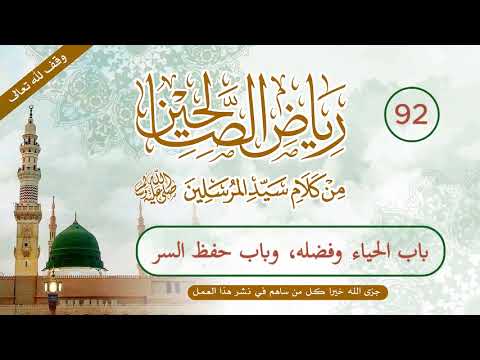
This lesson covers two chapters of Riyad as-Salihin: the chapter on modesty (al-haya') and its virtue, which explains that modesty is a branch of faith, that it brings only good, and that the Prophet ﷺ was more modest than a virgin in her chamber; and the chapter on keeping secrets, which warns against disclosing the intimate affairs of spouses, and includes the stories of Umar and Abu Bakr and of Fatimah radiyallahu anha. This is the final lesson of the series.
Key takeaways
Modesty is a branch of faith because it restrains its possessor from sins, just as faith does.
Legitimate modesty brings only good and moves a person to do what is right and avoid what is wrong.
Modesty that leads to neglecting rights or fearing to confront wrongdoing is not legitimate, even though it resembles modesty outwardly.
Disclosing the intimate affairs of spouses is one of the major sins, given the warning in the hadith.
Keeping a secret is part of good character; Anas radiyallahu anhu was faithful in guarding the Prophet's ﷺ secret.
Rebuke between loved ones does not spoil love; it is in proportion to the love between them.
Among the signs of prophethood is that the Prophet ﷺ told Fatimah radiyallahu anha that she would be the first of his family to join him.
Questions & answers
What does it mean that modesty is a branch of faith?
The lesson explains that modesty restrains a person from committing sins, just as faith does, which is why it is counted among the branches of faith.
Is every form of modesty praiseworthy?
No. The lesson specifies that it means legitimate modesty. Modesty that leads to neglecting rights or fearing to confront wrongdoing is not legitimate, even if it looks like modesty.
What is the ruling on disclosing marital secrets?
The lesson notes that spreading the details of intimacy and what passes between spouses is one of the major sins, given the warning in the hadith, and that not disclosing spouses' secrets is one of their rights over each other.
When is it permissible to reveal a secret?
The speaker explains that it is not permissible to reveal a secret if it would harm its owner while alive, or cause him disgrace after death. If it contains virtue or honour, mentioning it is fine. If keeping it means permitting unlawful bloodshed, unlawful sexual violation, or unjustly taking wealth, keeping it is forbidden and warning against it is obligatory.
Auto-generated from the lesson transcript; the lesson itself is the reference.
Qur’an verses cited in this lesson
Al-Isra 17:34 — Come not near the wealth of the orphan save with that which is better till he come to strength; and keep the covenant. Lo! of the covenant it will be asked.
Verses are matched automatically against the Qur’an text; some mentions may be missed. English: Pickthall.
Transcript
Machine translation — may contain errors
0:00*Riyadh al-Salihin* (The Meadows of the Righteous) from the Words of the Master of the Messengers, peace and blessings of Allah be upon him.
0:09Chapter: Modesty, Its Virtues, and the Encouragement to Adopt It as a Character Trait
0:16On the authority of Ibn 'Umar, may Allah be pleased with them both,
0:22that the Messenger of Allah, peace and blessings of Allah be upon him, passed by a man from the Ansar
0:28who was admonishing his brother regarding modesty.
0:31The Messenger of Allah, peace be upon him, said:
0:34"Leave him, for modesty is part of faith."
0:38Agreed upon.
0:40"Admonishing" means advising him in a reproving manner.
0:44"Leave him" means let him remain with this noble trait.
0:49Among the benefits of this hadith:
0:53Modesty is a branch of faith,
0:57because it prevents a person from committing sins, just as faith prevents him.
1:02The obligation of enjoining good and forbidding evil,
1:06and that clarifying a ruling must not be delayed beyond the time of need.
1:10On the authority of 'Imran Ibn Husayn, may Allah be pleased with them both, who said:
1:15The Messenger of Allah, peace and blessings of Allah be upon him, said:
1:19"Modesty brings nothing but good."
1:23Agreed upon.
1:25In a narration by Muslim:
1:28"Modesty is entirely good,"
1:30or he said:
1:32"Modesty is all good."
1:35Among the benefits of this hadith:
1:38Encouragement to adopt the character trait of modesty,
1:41and that it is beneficial for both the individual and society,
1:44because it leads one to perform good deeds and abandon evil ones.
1:48What is meant by modesty in these hadiths is the Islamically praised modesty.
1:54As for the timidity that leads to neglecting duties
1:58or the fear of confronting those who commit evil deeds,
2:01it is not Islamically praised modesty;
2:03rather, it is weakness, humiliation, and cowardice,
2:06even if it is named modesty
2:08due to its outward resemblance to Islamically praised modesty.
2:13On the authority of Abu Hurayrah, may Allah be pleased with him,
2:17that the Messenger of Allah, peace and blessings of Allah be upon him, said:
2:21"Faith has seventy-odd,
2:24or sixty-odd, branches.
2:27The highest of them is saying *La ilaha illa Allah* (There is no deity worthy of worship but Allah),
2:30and the lowest is removing a harmful object from the road,
2:34and modesty is a branch of faith."
2:38Agreed upon.
2:40"Odd" (*biḍ'*) refers to a number from three to ten.
2:45"Branch" (*shu'bah*) means a piece or a trait.
2:49"Removing" (*imāṭah*) means clearing away, and "harmful object" (*adhā*)
2:53includes anything that harms you, such as stones, thorns, mud,
2:57ashes, filth, and the like.
3:00On the authority of Abu Sa'id al-Khudri, may Allah be pleased with him, who said:
3:04The Messenger of Allah, peace and blessings of Allah be upon him, was
3:08more modest than a virgin in her private room.
3:12If he saw something he disliked, we would recognize it on his face.
3:17Agreed upon.
3:19The scholars said:
3:21The reality of modesty is an inner trait that prompts the abandonment of bad deeds
3:25and prevents falling short in fulfilling the rights of others.
3:28We narrated on the authority of Abu al-Qasim al-Junayd, may Allah have mercy on him, who said:
3:34"Modesty is recognizing divine favors—
3:37that is, blessings—and recognizing one's own shortcomings;
3:41between these two, a state is born called modesty."
3:46"Virgin" (*'adhrā'*) refers to an unmarried woman
3:49who has never been touched by a man.
3:52"Private room" (*khidr*) is a curtained corner within the house.
3:57"We would recognize it on his face" means through the change in his facial expression,
4:02as he would not speak due to the intensity of his modesty.
4:06Among the benefits of this hadith:
4:09The necessity of emulating the Messenger of Allah, peace be upon him, in modesty,
4:14because modesty is a noble character trait.
4:17Modesty is an innate trait in women.
4:22Chapter: Keeping Secrets
4:27Allah Almighty says:
4:30“Come not near the wealth of the orphan save with that which is better till he come to strength; and keep the covenant. Lo! of the covenant it will be asked.” (17:34)
4:36On the authority of Abu Sa'id al-Khudri, may Allah be pleased with him, who said:
4:41The Messenger of Allah, peace and blessings of Allah be upon him, said:
4:45"Among the most evil of people in status before Allah on the Day of Resurrection
4:50is a man who lies with his wife and she lies with him,
4:54and then he discloses her secret."
4:56Narrated by Muslim.
4:58"Lies with" (*yufḍī*) is an allusion to marital intimacy.
5:03"Discloses her secret"
5:05means mentioning to people the details of what occurs between him and his wife in privacy,
5:11whether during intimacy or the foreplay preceding it.
5:15Among the benefits of this hadith:
5:19Divulging marital intimate secrets is a major sin,
5:23due to the severe warning mentioned regarding it.
5:26Among the reciprocal rights of spouses is
5:30preserving each other's secrets.
5:33On the authority of 'Abdullah Ibn 'Umar, may Allah be pleased with them both,
5:38that when Hafsah became a widow, 'Umar, may Allah be pleased with him,
5:43said: "I met 'Uthman Ibn 'Affan, may Allah be pleased with him,
5:47and offered Hafsah to him in marriage.
5:50I said: 'If you wish, I will marry Hafsah, daughter of 'Umar, to you.'
5:55He said: 'I will consider my matter.'
5:58So I waited a few nights,
6:00then he met me and said:
6:02'It has become clear to me that I should not marry at this time.'
6:06Then I met Abu Bakr al-Siddiq, may Allah be pleased with him,
6:10and said: 'If you wish, I will marry Hafsah, daughter of 'Umar, to you.'
6:15Abu Bakr remained silent
6:18and did not give me any reply.
6:21I felt more upset with him than I was with 'Uthman.
6:25So I waited a few nights,
6:27and then the Prophet, peace and blessings of Allah be upon him, asked for her hand in marriage,
6:31and I married her to him.
6:33Afterwards, Abu Bakr met me and said:
6:36'Perhaps you were upset with me when you offered Hafsah to me
6:40and I gave you no reply?'
6:43I said: 'Yes.'
6:45He said:
6:46'Nothing prevented me from replying to your offer
6:51except that I knew the Prophet, peace be upon him, had mentioned her,
6:57and I was not one to divulge the secret of the Messenger of Allah, peace be upon him.
7:02Had the Prophet, peace be upon him, left her, I would have accepted her.'"
7:08Narrated by al-Bukhari.
7:10His saying "became a widow" (*ta'ayyamat*)
7:12means she was left without a husband,
7:14as her husband had passed away, may Allah be pleased with him.
7:18"I felt upset" (*wajadtu*) means I became angry.
7:22"I waited" (*labithtu*) means I stayed waiting.
7:26"It became clear" (*badā*) means it appeared to me.
7:29"More upset" (*awjad*) means more angry.
7:33"To divulge" (*li-ufshiya*) means to spread and disclose.
7:37Among the benefits of this hadith:
7:39The permissibility of a person offering his daughter or sister in marriage to people of goodness and righteousness,
7:45due to the benefit that returns to the woman offered.
7:50The virtue of keeping secrets and taking great care to conceal them.
7:54However, if the owner of the secret discloses it himself,
7:56the burden of confidentiality is lifted from whoever heard it.
7:59Gentle admonition does not spoil affection;
8:03rather, reproof is proportional to love, as it is said.
8:07That is why 'Umar, may Allah be pleased with him, was more upset with Abu Bakr
8:12than he was with 'Uthman,
8:15because of the abundance of mutual love and high esteem
8:18that existed between 'Umar and Abu Bakr.
8:23It is recommended for one to accept a valid excuse when it is presented.
8:29A previously married woman still requires a guardian for marriage, just like a virgin,
8:33and she may not conduct her own marriage contract.
8:35On the authority of 'A'ishah, may Allah be pleased with her, who said:
8:40"The wives of the Prophet, peace and blessings of Allah be upon him, were with him
8:45when Fatimah, may Allah be pleased with her, came walking,
8:48and her gait was identical to that of the Messenger of Allah, peace be upon him.
8:55When he saw her, he welcomed her and said:
8:59'Welcome, my daughter!'
9:01Then he seated her to his right or to his left.
9:05He then whispered to her,
9:07and she wept bitterly.
9:10When he saw her grief,
9:12he whispered to her a second time,
9:14and she smiled.
9:16I said to her:
9:18'The Messenger of Allah, peace be upon him, singled you out
9:21among his wives to share a secret,
9:24and yet you weep?'
9:26When the Messenger of Allah, peace be upon him, stood up,
9:30I asked her:
9:32'What did the Messenger of Allah, peace be upon him, say to you?'
9:36She said:
9:37'I am not one to divulge the secret of the Messenger of Allah, peace be upon him.'
9:43When the Messenger of Allah, peace be upon him, passed away,
9:47I said: 'I adjure you by the right I have over you
9:52that you tell me what the Messenger of Allah, peace be upon him, said to you.'
9:58She replied: 'Now, yes.
10:02As for when he whispered to me the first time,
10:06he informed me that Jibril used to review the Qur'an with him once or twice every year,
10:13and that he had reviewed it with him twice this year,
10:16and "I see my appointed time of death as having drawn near;
10:20so fear Allah and be patient,
10:23for I am an excellent predecessor for you."
10:26So I wept as you saw.
10:29When he saw my grief, he whispered to me a second time and said:
10:34"O Fatimah, are you not pleased to be the leader of the believing women,
10:39or the leader of the women of this Ummah?"
10:43So I laughed as you saw.'"
10:46Agreed upon,
10:48and this is the wording of Muslim.
10:52"Gait" (*mishyah*) refers to the manner of walking.
10:55"Welcome to you" (*marḥaban bik*)
10:57means you have arrived at a spacious and comfortable place.
11:00"He saw her grief" (*jaza'ahā*)
11:02means her weakness in bearing what she heard.
11:05"I adjure you" (*'azamtu 'alayki*)
11:08means I bind you by oath through the right I have over you,
11:11which is her status as the Mother of the Believers,
11:14the wife of the Prophet, peace be upon him,
11:17and his beloved.
11:19"Reviewing the Qur'an" (*yu'āriḍu al-Qur'ān*)
11:21means studying the Qur'an together,
11:23which is a reciprocal process from both sides:
11:26the Messenger of Allah, peace be upon him, would recite
11:30while Jibril, peace be upon him, listened,
11:33and then Jibril, peace be upon him, would recite
11:36while the Messenger of Allah, peace be upon him, listened.
11:40Among the benefits of this hadith:
11:44A statement on the virtue of Fatimah, may Allah be pleased with her,
11:47and that she is the leader of the women of this Ummah.
11:51The hadith is among the proofs of prophethood,
11:55as the Messenger, peace be upon him, informed his daughter
11:59of the proximity of his passing
12:01and let her know that she would be the first of his household to join him,
12:05and it occurred exactly as the Messenger of Allah, peace be upon him, informed.
12:10The permissibility of weeping that is free from screaming, wailing,
12:14lamentation, slapping cheeks, and tearing garments,
12:18for it is a mercy that Allah has placed in the heart of His believing servant.
12:23The recommendation of keeping secrets and not disclosing them
12:26until the reason for withholding them ceases to exist.
12:29Affirming the rights of the wives of the Prophet (peace and blessings of Allah be upon him)
12:34over all believing men and women,
12:36for they are indeed the Mothers of the Believers.
12:39Reciting the Qur'an before proficient memorizers and reviewing it with them
12:44is among the essential means of preserving and consolidating its memorization;
12:47it is an established Sunnah practiced among the people and memorizers of the Qur'an.
12:51Therefore, every memorizer ought to regularly review and maintain what they have memorized.
12:56The validity of drawing inferences from circumstantial indicators,
12:59for the Messenger of Allah (peace be upon him)
13:02inferred from Gabriel's reviewing the Qur'an with him twice—
13:06whereas he used to review it with him only once every year—
13:10the nearness of his appointed time and the approach of his departure from this world.
13:14On the authority of Thabit, from Anas (may Allah be pleased with him), who said:
13:20"The Messenger of Allah (peace and blessings of Allah be upon him) came to me
13:24while I was playing with other young boys,
13:26and he greeted us with peace.
13:28Then he sent me on an errand,
13:30which caused me to be late returning to my mother.
13:32When I arrived,
13:34she asked, 'What kept you?'
13:36I said,
13:38'The Messenger of Allah (peace be upon him) sent me on an errand.'
13:42She asked, 'What was his errand?'
13:45I replied, 'It is a secret.'
13:48She said, 'Do not disclose the secret of the Messenger of Allah (peace be upon him) to anyone!'
13:57Anas said,
13:59'By Allah, if I were ever to tell it to anyone,
14:02I would certainly have told you, O Thabit.'"
14:05Related by Muslim,
14:07and al-Bukhari related part of it in abridged form.
14:10"I was delayed" (fa-abta'tu)
14:12means: I was late and my absence lasted longer than usual.
14:15"What kept you?" (ma habasaka)
14:17means: What detained or prevented you?
14:20Among the benefits derived from this hadith:
14:22The great virtue of Anas ibn Malik,
14:24his remarkable gentleness,
14:26the sincerity of his trustworthiness and loyalty,
14:29and his meticulous keeping of the secret of the Messenger of Allah (peace be upon him),
14:33both during his lifetime and after his death.
14:36The excellent upbringing provided by Umm Sulaym to her son,
14:39as she instructed him never to disclose
14:42the secret of the Messenger of Allah (peace be upon him).
14:45Keeping the secrets of one's brethren and not divulging them
14:49is among the noblest of manners and Islamic etiquettes.
14:54What must be understood regarding the preservation of secrets
14:57is that it is impermissible to divulge a secret
14:59if doing so would cause harm to its owner during his lifetime.
15:03Likewise, if he passes away and it is known that revealing it would bring him reproach or dishonor,
15:07it is not permissible to mention that secret.
15:10However, if disclosing it highlights a virtue or honor for him,
15:13then there is no harm in mentioning it.
15:15If keeping a secret would result in unlawful bloodshed,
15:19the violation of illicit intimacy,
15:21or the unlawful seizure of property,
15:24then keeping it is strictly forbidden;
15:27rather, it becomes obligatory to warn against and prevent such wrongdoing.