budoorzahera launched in 2026 to carry the light of knowledge to every heart, in every language. Every lesson is available in the original audio with a full synced transcript, translated into fifteen other languages, with translated-audio listening available for a number of them.
You can copy any line of the transcript while listening, download the full text in multiple formats (TXT · SRT · VTT), or share a lesson with someone you care about in one tap. We ask God to make this work beneficial.
4192audio lessons
59complete series
16world languages
Error log
An automatic log of the most recent errors the app ran into on your device — copying and sending it to us helps a lot when troubleshooting a problem.
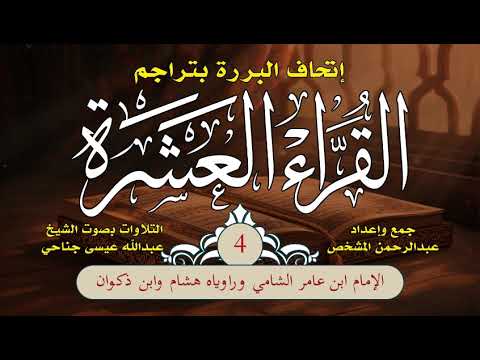
This fourth and final episode of the series Itḥāf al-Barara (Biographies of the Ten Reciters) covers the biography of the Imam Abdullah ibn Amir al-Yahsubi al-Shami, leader of the people of Damascus, and mentions his reception of recitation from al-Mughira ibn Abi Shihab and directly from Abu al-Darda ﷺ, may Allah be pleased with him. It then presents the biographies of his two transmitters, Hisham ibn Ammar and Ibn Dhakwan, with their teachers, students and dates of death, along with recitation samples from both narrations. With this episode the series is complete.
Key takeaways
An introduction to Imam Ibn Amir al-Shami, his lineage, and his status as leader of the people of Damascus.
His reception of recitation from al-Mughira ibn Abi Shihab al-Makhzumi, and directly from Abu al-Darda, may Allah be pleased with him.
The consensus of the people on accepting his recitation, and his role in leading prayer, judgeship and the teaching of recitation in Damascus.
The first transmitter, Hisham ibn Ammar: his knowledge, reliability, and his narration from Malik and others.
The second transmitter, Ibn Dhakwan, and the praise of al-Dhahabi and Abu Zur'a al-Dimashqi for his skill in recitation.
Recitation samples from the narrations of Hisham and Ibn Dhakwan on the authority of Ibn Amir.
Questions & answers
Who was Imam Ibn Amir al-Shami?
He was Abu Imran Abdullah ibn Amir al-Yahsubi, leader of the people of Damascus. The lesson describes him as a great imam, a distinguished Tabi'i and a renowned scholar, who died in Damascus on the day of Ashura in the year 118 AH.
Who were the two transmitters of Ibn Amir's recitation?
His recitation became famous through two narrations: that of Hisham ibn Ammar and that of Ibn Dhakwan, both of whom were his students.
From whom did Ibn Amir receive the recitation?
He received it from al-Mughira ibn Abi Shihab al-Makhzumi, and directly from Abu al-Darda, may Allah be pleased with him.
What was the standing of Ibn Dhakwan in recitation?
Al-Dhahabi said that Ibn Dhakwan was far more skilled in recitation than Hisham, while Abu Zur'a al-Dimashqi said that in his time no one in the mentioned regions was a better reciter than him.
Auto-generated from the lesson transcript; the lesson itself is the reference.
Qur’an verses cited in this lesson
Ibrahim 14:35 — And when Abraham said: My Lord! Make safe this territory, and preserve me and my sons from serving idols.
Ibrahim 14:36 — My Lord! Lo! they have led many of mankind astray. But whoso followeth me, he verily is of me. And whoso disobeyeth me - Still Thou art Forgiving, Merciful.
Ibrahim 14:37 — Our Lord! Lo! I have settled some of my posterity in an uncultivable valley near unto Thy holy House, our Lord! that they may establish proper worship; so incline some hearts of men that they may yearn toward them, and provide Thou them with fruits in order that they may be thankful.
Ibrahim 14:38 — Our Lord! Lo! Thou knowest that which we hide and that which we proclaim. Nothing in the earth or in the heaven is hidden from Allah.
Ibrahim 14:39 — Praise be to Allah Who hath given me, in my old age, Ishmael and Isaac! Lo! my Lord is indeed the Hearer of Prayer.
Ibrahim 14:41 — Our Lord! Forgive me and my parents and believers on the day when the account is cast.
Al-Hajj 22:27 — And proclaim unto mankind the pilgrimage. They will come unto thee on foot and on every lean camel; they will come from every deep ravine,
Al-Hajj 22:30 — That (is the command). And whoso magnifieth the sacred things of Allah, it will be well for him in the sight of his Lord. The cattle are lawful unto you save that which hath been told you. So shun the filth of idols, and shun lying speech,
Al-Hajj 22:31 — Turning unto Allah (only), not ascribing partners unto Him; for whoso ascribeth partners unto Allah, it is as if he had fallen from the sky and the birds had snatched him or the wind had blown him to a far-off place.
Verses are matched automatically against the Qur’an text; some mentions may be missed. English: Pickthall.
Transcript
Machine translation — may contain errors
0:00In the name of Allah, the Most Gracious, the Most Merciful.
0:05*Ithāf al-Bararah bi-Tarājim al-Qurrā' al-'Asharah* (The Gift to the Virtuous: Biographies of the Ten Qur'an Reciters).
0:12Biography of Imam Ibn 'Āmir al-Shāmī.
0:19He is Abū 'Imrān 'Abd Allāh ibn 'Āmir ibn Yazīd,
0:24Ibn Tamīm ibn Rabī'ah,
0:26Al-Yaḥṣubī—with the letter *ṣād* vowelled with *fatḥah*, *ḍammah*, or *kasrah*—
0:30In attribution to Yaḥṣub ibn Dūhmān.
0:33The Imam of the people of Damascus.
0:35His lineage is purely Arab according to the correct opinion.
0:38He was born—may Allah have mercy on him—in the year 8 AH,
0:42According to what Imam Ibn al-Jazarī verified in *Al-Ghāyah*.
0:46And it was also said: in the year 21 AH.
0:51He studied and received the recitations directly from Al-Mughīrah ibn Abī Shihāb al-Makhzūmī,
0:56Who recited to 'Uthmān ibn 'Affān,
0:59Just as he also received it directly from Abū al-Dardā' (may Allah be pleased with him),
1:03A chain confirmed by Imam al-Dānī.
1:06Both 'Uthmān and Abū al-Dardā' recited directly to the Messenger of Allah (peace and blessings of Allah be upon him).
1:12He was a great Imam, an illustrious Tabi'i,
1:16And a renowned scholar.
1:18Whenever he saw an innovation in the mosque, he would immediately change it.
1:23He led the Muslims in prayer at the Umayyad Mosque for many years,
1:28During the era of 'Umar ibn 'Abd al-'Azīz,
1:30As well as before him and after him.
1:32'Umar ibn 'Abd al-'Azīz himself would pray behind him while serving as Commander of the Faithful,
1:36And that alone is sufficient testimony to his exalted stature.
1:39He combined the positions of religious leadership, the judgeship,
1:42And the mastership of Qur'anic recitation in Damascus—
1:45Which was at that time the seat of the Caliphate,
1:48And the destination of scholars and the Tabi'un.
1:52Thus, the people unanimously agreed upon his recitation,
1:54Receiving and accepting it wholeheartedly,
1:57Including the first generation, who were the most virtuous of the Muslims.
2:02A vast number of students narrated the recitation from him, both through direct presentation (*'arḍ*) and auditory transmission (*samā'*).
2:08The most famous among them was Yaḥyā ibn al-Ḥārith al-Dhimārī,
2:12Who succeeded him in leading the school of recitation.
2:15His recitation became widely renowned through two primary transmitters:
2:18Hishām and Ibn Dhakwān.
2:21He passed away—may Allah have mercy on him—in Damascus on the Day of 'Āshūrā',
2:25In the year 118 AH.
2:29Biography of Imam Hishām,
2:35The first narrator from Imam Ibn 'Āmir al-Shāmī.
2:41He is Abū al-Walīd
2:43Hishām ibn 'Ammār ibn Naṣīr ibn Maysarah,
2:46Al-Sulamī al-Dimashqī.
2:49He was born—may Allah have mercy on him—in the year 153 AH.
2:54He was the most knowledgeable of the people of Damascus, their chief orator (*khaṭīb*),
2:57Their master reciter, their prominent hadith scholar, and their mufti,
3:01Possessing utmost trustworthiness, precision, and probity.
3:04Ibn Ma'īn declared him trustworthy,
3:06And Al-Dāraquṭnī said of him:
3:08"He is truthful and holds a lofty standing."
3:11He was highly eloquent, a erudite scholar, and vast in his narrations.
3:15'Abdān al-Ahwāzī said:
3:19I heard him say:
3:21"I have not prepared a sermon for twenty years."
3:25He studied recitation under 'Irāk ibn Khālid,
3:27Ayyūb ibn Tamīm,
3:29And others among the companions of Yaḥyā al-Dhimārī.
3:32He heard hadith from Mālik ibn Anas,
3:35Muslim ibn Khālid al-Zanjī,
3:37Ismā'īl ibn 'Ayyāsh,
3:39Yaḥyā ibn Ḥamzah al-Ḥaḍramī,
3:42Al-Haytham ibn Ḥumayd al-Ghassānī,
3:45And a vast multitude of scholars.
3:47The hadith memorizer Ṣāliḥ ibn Muḥammad (may Allah have mercy on him) said:
3:51I heard Hishām ibn 'Ammār say:
3:54"I entered upon Mālik
3:56And said, 'Narrate hadith to me.'
3:59He said, 'Recite [what you know].'
4:01I replied, 'No, rather narrate to me.'
4:04When I kept pressing him,
4:06He said to his servant, 'Lash him.'
4:09So he struck me fifteen lashes with a whip.
4:12I said, 'You have wronged me, and I will not forgive you!'
4:17He asked, 'What is the expiation for it?'
4:20I said, 'That you narrate fifteen hadiths to me.'
4:24So he narrated them to me,
4:26Whereupon I said, 'Lash me more,
4:29And increase the hadiths!'
4:31He smiled and said, 'Begone!'"
4:35Abū 'Ubayd
4:37Al-Qāsim ibn Sallām recited to him,
4:39Despite his own precedence,
4:40As did Aḥmad ibn Yazīd al-Ḥulwānī,
4:43Hārūn ibn Mūsā al-Akhfash,
4:46Aḥmad ibn Muḥammad ibn Māmūyah,
4:49And many others.
4:51Narrations were transmitted from him by Al-Walīd ibn Muslim
4:53And Muḥammad ibn Shu'ayb—
4:55Both of whom were among his own teachers—
4:57As well as Al-Bukhārī in his *Ṣaḥīḥ*,
4:59Abū Dāwūd al-Sijistānī,
5:01Al-Nasā'ī, and Ibn Mājah in their *Sunan* collections,
5:05Among many others.
5:07He passed away—may Allah have mercy on him—in the year 245 AH.
5:12A sample from the narration of Hishām from Ibn 'Āmir:
5:18"I seek refuge in Allah from Satan, the accursed."
5:23"In the name of Allah, the Most Gracious, the Most Merciful."
5:28﴿And [remember] when Abraham said, "My Lord,
5:31“And when Abraham said: My Lord! Make safe this territory, and preserve me and my sons from serving idols.” (14:35)
5:35And keep me and my sons away
5:37From worshipping idols.
5:43My Lord, indeed they have led astray
5:48Many among mankind.
5:54“My Lord! Lo! they have led many of mankind astray. But whoso followeth me, he verily is of me. And whoso disobeyeth me - Still Thou art Forgiving, Merciful.” (14:36)
5:59“My Lord! Lo! they have led many of mankind astray. But whoso followeth me, he verily is of me. And whoso disobeyeth me - Still Thou art Forgiving, Merciful.” (14:36)
6:10“Our Lord! Lo! I have settled some of my posterity in an uncultivable valley near unto Thy holy House, our Lord! that they may establish proper worship; so incline some hearts of men that they may yearn toward them, and provide Thou them with fruits in order that they may be thankful.” (14:37)
6:22“Our Lord! Lo! I have settled some of my posterity in an uncultivable valley near unto Thy holy House, our Lord! that they may establish proper worship; so incline some hearts of men that they may yearn toward them, and provide Thou them with fruits in order that they may be thankful.” (14:37)
6:25Near Your Sacred House,
6:29Our Lord, that they may establish prayer.
6:37So make hearts among mankind
6:42Incline toward them
6:45And provide for them from the fruits
6:56That they may be grateful.
7:00“Our Lord! Lo! Thou knowest that which we hide and that which we proclaim. Nothing in the earth or in the heaven is hidden from Allah.” (14:38)
7:10“Our Lord! Lo! Thou knowest that which we hide and that which we proclaim. Nothing in the earth or in the heaven is hidden from Allah.” (14:38)
7:16In the earth or in the heaven.
7:20“Praise be to Allah Who hath given me, in my old age, Ishmael and Isaac! Lo! my Lord is indeed the Hearer of Prayer.” (14:39)
7:24“Praise be to Allah Who hath given me, in my old age, Ishmael and Isaac! Lo! my Lord is indeed the Hearer of Prayer.” (14:39)
7:31“Praise be to Allah Who hath given me, in my old age, Ishmael and Isaac! Lo! my Lord is indeed the Hearer of Prayer.” (14:39)
7:36My Lord, make me an establisher of prayer
7:40And [many] from my offspring.
7:44Our Lord, and accept my supplication.
7:48Our Lord, forgive me and my parents...﴾
7:52“Our Lord! Forgive me and my parents and believers on the day when the account is cast.” (14:41)
8:02Biography of Imam Ibn Dhakwān,
8:08The second narrator from Imam Ibn 'Āmir al-Shāmī.
8:14He is Abū 'Amr 'Abd Allāh ibn Aḥmad ibn Bashīr ibn Dhakwān,
8:20Al-Qurashī al-Dimashqī.
8:22He was born—may Allah have mercy on him—on the Day of 'Āshūrā',
8:26In the year 173 AH.
8:29He served as the Imam of the Umayyad Mosque,
8:32And leadership in the instruction of Qur'anic recitation devolved to him
8:35After Ayyūb ibn Tamīm.
8:37He recited to Ayyūb ibn Tamīm,
8:40Isḥāq ibn al-Musayyibī, and others.
8:43Al-Dhahabī said:
8:46"Ibn Dhakwān was far superior to Hishām in mastery of recitation,
8:50While Hishām was far broader in general scholarly knowledge than Ibn Dhakwān."
8:55Abū Zur'ah al-Dimashqī said:
8:58"There was no one in Iraq, nor in the Hijaz,
9:01Nor in the Levant, nor in Egypt,
9:04Nor in Khurasan in the time of Ibn Dhakwān
9:07Who was a master reciter in my view superior to him."
9:09A great number of students recited to him,
9:11Among them Aḥmad ibn Yūsuf al-Taghlibī,
9:14Muḥammad ibn Mūsā al-Ṣūrī,
9:16Hārūn ibn Sharīk al-Akhfash,
9:19Muḥammad ibn al-Qāsim al-Iskandarānī,
9:22And others.
9:24He passed away—may Allah have mercy on him—in the year 242 AH.
9:32A sample from the narration of Ibn Dhakwān from Ibn 'Āmir:
9:37"I seek refuge in Allah from Satan, the accursed."
9:42"In the name of Allah, the Most Gracious, the Most Merciful."
9:46﴿And [remember] when We assigned to Abraham the site of the House,
9:51[Saying], "Do not associate anything with Me and purify My House
9:57For those who perform tawaf and those who stand [in prayer]
10:03And those who bow and prostrate."
10:08“And proclaim unto mankind the pilgrimage. They will come unto thee on foot and on every lean camel; they will come from every deep ravine,” (22:27)
10:12They will come to you on foot
10:15And on every lean camel;
10:18“And proclaim unto mankind the pilgrimage. They will come unto thee on foot and on every lean camel; they will come from every deep ravine,” (22:27)
10:27That they may witness benefits for themselves
10:30And mention the name of Allah on known days
10:37Over what He has provided them of [sacrificial] animals.
10:45So eat of them and feed the miserable and poor.
10:56Then let them end their filth
11:00And fulfill their vows
11:03And perform tawaf around the Ancient House.
11:10That [is so].
11:12And whoever honors the sacred ordinances of Allah—
11:16“That (is the command). And whoso magnifieth the sacred things of Allah, it will be well for him in the sight of his Lord. The cattle are lawful unto you save that which hath been told you. So shun the filth of idols, and shun lying speech,” (22:30)
11:23And permitted to you are the grazing livestock,
11:26Except what is recited to you.
11:30“That (is the command). And whoso magnifieth the sacred things of Allah, it will be well for him in the sight of his Lord. The cattle are lawful unto you save that which hath been told you. So shun the filth of idols, and shun lying speech,” (22:30)
11:34And avoid false speech,
11:40“Turning unto Allah (only), not ascribing partners unto Him; for whoso ascribeth partners unto Allah, it is as if he had fallen from the sky and the birds had snatched him or the wind had blown him to a far-off place.” (22:31)
11:46And whoever associates others with Allah—
11:49“Turning unto Allah (only), not ascribing partners unto Him; for whoso ascribeth partners unto Allah, it is as if he had fallen from the sky and the birds had snatched him or the wind had blown him to a far-off place.” (22:31)
11:55The birds snatch him away
11:58“Turning unto Allah (only), not ascribing partners unto Him; for whoso ascribeth partners unto Allah, it is as if he had fallen from the sky and the birds had snatched him or the wind had blown him to a far-off place.” (22:31)
12:07Into a remote place.﴾
12:14May Allah reward on our behalf with all blessings those Imams
12:27Who transmitted the Qur'an to us pure, sweet, and flowing.