budoorzahera launched in 2026 to carry the light of knowledge to every heart, in every language. Every lesson is available in the original audio with a full synced transcript, translated into fifteen other languages, with translated-audio listening available for a number of them.
You can copy any line of the transcript while listening, download the full text in multiple formats (TXT · SRT · VTT), or share a lesson with someone you care about in one tap. We ask God to make this work beneficial.
4192audio lessons
59complete series
16world languages
Error log
An automatic log of the most recent errors the app ran into on your device — copying and sending it to us helps a lot when troubleshooting a problem.
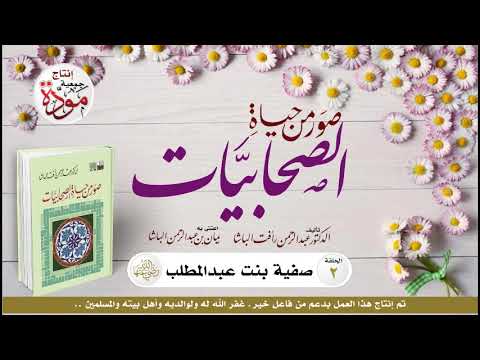
This lesson covers the life of the noble Companion Safiyya bint Abd al-Muttalib, may Allah be pleased with her, the aunt of the Prophet ﷺ, and her strength of character and firm upbringing of her son al-Zubayr ibn al-Awwam. The lesson presents her conversion to Islam and her stances at the battles of Uhud and the Trench, most notably her killing of a Jewish spy who was prowling around the fort sheltering the women and children. The lesson concludes that Safiyya was the first woman to kill a polytheist in Islam, and that she is an example of the resolute, courageous Muslim woman.
Key takeaways
Following Safiyya's example in raising children well and preparing them for courage and responsibility.
Patience and seeking reward from Allah in the face of calamity, as seen in her reaction to the death of her brother Hamza.
Steadfastness in faith, placing it above all worldly honour, as she migrated to Madinah with her religion.
The value of sharp judgement and quick action in the face of danger, as in the story of the fort during the Trench.
Courage in defending the religion and the honour of the community.
The role of the Muslim woman in jihad, including giving water to the thirsty and preparing arrows, as Safiyya did at Uhud.
Questions & answers
Who was Safiyya bint Abd al-Muttalib, may Allah be pleased with her?
She was the aunt of the Prophet ﷺ from the Banu Hashim, one of the early believers, and known among the women of Quraysh for her firmness and courage.
What was Safiyya's role at the Battle of Uhud?
She went out with the Muslims to give water to the thirsty, sharpen arrows and repair bows. When some Muslims fled and the polytheists neared the Prophet ﷺ, she struck at the enemy with a spear to protect him. When the Prophet ﷺ saw her approaching and feared she would see her brother Hamza mutilated, he told her son al-Zubayr to turn her back; she accepted this after saying she had accepted it for the sake of Allah.
What is the story of Safiyya at the Battle of the Trench?
The women and children were in Hassan ibn Thabit's fort while the men were guarding the trench. Safiyya saw a Jew spying on the fort and feared he would report its weakness to his people. She went down, struck him with a pole until he died, cut off his head and threw it from the top of the fort. When the Jews saw it, they assumed the fort was defended and withdrew.
Why is Safiyya described as the first woman to kill a polytheist in Islam?
The lesson states that history records her as the first woman to kill a polytheist in Islam, in defence of the religion of Allah and of those inside the fort.
Auto-generated from the lesson transcript; the lesson itself is the reference.
Transcript
Machine translation — may contain errors
0:00In the name of Allah, the Most Gracious, the Most Merciful.
0:15The Mawaddah Association is pleased
0:17to present to you
0:19Portraits from the Lives of the Female Companions,
0:22by Dr. Abd al-Rahman Ra'fat al-Basha,
0:26may Allah have mercy upon him.
0:28Safiyyah bint Abd al-Muttalib,
0:33may Allah be pleased with her.
0:47Who was this formidable and dignified lady,
0:52whom men held in such high regard?
0:55Who was this courageous Companion
0:58who was the first woman in Islam to kill a polytheist?
1:02Who was this resolute woman
1:04who raised the first knight for the Muslims
1:07to draw a sword in the cause of Allah?
1:10She is Safiyyah bint Abd al-Muttalib,
1:13the Hashimite, the Qurayshite,
1:15the paternal aunt of the Messenger of Allah, peace be upon him.
1:19Glory surrounded Safiyyah bint Abd al-Muttalib from every side.
1:24Her father was Abd al-Muttalib ibn Hashim,
1:27the grandfather of the Prophet and the leader of Quraysh,
1:30their obeyed master.
1:32Her mother was Halah bint Wahb,
1:34the sister of Aminah bint Wahb, the mother of the Prophet.
1:38Her first husband was al-Harith ibn Harb,
1:41the brother of Abu Sufyan ibn Harb,
1:43the leader of the Banu Umayyah,
1:45and he passed away while married to her.
1:47Her second husband was al-Awwam ibn Khuwaylid,
1:51the brother of Khadijah bint Khuwaylid,
1:53the mistress of the women of the Arabs in the pre-Islamic era,
1:56and the first of the Mothers of the Believers in Islam.
1:59Her son was al-Zubayr ibn al-Awwam,
2:02the disciple of the Messenger of Allah, peace be upon him.
2:05After such nobility,
2:07is there any honor that souls might aspire to other than the honor of faith?
2:11Her husband, al-Awwam ibn Khuwaylid, passed away,
2:15leaving her with a young child,
2:18who was al-Zubayr.
2:19She raised him to be rugged and tough,
2:22and trained him in horsemanship and warfare.
2:25She made his play consist of sharpening arrows and repairing bows.
2:29She was diligent in thrusting him into every fearful situation,
2:33and pushing him into every danger.
2:35If she saw him hold back or hesitate,
2:38she would strike him severely.
2:40So much so that one of his uncles reproached her for it,
2:44saying to her:
2:46"This is not how a child is struck."
2:48"You strike him with the blow of one who hates, not the blow of a mother."
2:52She then recited in verse:
2:54"Whoever says I hate him has lied;
2:57I only strike him so that he may become wise,
3:00defeat armies, and bring back spoils."
3:03When Allah sent His Prophet with the religion of guidance and truth,
3:07and sent him as a warner and a bringer of glad tidings to the people,
3:10and commanded him to begin with his closest kin,
3:13he gathered the Banu Abd al-Muttalib,
3:15their women, their men, their elders, and their young.
3:19He addressed them, saying:
3:22"O Fatimah bint Muhammad,
3:24O Safiyyah bint Abd al-Muttalib,
3:27O Banu Abd al-Muttalib,
3:29I possess no power to help you against Allah in anything."
3:32Then he called them to believe in Allah,
3:35and urged them to affirm his message.
3:38Some of them turned toward the divine light,
3:42while others turned away from its radiance.
3:44Safiyyah bint Abd al-Muttalib was
3:47among the first rank of the believing, affirming ones.
3:52At that point, Safiyyah gathered glory from all its corners:
3:56the nobility of lineage and the might of Islam.
3:59Safiyyah bint Abd al-Muttalib joined the procession of light,
4:03she and her young son, al-Zubayr ibn al-Awwam.
4:06She endured what the early Muslims endured
4:09of the might, oppression, and tyranny of Quraysh.
4:12When Allah gave permission to His Prophet and the believers with him
4:16to migrate to Medina,
4:18the Hashimite lady left Mecca behind,
4:21with all the memories it held for her,
4:24and all its various glories and achievements.
4:27She set her face toward Medina,
4:30migrating with her religion to Allah and His Messenger.
4:33Even though the great lady
4:36was at that time approaching 60 years of her long and eventful life,
4:41she had positions in the fields of jihad
4:45that history continues to mention with a tongue moist with admiration and fresh with praise.
4:51Two scenes are sufficient for us from these positions:
4:55the first was the day of Uhud, and the second was the day of the Trench.
4:59As for what she did at Uhud,
5:02it is that she went out with the Muslim army
5:05among a group of women, striving in the cause of Allah.
5:09She began carrying water and quenching the thirst of the thirsty,
5:12sharpening arrows, and repairing bows.
5:16She had, along with that, another purpose:
5:19to watch the battle with all her emotions.
5:23And no wonder,
5:25for on its field was her nephew, Muhammad, the Messenger of Allah,
5:29her brother, Hamzah ibn Abd al-Muttalib, the Lion of Allah,
5:33and her son, al-Zubayr ibn al-Awwam, the disciple of the Prophet of Allah.
5:38And in the battle, before all that and above all that,
5:42was the fate of the Islam she had embraced willingly,
5:46and for which she had migrated, seeking reward,
5:49and through which she had seen the path to Paradise.
5:52When she saw the Muslims retreating from the Messenger of Allah,
5:56except for a few of them,
5:58and found that the polytheists were about to reach the Prophet and finish him off,
6:02she threw her water skin to the ground,
6:05and sprang up like a lioness whose cubs had been attacked.
6:08She snatched a spear from the hand of one of the retreating men,
6:11and began to cut through the ranks with it,
6:14striking faces with its tip,
6:16and roaring at the Muslims, saying:
6:18"Woe to you! Have you retreated from the Messenger of Allah?"
6:22When the Prophet, peace and blessings of Allah be upon him, saw her approaching,
6:26he feared for her that she might see her brother Hamzah lying dead,
6:30for the polytheists had mutilated him in the most hideous way.
6:33He signaled to her son, al-Zubayr, saying:
6:36"The woman, O Zubayr!"
6:39Al-Zubayr went to her and said:
6:42"O Mother, go back, O Mother!"
6:45She said: "Get away, may you have no mother!"
6:48He said: "The Messenger of Allah commands you to return."
6:52She said: "And why?"
6:55"It has reached me that he has been mutilated, my brother."
6:58"And that is for the sake of Allah."
7:00The Messenger said to him:
7:02"Let her pass, O Zubayr."
7:04So he let her pass.
7:06When the battle laid down its burdens,
7:09Safiyyah stood over her brother Hamzah,
7:12and found that his stomach had been ripped open,
7:14his liver had been removed,
7:16his nose had been cut off, his ears had been severed,
7:19and his face had been disfigured.
7:21She sought forgiveness for him and began to say:
7:24"Indeed, that is for the sake of Allah."
7:26"I am content with the decree of Allah."
7:29"By Allah, I shall surely be patient,"
7:31"and I shall surely seek reward, if Allah wills."
7:33That was the position of Safiyyah bint Abd al-Muttalib on the day of Uhud.
7:39As for her position on the day of the Trench,
7:41it has an exciting story,
7:43its warp is cunning and intelligence,
7:46and its woof is courage and firmness.
7:49So here is its news as the books of history have preserved it.
7:53It was the custom of the Messenger of Allah, peace be upon him,
7:57when he resolved upon one of the expeditions,
8:00to place the women and children in the fortresses,
8:03for fear that someone might betray Medina
8:05in the absence of its protectors.
8:08When the day of the Trench came,
8:10he placed his wives, his aunt,
8:12and a group of Muslim women
8:15in a fortress belonging to Hassan ibn Thabit,
8:17which he had inherited from his forefathers.
8:19It was one of the most secure fortresses of Medina,
8:21in terms of fortification and inaccessibility.
8:24While the Muslims were
8:26stationed on the edges of the Trench,
8:28facing Quraysh and its allies,
8:31and were occupied away from the women and children
8:34by engaging the enemy,
8:36Safiyyah bint Abd al-Muttalib saw
8:38a shadow moving in the darkness of dawn.
8:41She strained her hearing for it,
8:43and fixed her gaze upon it.
8:45It was a Jew who had approached the fortress,
8:48and began to circle it, sensing its news,
8:52spying on those within it.
8:54She realized that he was a scout for his people,
8:57who had come to know if there were men in the fortress
8:59defending those inside,
9:01or if it contained within its walls
9:03nothing but women and children.
9:06She said to herself:
9:08"The Jews of Banu Qurayzah
9:09have broken the covenant that was between them
9:11and the Messenger of Allah."
9:13"They have supported Quraysh and its allies
9:15against the Muslims."
9:17"And there is no one between us and them
9:19of the Muslims to defend us."
9:21"The Messenger of Allah and those with him
9:23are stationed facing the enemy."
9:26"If this enemy of Allah is able to convey
9:28the reality of our situation to his people,"
9:31"the Jews will take the women captive,"
9:33"and enslave the children."
9:35"And that would be a catastrophe for the Muslims."
9:38At that, she hastened to her headscarf,
9:41wrapped it around her head,
9:43and went to her clothes,
9:45tightening them around her waist.
9:47She took a pillar onto her shoulder,
9:50and went down to the door of the fortress.
9:52She opened it with patience and skill,
9:55and began to watch through it
9:57The enemy of Allah, in wakefulness and caution,
10:00until she was certain he had become
10:02within her reach,
10:04she charged at him with a decisive, firm strike.
10:08And she struck him on the head with the pillar,
10:10throwing him to the ground.
10:12Then she reinforced the first blow
10:14with a second and a third,
10:16until she finished him off
10:18and extinguished the breath within his sides.
10:21Then she hastened to him
10:23and severed his head with a knife she had with her.
10:26And she threw the head from the top of the fort,
10:29and it began to roll down its slopes
10:32until it settled among the hands of the Jews
10:34who were lying in wait at its base.
10:37When the Jews saw the head of their companion,
10:40some of them said to others:
10:42"We know that Muhammad
10:44would not leave women
10:46and children without protection."
10:48Then they turned back.
10:50May Allah be pleased with Safiyyah bint 'Abd al-Muttalib.
10:54She was indeed a prime example for the Muslim woman.
10:58She raised her only son,
11:00and perfected his upbringing.
11:02And she was afflicted by the loss of her brother,
11:04and she bore it with excellent patience.
11:06And trials tested her,
11:08and in them she was found to be a decisive, wise, and valiant woman.
11:13Then history wrote on its most brilliant pages
11:17that Safiyyah bint 'Abd al-Muttalib
11:20was the first woman to kill a polytheist in Islam.
11:24Safiyyah was the first woman to kill a polytheist in defense of the religion of Allah.