budoorzahera launched in 2026 to carry the light of knowledge to every heart, in every language. Every lesson is available in the original audio with a full synced transcript, translated into fifteen other languages, with translated-audio listening available for a number of them.
You can copy any line of the transcript while listening, download the full text in multiple formats (TXT · SRT · VTT), or share a lesson with someone you care about in one tap. We ask God to make this work beneficial.
4192audio lessons
59complete series
16world languages
Error log
An automatic log of the most recent errors the app ran into on your device — copying and sending it to us helps a lot when troubleshooting a problem.
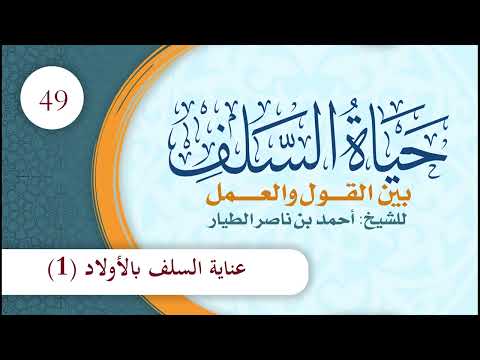
The lesson covers the care the righteous predecessors (salaf) showed in raising and educating their children, and their patience in doing so. It begins with Ali ibn Abi Talib's explanation of the verse "protect yourselves and your families from a Fire," as teaching and disciplining them. The sheikh presents sayings and reports from Umar ibn al-Khattab, Ibn Abbas, Ibn Umar, al-Shafi'i and Ahmad ibn Hanbal on teaching children and choosing their companions. It also touches on spending on one's dependents and the patience required when losing a child. The sheikh notes that this episode completes the series.
Key takeaways
Teaching and disciplining children is a means of protecting them from the Fire, as Ali explained the verse.
Including young children in gatherings of knowledge, since they will become the leaders of the future.
Hastening to discipline children before worldly preoccupations accumulate, as it is easier to shape them young.
Choosing good companions for children and avoiding bad company, since corruption spreads among them.
Good example from the educator, since children's eyes are fixed on those who raise them.
Spending on one's dependents is among the best kinds of spending, and a person is accountable for them.
Patience at the loss of a child while hoping for reward, illustrated by al-Shafi'i's condolence to Abd al-Rahman ibn Mahdi.
Questions & answers
What does the verse "protect yourselves and your families from a Fire" mean in the context of the salaf's care for children?
Ali ibn Abi Talib radiyallahu anhu said that the verse means teaching and disciplining one's family, according to the lesson.
Why were children taught and disciplined from a young age?
The lesson quotes some wise people: hasten to discipline children before worldly affairs pile up and the mind becomes scattered, since upbringing in youth is easier and more beneficial.
What advice did al-Shafi'i give to the tutor of Harun al-Rashid's children?
Al-Shafi'i told Abu Abd al-Samad that the first thing to do in reforming the children of the Commander of the Faithful is to reform himself, because their eyes are fixed on him. He should teach them the Book of Allah without forcing them so they grow weary of it, nor leaving it so they abandon it.
What is the virtue of spending on one's dependents according to the hadith mentioned in the lesson?
Thawban radiyallahu anhu reported from the Prophet ﷺ that among the best dinars is that which a man spends on his dependents, and the Prophet ﷺ began with this in ranking the virtues of spending.
Auto-generated from the lesson transcript; the lesson itself is the reference.
Transcript
Machine translation — may contain errors
0:00In the name of Allah, the Most Gracious, the Most Merciful.
0:04The life of the salaf was defined by the harmony between their words and their deeds.
0:12The salaf were deeply concerned with the upbringing of their children.
0:14They were diligent in raising and educating them.
0:19And they exercised great patience in doing so.
0:21Ali Ibn Abi Talib, may Allah be pleased with him, said regarding this verse:
0:26﴾Protect yourselves and your families from a Fire...﴿
0:30"Teach them and discipline them."
0:34Umar Ibn al-As, may Allah be pleased with him, once stood by a circle of the Quraysh.
0:39He said:
0:40"Why have you pushed these young boys aside?"
0:44"Do not do that."
0:46"Make space for them in the gathering."
0:48"Let them hear the hadith."
0:50"And help them understand it."
0:52"For they are the youth of a people today,"
0:56"And they are likely to become the leaders of a people tomorrow."
0:59"You yourselves were once the youth of a people,"
1:01"And today you are the leaders of a people."
1:04Ikrimah reported that he said:
1:06"Ibn Abbas, may Allah be pleased with them both,"
1:09"Would place shackles on my legs,"
1:12"And teach me the Qur'an and the Sunnah."
1:15Some of the wise said:
1:18"Hasten to discipline your children,"
1:21"Before your tasks multiply and your mind becomes preoccupied."
1:25Some poets said:
1:27"Twigs, when you straighten them, they become straight,"
1:31"But wood does not soften once it has hardened."
1:35"Discipline may benefit the young while there is time,"
1:39"But discipline is of no avail in old age."
1:43Ibn Umar, may Allah be pleased with them both, said:
1:46"A child should be taught to pray,"
1:49"Once he can distinguish his right from his left."
1:52He also said to a man, may Allah be pleased with him:
1:56"O man, discipline your son well,"
2:00"For you are responsible for him,"
2:03"And he is responsible for his righteousness toward you."
2:06Sufyan al-Thawri, may Allah have mercy on him, said:
2:09"It is appropriate for a man to compel his child to seek knowledge,"
2:13"For he is responsible for him."
2:16Ibrahim al-Harbi, may Allah have mercy on him, said:
2:19"Keep your children away from bad companions,"
2:22"Before they dye them in corruption,"
2:25"Just as a garment is dyed."
2:28He also said, may Allah have mercy on him, "The beginning of the corruption of children,"
2:31"Is one from another."
2:34It reached Umar Ibn Abd al-Aziz, may Allah have mercy on him,
2:38That a ring-stone had been bought for his son for a thousand dirhams.
2:41And he had used it as a seal.
2:44So Umar wrote to him:
2:47"It is my firm command to you that you sell the stone,"
2:50"Which you bought for a thousand dirhams,"
2:53"And give its price in charity."
2:57"And have inscribed upon it:"
3:00"'May Allah have mercy on a person who knows his own worth.'"
3:03"Peace."
3:06He also wrote, may Allah have mercy on him, to the tutor of his children:
3:09"Be stern with them, for that is more effective,"
3:12"In preventing their rashness and their morning idleness."
3:15"For habit breeds negligence."
3:18"And minimize their laughter,"
3:21"For excessive laughter kills the heart."
3:24"Instill in them through your discipline,"
3:27"A hatred for amusements,"
3:30"Which begin with Shaytan,"
3:33"And whose consequence is the wrath of the Most Merciful."
3:36"For it has reached me from reliable carriers of knowledge,"
3:39"That attending musical gatherings and listening to songs,"
3:42"And being obsessed with them,"
3:45"Causes hypocrisy to grow in the heart,"
3:48"Just as grass grows with water."
3:52Al-Shafi'i, may Allah have mercy on him, entered one day,
3:56Into one of the chambers of Harun al-Rashid.
3:59Permission was sought for him to enter.
4:02The servant seated him next to Abu Abd al-Samad,
4:05The tutor of al-Rashid's children.
4:08He said to him, "O Abu Abd Allah,"
4:11"These are the children of the Commander of the Faithful,"
4:14"And this is their tutor."
4:17"So give some advice." He turned to Abu Abd al-Samad,
4:20And said to him, "Let the first thing you begin with,"
4:23"In reforming the children of the Commander of the Faithful,"
4:26"Is to reform yourself."
4:29"For their eyes are fixed upon your eyes."
4:32"What is good to them is what you deem good,"
4:35"And what is evil to them is what you deem evil."
4:38"Teach them the Book of Allah,"
4:41"But do not force them, lest they grow weary of it,"
4:44"And do not neglect them, lest they abandon it."
4:47"Then increase them with the purest of poetry,"
4:50"And the noblest of hadith."
4:53"Do not move them from one branch of knowledge to another,"
4:56"Until they have mastered it."
4:59"For the crowding of words in the ear,"
5:03"Is a cause of confusion for the understanding."
5:06Al-Maymuni, may Allah have mercy on him, said:
5:09"I asked Abu Abd Allah,"
5:12"Ahmad Ibn Hanbal, may Allah have mercy on him,"
5:16"He said, 'Start with the Qur'an.'"
5:19"I said, 'Should I teach him the whole of it?'"
5:22"He said, 'Unless it is too difficult, then teach him from it.'"
5:25"Then he said to me,"
5:28"Once he reads it first,"
5:31"He will become accustomed to reading and will adhere to it."
5:34Ibn Muflih, may Allah have mercy on him, said:
5:37"And upon this are the followers of Imam Ahmad,"
5:40"Up to our present time."
5:45Abu Hurayrah, may Allah be pleased with him, said:
5:50"A man will have his rank raised,"
5:53"And he will say, 'My Lord,'"
5:56"'How did I attain this?'"
5:59"It will be said to him, 'Through your child's seeking forgiveness for you.'"
6:02Ibrahim Ibn Adham, may Allah have mercy on him, said,
6:05To a man, "Do you have children?"
6:08He said, "Yes." He said,
6:11"The anxiety of your children is a form of anxiety."
6:15Patience in the loss of a child.
6:20Muhammad Ibn Isa al-Zahid said,
6:24May Allah have mercy on him, according to what reached him,
6:27That Abd al-Rahman Ibn Mahdi, may Allah have mercy on him,
6:30Had a son who died.
6:33He grieved for him with intense grief.
6:36This reached Muhammad Ibn Idris,
6:39Al-Shafi'i, may Allah have mercy on him.
6:42So he wrote to him:
6:46"How will it be when we are gathered,"
6:49"To account for our sins?"
6:52"I offer you my condolences,"
6:55"Not because I am certain,"
6:58"Of immortality, but because it is the way of the religion."
7:01"So be comforted by the one who remains,"
7:04"After his companion, and for the one who offers condolences,"
7:07"Even if they both live for a while."
7:10He said, "So they used to console one another."
7:14The virtue of spending on them.
7:19From Abu Qilabah, from Abu Asma',
7:22From Thawban, may Allah be pleased with him,
7:25From the Prophet, peace be upon him, who said:
7:28"The best dinar a man spends,"
7:31"Is a dinar he spends on his family,"
7:34"And a dinar a man spends,"
7:37"On his mount in the path of Allah,"
7:40"And a dinar he spends on his companions,"
7:43"In the path of Allah."
7:45Abu Qilabah, may Allah have mercy on him, said:
7:49"He began with the family."
7:51"And what man has a greater reward,"
7:54"Than a man who spends on young children,"
7:57"Until Allah, the Almighty and Majestic, makes them self-sufficient?"
8:00Abd Allah Ibn al-Mubarak,
8:03May Allah have mercy on him, said, "Nothing takes the place,"
8:06"Of earning for one's family,"
8:09"Not even jihad in the path of Allah, the Almighty and Majestic."
8:12Al-Sha'bi, may Allah have mercy on him, said:
8:15"A servant leaves no wealth for which he has a greater reward,"
8:19"Than wealth he leaves for his child,"
8:22"By which he keeps him from needing others."
8:26Al-Hasan, may Allah have mercy on him, said:
8:29"He who is stingy with his family is a traitor."
8:32Muslim said:
8:36"Mu'awiyah Ibn Qurrah, may Allah have mercy on him, met me,"
8:39"While I was coming from the pasture."
8:42He said, "What have you done?"
8:45I said, "I have provided for my family such and such."
8:48He said, "And did you earn it from a lawful source?"
8:51I said, "Yes."
8:54He said, "For me to go out,"
8:57"In the pursuit I went out for every day,"
9:00"Is more beloved to me than to stand in prayer at night,"