budoorzahera launched in 2026 to carry the light of knowledge to every heart, in every language. Every lesson is available in the original audio with a full synced transcript, translated into fifteen other languages, with translated-audio listening available for a number of them.
You can copy any line of the transcript while listening, download the full text in multiple formats (TXT · SRT · VTT), or share a lesson with someone you care about in one tap. We ask God to make this work beneficial.
4192audio lessons
59complete series
16world languages
Error log
An automatic log of the most recent errors the app ran into on your device — copying and sending it to us helps a lot when troubleshooting a problem.
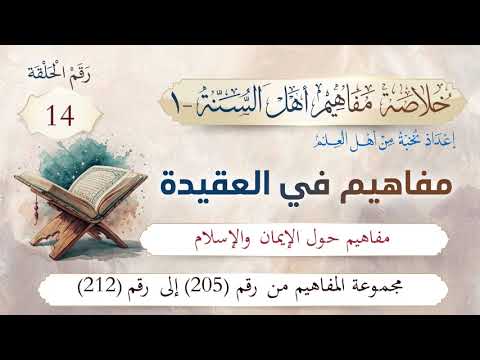
This lesson explains the definition of faith according to Ahl as-Sunnah wal-Jama'ah as belief, speech and action, which increases with obedience and decreases with disobedience. It contrasts this view with the positions of the Jahmiyyah, Murji'ah and Khawarij. It clarifies that actions of the heart and limbs are part of faith, and that neglecting some obligations or committing some prohibitions does not remove the root of faith unless the act is explicitly stated in the law as kufr. It also covers the meaning of Islam and its pillars, the obligation to believe in the Prophet ﷺ after his mission, the relation between reason and revelation, and the benefits of faith in life.
Key takeaways
According to Ahl as-Sunnah, faith consists of three parts: belief in the heart, speech of the tongue, and action of the heart and limbs.
Faith increases with obedience and decreases with disobedience, and sin does not remove the root of faith unless it is an act the law explicitly declares to be kufr.
Faith brings inner peace and confidence on the path, and frees a person from enslavement to desires and to other people.
Belief in the unseen is the foundation of faith, and reason follows revelation, serving to understand the texts rather than to judge them.
Islam combines two meanings: submission and surrender to Allah, and sincerely devoting worship to Him alone; its pillars are five, as the hadith mentions.
After the mission of the Prophet ﷺ, monotheism alone is not sufficient while one remains on a previous religion, because rejecting Muhammad ﷺ is rejecting the earlier prophets as well.
Losing faith places a person in a state lower than that of animals, as Allah describes the disbelievers as being more astray.
Questions & answers
What is the definition of faith according to Ahl as-Sunnah wal-Jama'ah?
Ahl as-Sunnah hold that faith is belief, speech and action, and it increases with obedience and decreases with disobedience. Belief is the heart's affirmation and acceptance, speech is the tongue's testimony of the two shahadas, and action includes the deeds of the heart and of the limbs.
Does neglecting some actions remove a person from faith according to Ahl as-Sunnah?
No, the root of faith remains when some obligations are neglected or some prohibitions are committed, and only the required completeness of faith is diminished. However, if the neglected act is explicitly stated in the law as kufr, such as abandoning the prayer, it is kufr according to what the text states.
Is monotheism alone enough for someone who stayed on his religion after the Prophet ﷺ was sent?
No, it is not enough, because rejecting Muhammad ﷺ after his mission is also rejecting Musa and Isa, peace be upon them. Everyone must believe in him and follow him, and the lesson cites the hadith narrated by Muslim that whoever among the Jews and Christians hears of him and dies without believing will be among the people of the Fire.
Auto-generated from the lesson transcript; the lesson itself is the reference.
Qur’an verses cited in this lesson
Al-Baqarah 2:3 — Who believe in the Unseen, and establish worship, and spend of that We have bestowed upon them;
Al-Baqarah 2:62 — Lo! Those who believe (in that which is revealed unto thee, Muhammad), and those who are Jews, and Christians, and Sabaeans - whoever believeth in Allah and the Last Day and doeth right - surely their reward is with their Lord, and there shall no fear come upon them neither shall they grieve.
Al-Baqarah 2:131 — When his Lord said unto him: Surrender! he said: I have surrendered to the Lord of the Worlds.
Ali 'Imran 3:81 — When Allah made (His) covenant with the prophets, (He said): Behold that which I have given you of the Scripture and knowledge. And afterward there will come unto you a messenger, confirming that which ye possess. Ye shall believe in him and ye shall help him. He said: Do ye agree, and will ye take up My burden (which I lay upon you) in this (matter)? They answered: We agree. He said: Then bear ye witness. I will be a witness with you.
Ali 'Imran 3:83 — Seek they other than the religion of Allah, when unto Him submitteth whosoever is in the heavens and the earth, willingly or unwillingly, and unto Him they will be returned.
An-Nisa 4:125 — Who is better in religion than he who surrendereth his purpose to Allah while doing good (to men) and followeth the tradition of Abraham, the upright? Allah (Himself) chose Abraham for friend.
An-Nisa 4:136 — O ye who believe! Believe in Allah and His messenger and the Scripture which He hath revealed unto His messenger, and the Scripture which He revealed aforetime. Whoso disbelieveth in Allah and His angels and His scriptures and His messengers and the Last Day, he verily hath wandered far astray.
Al-Furqan 25:44 — Or deemest thou that most of them hear or understand? They are but as the cattle - nay, but they are farther astray?
Al-Ahzab 33:35 — Lo! men who surrender unto Allah, and women who surrender, and men who believe and women who believe, and men who obey and women who obey, and men who speak the truth and women who speak the truth, and men who persevere (in righteousness) and women who persevere, and men who are humble and women who are humble, and men who give alms and women who give alms, and men who fast and women who fast, and men who guard their modesty and women who guard (their modesty), and men who remember Allah much and women who remember - Allah hath prepared for them forgiveness and a vast reward.
Al-Hujurat 49:14 — The wandering Arabs say: We believe. Say (unto them, O Muhammad): Ye believe not, but rather say "We submit," for the faith hath not yet entered into your hearts. Yet, if ye obey Allah and His messenger, He will not withhold from you aught of (the reward of) your deeds. Lo! Allah is Forgiving, Merciful.
Al-Hujurat 49:15 — The (true) believers are those only who believe in Allah and His messenger and afterward doubt not, but strive with their wealth and their lives for the cause of Allah. Such are the sincere.
Verses are matched automatically against the Qur’an text; some mentions may be missed. English: Pickthall.
Transcript
Machine translation — may contain errors
0:00A summary of the concepts held by Ahl al-Sunnah.
0:08The definition of faith (iman).
0:10Faith according to Ahl al-Sunnah wal-Jama'ah.
0:15It consists of belief, speech, and action.
0:17It increases through obedience and decreases through disobedience.
0:21Belief is the heart’s affirmation and acknowledgment.
0:25This is also referred to as the "speech of the heart."
0:29Speech is the utterance of the two testimonies by the tongue.
0:34Action includes the action of the heart.
0:37This is the heart’s submission, acceptance, and surrender.
0:41The actions of the limbs through acts of obedience constitute the category of action.
0:45According to the Jahmiyyah, faith is merely knowledge.
0:49According to the Ash'ariyyah, it is affirmation.
0:52According to the Karramiyyah, faith is merely the utterance of the tongue.
0:56Even if affirmation and acceptance are absent.
0:59According to the Murji'ah, faith is affirmation and the speech of the tongue.
1:04According to the Khawarij, faith encompasses all prescribed speech and actions, such as performing obligations or abstaining from prohibitions.
1:12If a person abandons a single obligation or commits a single prohibition, they become a disbeliever.
1:18The Khawarij and the Murji'ah agree on the claim that faith neither increases nor decreases.
1:24The jurists of the Murji'ah affirm the actions of the heart and acknowledge their importance.
1:30However, they categorize them as something other than faith.
1:34Likewise, they exclude the actions of the limbs from the definition of faith.
1:39Yet, when they are asked about the relationship of the actions of the heart and the limbs to faith,
1:46They say these are among its requirements and fruits.
1:50The inclusion of actions in faith according to Ahl al-Sunnah.
1:55The category of action is a pillar of faith according to Ahl al-Sunnah.
2:01Therefore, if it is entirely lost—meaning one abandons all acts of obedience—the foundation of faith is lost.
2:07Shaykh al-Islam Ibn Taymiyyah said regarding the total loss of the category of action:
2:12It is impossible for a person to perform nothing of what they were commanded, such as prayer, zakat, fasting, and Hajj,
2:20While committing whatever prohibitions they are able to,
2:23And yet remain a believer in their heart.
2:26One would not do this unless there were an absence of faith in their heart.
2:30As for when some actions are neglected,
2:33Such as abandoning some obligations or committing some prohibitions,
2:37Then the foundation of faith remains.
2:40However, the obligatory faith is diminished.
2:43Unless the abandoned action is explicitly stated in the Shari'ah to be an act of disbelief,
2:49Such as the total abandonment of prayer,
2:52Even if one is lazy,
2:54Or ruling by other than what Allah has revealed,
2:57Or rejecting the law of Allah.
3:00Because the Murji'ah do not include actions in the definition of faith,
3:04They do not view the one who abandons the category of action as a disbeliever.
3:08Rather, affirmation is sufficient for them to be a believer.
3:12The Khawarij view, as Ahl al-Sunnah does,
3:15That actions are included in the definition of faith.
3:19But they differ from them because they consider the commission of any prohibition or the abandonment of any obligation
3:25To be disbelief that necessitates eternal residence in the Fire,
3:28If the person does not repent from it.
3:31Even if they performed all other obligations and avoided all other prohibitions.
3:35This is the opposite of Ahl al-Sunnah,
3:37Who do not negate the foundation of faith from one who commits a major sin, provided they do not deem it lawful.
3:43They say:
3:45They are a believer by virtue of their faith,
3:47A sinner by virtue of their major sin, and their faith is deficient.
3:51It has come in the hadith of Jibril
3:53That the pillars of faith are belief in Allah, His angels,
3:58“O ye who believe! Believe in Allah and His messenger and the Scripture which He hath revealed unto His messenger, and the Scripture which He revealed aforetime. Whoso disbelieveth in Allah and His angels and His scriptures and His messengers and the Last Day, he verily hath wandered far astray.” (4:136)
4:01And the divine decree, both its good and its evil.
4:05A contemporary deviation in understanding faith.
4:09We live today in a miserable state, unique in the history of Islam,
4:15If not in the history of all humanity,
4:18Where many people believe in the oneness of Allah, who has no partner,
4:23Then do not implement His law in the reality of life,
4:27And see no harm in that.
4:30In fact, some of them may see that the interest today
4:33Lies in removing the law of Allah from the reality of humanity,
4:37And adopting man-made legislation in its place.
4:41Yet they claim to be Muslims,
4:44Loving Islam and its people.
4:47Such a thing has never occurred before in the history of humanity as a whole.
4:52For humanity, throughout its entire history,
4:56Never departed from one of two states:
4:59Either believing in Allah, the One, the Unique,
5:02And implementing His law in a general sense,
5:06Or being polytheistic in belief,
5:09Believing in the existence of other gods and legislators,
5:13And implementing their laws instead of Allah’s.
5:16But to believe in the One Allah,
5:19Then implement the law of someone else—
5:21This is a form of insanity.
5:24It has never happened before in either the Age of Ignorance (Jahiliyyah) or in Islam.
5:34It states in the dictionary:
5:36"Aslama" means he submitted and became a Muslim.
5:39Ibn Taymiyyah says, explaining the meaning of Islam:
5:43The term "Islam" is used in two ways.
5:46The first is transitive,
5:48As in His saying, the Almighty:
5:50“Who is better in religion than he who surrendereth his purpose to Allah while doing good (to men) and followeth the tradition of Abraham, the upright? Allah (Himself) chose Abraham for friend.” (4:125)
5:56The second is intransitive,
5:58As in His saying, the Almighty:
6:00“When his Lord said unto him: Surrender! he said: I have surrendered to the Lord of the Worlds.” (2:131)
6:03“When his Lord said unto him: Surrender! he said: I have surrendered to the Lord of the Worlds.” (2:131)
6:06And as in His saying, the Almighty:
6:08“Seek they other than the religion of Allah, when unto Him submitteth whosoever is in the heavens and the earth, willingly or unwillingly, and unto Him they will be returned.” (3:83)
6:12It combines two meanings:
6:14One of them:
6:16Submission and surrender.
6:18The second:
6:19Sincerity in that and singling it out.
6:22Its title is the statement "There is no god but Allah."
6:25It has two meanings:
6:27One of them:
6:29The common religion,
6:30Which is the worship of Allah alone, with no partner,
6:34With which all the prophets were sent.
6:37The second:
6:39That which is specific to Muhammad, peace be upon him,
6:42Of religion, law, and methodology.
6:45It is the Shari'ah, the path, and the reality.
6:48The pillars of Islam are five:
6:51The testimony that there is no god but Allah and that Muhammad is the Messenger of Allah,
6:56Establishing prayer,
6:58Giving zakat,
7:00Fasting Ramadan,
7:01And pilgrimage to the House of Allah for whoever is able to find a way.
7:07A mistaken understanding of Islam.
7:10Some people think,
7:13Either out of ignorance of the reality of Islam,
7:16Or out of desire and fallacy,
7:18That a monotheist from any religion whatsoever
7:21Is a Muslim believer,
7:23Even if they remained upon their religion after the mission of our Prophet Muhammad, peace be upon him.
7:30They cite as evidence for their opinion His saying, the Almighty:
7:34“Lo! Those who believe (in that which is revealed unto thee, Muhammad), and those who are Jews, and Christians, and Sabaeans - whoever believeth in Allah and the Last Day and doeth right - surely their reward is with their Lord, and there shall no fear come upon them neither shall they grieve.” (2:62)
7:39"Whoever believes in Allah and the Last Day and does righteousness,
7:44They will have their reward with their Lord, and no fear will there be concerning them, nor will they grieve."
7:50This is a deviant understanding,
7:52Because the verse was revealed regarding those who died upon monotheism from among the Christians, Jews, or Sabians
7:58Before the mission of the Prophet, peace be upon him.
8:02As for after his mission, peace be upon him,
8:06Everyone must believe in him and follow him.
8:10It is not sufficient for them to be a monotheist while remaining on their religion and not following him, peace be upon him.
8:18Because disbelief in Muhammad, peace be upon him, after his mission,
8:23Is disbelief in Musa and 'Isa, peace be upon them.
8:27For the Almighty said:
8:29“When Allah made (His) covenant with the prophets, (He said): Behold that which I have given you of the Scripture and knowledge. And afterward there will come unto you a messenger, confirming that which ye possess. Ye shall believe in him and ye shall help him. He said: Do ye agree, and will ye take up My burden (which I lay upon you) in this (matter)? They answered: We agree. He said: Then bear ye witness. I will be a witness with you.” (3:81)
8:36"Then there came to you a messenger confirming what is with you, so you must believe in him and support him."
8:44He said, "Have you acknowledged and taken upon that My commitment?"
8:49They said, "We have acknowledged."
8:51“When Allah made (His) covenant with the prophets, (He said): Behold that which I have given you of the Scripture and knowledge. And afterward there will come unto you a messenger, confirming that which ye possess. Ye shall believe in him and ye shall help him. He said: Do ye agree, and will ye take up My burden (which I lay upon you) in this (matter)? They answered: We agree. He said: Then bear ye witness. I will be a witness with you.” (3:81)
8:55And the Prophet, peace be upon him, said: "By the One in whose hand is the soul of Muhammad,
9:02No one of this Ummah, Jew or Christian, hears of me,
9:07Then dies without believing in that with which I was sent,
9:11But they will be among the companions of the Fire."
9:14Narrated by Muslim.
9:16The meaning of faith and Islam when mentioned together and when mentioned separately.
9:25The concept of faith and Islam falls under the well-known rule:
9:30"When they are mentioned together, they are distinct; when they are mentioned separately, they are synonymous."
9:35That is, the term "faith,"
9:37If it is coupled with the term "Islam" in one verse or one hadith,
9:42Then they differ in meaning.
9:45The term "faith" expresses
9:47Inner faith, consisting of affirmation, submission, acceptance, and heart-based beliefs.
9:54And "Islam" expresses outward faith through the limbs and pillars.
9:59But if they are mentioned separately,
10:02For example, if the term "faith" appears in a verse without being coupled with "Islam," or vice versa,
10:09Then they are synonymous in meaning.
10:13It is faith and submission, both outwardly and inwardly.
10:17An example of being coupled in mention:
10:21The saying of Allah, the Almighty:
10:23"The bedouins say, 'We have believed.'"
10:26“The wandering Arabs say: We believe. Say (unto them, O Muhammad): Ye believe not, but rather say "We submit," for the faith hath not yet entered into your hearts. Yet, if ye obey Allah and His messenger, He will not withhold from you aught of (the reward of) your deeds. Lo! Allah is Forgiving, Merciful.” (49:14)
10:34And His saying, the Almighty:
10:36“Lo! men who surrender unto Allah, and women who surrender, and men who believe and women who believe, and men who obey and women who obey, and men who speak the truth and women who speak the truth, and men who persevere (in righteousness) and women who persevere, and men who are humble and women who are humble, and men who give alms and women who give alms, and men who fast and women who fast, and men who guard their modesty and women who guard (their modesty), and men who remember Allah much and women who remember - Allah hath prepared for them forgiveness and a vast reward.” (33:35)
10:42And an example of being separate:
10:44The saying of Allah, the Almighty, regarding faith:
10:47“The (true) believers are those only who believe in Allah and His messenger and afterward doubt not, but strive with their wealth and their lives for the cause of Allah. Such are the sincere.” (49:15)
10:53"And strive with their wealth and their lives in the cause of Allah.
10:58Those are the truthful."
11:01And His saying, the Almighty, regarding Islam:
11:04“When his Lord said unto him: Surrender! he said: I have surrendered to the Lord of the Worlds.” (2:131)
11:07“When his Lord said unto him: Surrender! he said: I have surrendered to the Lord of the Worlds.” (2:131)
11:11The value of faith in life and its fruits.
11:15First, the most important value of faith:
11:20It is knowledge of the primary truth:
11:23The existence of Allah, the Almighty.
11:25That knowledge without which no other knowledge of the existence of anything else can be valid in the human soul.
11:34Thus, one realizes that existence is the creation of Allah.
11:37Consequently, the human interacts with the universe
11:40While knowing its nature,
11:42Just as they know the laws that govern it.
11:45They coordinate their movement with the movement of this vast existence according to this understanding,
11:51And do not deviate from its universal laws.
11:54They find happiness in this harmony,
11:56And proceed with the entire universe toward the Creator of existence,
12:00In obedience, submission, and peace,
12:03As a servant of Allah, monotheistic, with no partner.
12:08That is a necessary quality for every human,
12:12But it is most necessary for the community that leads humanity to the Creator of existence.
12:20Second, the value of faith also lies in its realization of psychological tranquility,
12:27Confidence in the path,
12:29And the absence of confusion, hesitation, fear, or despair.
12:33These are necessary qualities for every human on their journey on earth,
12:38But they are most necessary for the leader who explores the path
12:43And leads humanity on this path.
12:47Third, the value of faith lies in detachment from desires, interests, agendas, and personal gains,
12:55As the heart becomes attached to a goal beyond its own self.
12:59One feels that they have no authority over the matter,
13:02But rather it is the call of Allah, and they are merely a hired worker for Allah in it.
13:08This feeling is most necessary for those entrusted with the task of leadership,
13:13So that they do not despair if the straying flock turns away from them or if they are harmed in the cause of the call,
13:20And they are not deluded if the masses respond to them or bow their necks to them, for they are but a hired worker.
13:28Fourth, faith in Allah is evidence of the vitality of the innate nature (fitra) and the soundness of its receptive faculties,
13:36Of the truthfulness of human perception and the vitality of the human structure,
13:42And of a breadth in the field of sensing the truths of existence.
13:47These are all qualifications for success in real life.
13:52Fifth:
13:54Faith in Allah is a surging, driving force
13:58That gathers all aspects of human existence and directs them toward a single goal,
14:05And releases them to derive their strength from the strength of Allah,
14:09And to work toward fulfilling His will, may He be glorified and exalted,
14:13in acting as stewards of the earth, cultivating it, and warding off corruption and strife from it,
14:18and in advancing and developing life,
14:21while realizing the reality of its transience and the permanence of the Hereafter.
14:25Thus, one directs their worldly labor toward a desire for the Hereafter.
14:29This is also among the qualifications for success in practical life.
14:35Sixth:
14:37Faith in Allah is a liberation from servitude to whims and from servitude to fellow creatures.
14:44There is no doubt that the human being who is liberated through servitude to Allah
14:49is more capable of a righteous and sound stewardship of the earth.
14:54Seventh:
14:55Faith is the foundation of virtues and the bridle of vices,
15:00the strength of conscience and the support of resolve in times of hardship,
15:04the balm of patience during calamities,
15:07the pillar of contentment and satisfaction with one's lot,
15:10the light of hope in the breasts,
15:13and the solace and tranquility of souls when life becomes desolate.
15:17It is the consolation of hearts when death descends or its days draw near,
15:22and the firmest bond between humanity and its noble ideals.
15:27Eighth:
15:28By losing faith, we become the most unfortunate in life,
15:33and the lowest in rank on the scale of creation,
15:36lower than the humblest beasts, the most contemptible insects, and the fiercest predators.
15:41For beasts hunger as we hunger,
15:45yet they are free from the anxiety of provision, the fear of poverty, and the humiliation of begging.
15:51They give birth as we give birth,
15:53and they lose their young as we lose ours,
15:56yet they are at rest from the panic of bereavement and the fear of orphanhood.
16:01They suffer in their bodies as we suffer,
16:05yet they are at rest from that which consumes hearts, severs ties of kinship, and divides the community,
16:11such as envy, lying, and slander.
16:14They fall ill as we fall ill and die as we die,
16:18yet they are at rest from contemplating the consequences of death.
16:23If we do not have faith that consoles us, satisfies us, and comforts us,
16:28we would be more wretched and more misguided than the speechless animals.
16:33Allah the Almighty spoke the truth when He said, describing the disbelievers:
16:37“Or deemest thou that most of them hear or understand? They are but as the cattle - nay, but they are farther astray?” (25:44)
16:42﴾They are only like livestock; nay, they are even further astray in their path.﴿
16:47Faith in the Unseen regulates the relationship between reason and revelation.
16:53Faith in the Unseen is the trunk of the tree of faith, which cannot stand without it.
17:00For faith in Allah, may He be glorified and exalted,
17:03and in His angels, His books, His messengers, the Last Day, and the divine decree,
17:08is rooted entirely in faith in the Unseen.
17:11It is the submission to the reports that have come in the Qur'an and the authentic Sunnah regarding these six pillars.
17:18It is the certainty that reason has its limits in perception, and upon it—
17:23for reason is subordinate to revelation.
17:25Its role is to comprehend from Allah and His Messenger and to reflect upon the texts of the two revelations,
17:30and to worship Allah, may He be glorified and exalted, by believing in them and their implications.
17:37Sound reason does not conflict with explicit revelation.
17:41If any apparent conflict arises,
17:43its cause is either a corruption in reason and perception,
17:47or that the report is not authentic or not explicit.
17:51Allah, may He be glorified and exalted, has described His pious servants by saying:
17:56“Who believe in the Unseen, and establish worship, and spend of that We have bestowed upon them;” (2:3)
18:03This is the way of the salaf, may Allah have mercy upon them,
18:06as they prioritize revelation over reason.
18:09They benefit from the blessing of reason by reflecting upon the verses and increasing their faith,
18:15and by preparing for the bliss in the Hereafter that Allah, may He be glorified and exalted, has promised His servants,
18:20as a reward for righteous deeds,
18:23or for the punishment with which Allah has threatened the wrongdoers,
18:27so they distance themselves from its causes and what leads to it.
18:31The role of reason is to receive from Allah, may He be glorified and exalted, and from His Messenger, peace be upon him,
18:38and to submit to what it receives,
18:40not to act as a judge over the texts of the two revelations,
18:44taking from them what it wills and leaving what it wills.
18:48The meaning of this religion addressing reason
18:51is that it awakens, directs, and purifies it, and establishes for it a correct methodology for observation and thought,
18:59not that it allows it to judge the validity or invalidity of its legislations.
19:04Once the text is established, it is the authority,
19:08and it is upon human reason to accept the text, submit to it, and implement it,
19:13whether it perceives the wisdom behind it or not.
19:17For revelation is from Allah, the All-Knowing, the All-Aware,
19:20and reason is not a deity that judges validity or invalidity,
19:24or acceptance or rejection of what has come from Allah.
19:28By failing to grasp the correct role of reason, much confusion occurs,
19:34whether from those who wish to deify human reason
19:37and make it a judge over the texts,
19:40or from those who wish to abolish reason
19:43and deny its role in faith, guidance, and deduction.
19:47Summary of the concepts of the Ahl al-Sunnah.