budoorzahera launched in 2026 to carry the light of knowledge to every heart, in every language. Every lesson is available in the original audio with a full synced transcript, translated into fifteen other languages, with translated-audio listening available for a number of them.
You can copy any line of the transcript while listening, download the full text in multiple formats (TXT · SRT · VTT), or share a lesson with someone you care about in one tap. We ask God to make this work beneficial.
4192audio lessons
59complete series
16world languages
Error log
An automatic log of the most recent errors the app ran into on your device — copying and sending it to us helps a lot when troubleshooting a problem.
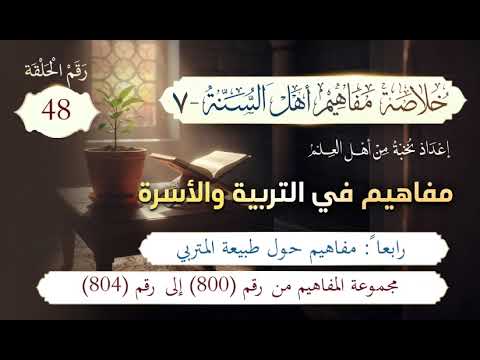
The lesson explains the reality of the human being as a unified whole of body, mind and soul, and that Islam disciplines desires without suppressing or leaving them unchecked. The sheikh explains that humans share a sensory energy with animals but possess a distinct moral energy whose scope extends beyond worldly knowledge to faith, virtues and ethics. The lesson presents Islam's position on individuality and collectivity as two original, complementary tendencies, and concludes with the child's capacity to absorb and imitate, and the effect of role models in forming his first foundations.
Key takeaways
The human being is one interconnected whole of body, mind and soul; the work of one does not separate from the others.
Islam disciplines and refines desires rather than unleashing or suppressing them.
Islam rejects monasticism that cuts a person off from real life and attachment to clay alone.
The ideal realism views human nature and then raises the person toward the perfection he can attain.
Moral energy is specific to humans, and its field includes faith, virtues and ethics alongside worldly knowledge.
Islam affirms both individuality and collectivity as original, mutually supporting tendencies.
Good role models form sound foundations in a child, while bad role models form disturbed ones.
Questions & answers
What is the reality of the human being in Islam?
The sheikh explains that man was created from a handful of clay and a breath of Allah's spirit, and Islam treats him as body, mind and soul combined in one entity.
Does Islam suppress desires?
No. The lesson clarifies that Islam does not leave a person to his desires nor suppress them, but disciplines, purifies and refines them.
What is the difference between sensory and moral energy in humans?
Sensory energy is shared with animals and relates to the senses and nerves, while moral energy is conceptual thinking that grasps higher values such as justice, truth and virtue, which animals do not possess.
Does Islam favor individualism or collectivism?
Islam affirms both. It regards them as two original tendencies in the human being that complement one another rather than conflict.
Auto-generated from the lesson transcript; the lesson itself is the reference.
Transcript
Machine translation — may contain errors
0:00A Summary of the Concepts of Ahl al-Sunnah
0:08The reality of the human being
0:12The human being as his father Adam, peace be upon him, was created
0:16A handful of clay and a breath from the spirit of Allah
0:21Thus, if he clings to the earth and sticks to the clay,
0:24desires enslave him, rendering him incapable of fulfilling his complete potential.
0:30Therefore, Islam—as we have previously mentioned—
0:33does not abandon the human being to his desires;
0:36yet at the same time,
0:38it does not suppress them or waste their energies,
0:42but rather regulates, purifies, and refines them.
0:46As for the person who neglects his clay-like nature
0:50and focuses solely on the spirit,
0:52he falls into forbidden monasticism—
0:56"and monasticism they innovated; We did not prescribe it for them"—
1:01detached from the reality of life,
1:03falling short in fulfilling the role entrusted to him to inhabit and build the earth.
1:08For this reason, Islam addresses the human soul
1:12as a body, mind, and spirit—
1:16integrated and interconnected in a single entity—
1:20where the function of one component is never isolated from the others.
1:24Through this integration, the features of the righteous person are defined,
1:28and two things are simultaneously guaranteed:
1:32First, the utilization of all human energies in cultivating the earth,
1:38without neglecting any of them;
1:41second, the attainment of inner equilibrium within the soul,
1:45as well as within the reality of practical life alike.
1:49Idealistic Realism
1:53The idealistic realism through which Islam nurtures the human being
1:59is that which considers his nature as previously explained,
2:03then constantly summons him to ascend toward higher pursuits,
2:08charging him to strive for the perfection that lies within his capacity.
2:13The realistic path for his upbringing and treatment
2:17is to present a complete vision before him,
2:20constantly training him to ascend toward it and draw close to it
2:25through every possible avenue and to the utmost of his ability.
2:31Man possesses two types of capacity: physical and intellectual.
2:37Physical capacity is the energy of the body connected to the senses, nerves,
2:43and physiological functions.
2:47No one knows its exact location or essence,
2:52yet it is defined as conceptual thinking,
2:56which comprehends universal concepts, abstract meanings, and supreme values—
3:01such as justice, truth, virtue, beauty, and so forth.
3:07Man shares physical capacity with animals,
3:12whereas intellectual capacity distinguishes him from them, as animals do not possess it;
3:18thus, it is considered a uniquely human capacity.
3:24The contemporary world, led unfortunately by the West,
3:29utilizes this intellectual capacity in only a single realm:
3:34the realm of worldly science, with its various theories and practical applications.
3:40While this is undoubtedly a vast domain that opens immense, renewed horizons toward material progress and prosperity,
3:50the scope of this intellectual capacity is far broader than the field of secular science alone.
3:57It encompasses the most elevated aspects of the human being:
4:01creed, virtues, morals, and numerous other values.
4:07All these dimensions must be engaged,
4:10and this capacity must be applied within them in a sound and disciplined manner,
4:16so that secular scientific advancement remains guided,
4:20and human conduct in worldly life is properly regulated overall.
4:27Between Individualism and Collectivism
4:31Western capitalism is founded upon human individualism,
4:37expanding the boundaries of the individual's autonomy,
4:40leaving him free to act in many matters
4:45even to the point of harming others and harming himself,
4:50giving free rein to desires and caprices,
4:53thereby destroying values and morals,
4:56and refusing to recognize anyone's right to direct or regulate his conduct.
5:02Communism in the East is founded upon human collectivism,
5:07expanding the scope of the collective and the state,
5:10while restricting individual initiative,
5:13thereby suppressing all individual freedom—
5:16whether in ownership, employment, belief, and so forth.
5:22Islam, however—the religion of natural human inclination (Fitrah)—
5:25affirms both the individual and collective aspects of man.
5:31It does not view them as contradictory tendencies,
5:34but rather recognizes that human nature makes one an individual integrated into the collective—
5:39innately individual, yet innately inclined toward the group.
5:44Islam addresses these two tendencies as fundamental inherent traits,
5:49rendering them mutually supportive,
5:52such that one complements the other without conflict.
5:56A Child's Perception
6:00We often assume that a child is a tiny creature lacking perception and awareness;
6:05however, in reality, a child possesses an extraordinary capacity for perception and absorption,
6:10both conscious and subconscious—
6:13a capacity far greater than we might think.
6:17Even if a child does not fully comprehend everything he sees,
6:22he is nonetheless influenced by all that he observes and senses around him.
6:27For he possesses two highly sensitive faculties:
6:31the faculty of absorption and the faculty of imitation.
6:35Working together, these allow him to absorb information—whether subconsciously or with partial awareness—
6:40and subsequently imitate what he absorbs, also subconsciously or with partial awareness.
6:47Thus, although a child does not grasp the abstract meanings of values and principles as adults do,
6:54he nonetheless constructs within himself a foundation upon which those future principles will be built.
7:02If the role model is righteous, the foundation will be sound,
7:08and there is a high likelihood, by Allah's leave, of the child's righteousness.
7:13Conversely, if the role model is corrupt, the foundation the child constructs will be unstable and warped,
7:21resulting in a greater probability of his corruption.