budoorzahera launched in 2026 to carry the light of knowledge to every heart, in every language. Every lesson is available in the original audio with a full synced transcript, translated into fifteen other languages, with translated-audio listening available for a number of them.
You can copy any line of the transcript while listening, download the full text in multiple formats (TXT · SRT · VTT), or share a lesson with someone you care about in one tap. We ask God to make this work beneficial.
4192audio lessons
59complete series
16world languages
Error log
An automatic log of the most recent errors the app ran into on your device — copying and sending it to us helps a lot when troubleshooting a problem.
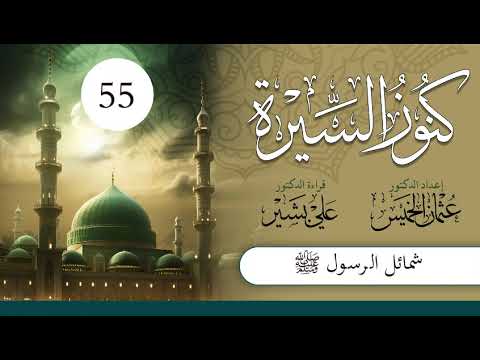
In this final episode of the Treasures of the Prophetic Biography series, Sheikh Uthman al-Khamis discusses several topics: the ruling on graves and mosques, and that the Prophet's ﷺ grave was not built into a mosque but was buried in the house of Aisha ﵂, which was later absorbed into the mosque during its expansion. He then covers the names of the Prophet ﷺ and their meanings, and notes that Ta-Ha and Ya-Sin are, correctly, among the disjointed letters that open some surahs, not his names. The lesson also covers his lineage, his children and wives, the wisdom behind his multiple marriages, and the description of the seal of prophethood between his shoulders.
Key takeaways
It is not permitted to build a mosque over a grave or to bury the dead inside a mosque; the Prophet's ﷺ grave was not built over, but was buried in the house of Aisha ﵂.
The names of Allah, the Qur'an and the Prophet ﷺ all indicate meanings; among the Prophet's ﷺ names are Muhammad, Ahmad, al-Mahi, al-Hashir and al-Aqib.
Ta-Ha and Ya-Sin are, according to the correct view, among the disjointed letters that open some surahs, and are not names of the Prophet ﷺ.
The Prophet's ﷺ lineage, which scholars of genealogy agree upon, traces back to Adnan and through him to Isma'il, peace be upon him.
An overview of the Prophet's ﷺ children, daughters and wives, including the virtues of Khadijah and Aisha ﵂.
The Prophet ﷺ did not marry a virgin other than Aisha ﵂; most of his wives were divorcees or widows, and one wisdom was that they could relay what happens in the home for the Ummah to follow.
The description of the seal of prophethood between the Prophet's ﷺ shoulders, as narrated by the Companions ﵃.
Questions & answers
Is it permissible to build a mosque over a grave?
The sheikh explains that it is not permitted to build a mosque over a grave or to bury a dead person inside a mosque. If a mosque was built over a grave, the mosque must be demolished and the grave exhumed.
Are Ta-Ha and Ya-Sin names of the Prophet ﷺ?
The sheikh states this is not correct. According to the sound view, Ta-Ha and Ya-Sin are among the disjointed letters that open some surahs, and they indicate that the Qur'an is composed of these same letters.
What is the lineage of the Prophet ﷺ?
He is Muhammad bin Abdullah bin Abd al-Muttalib bin Hashim bin Abd Manaf, and his lineage goes back to Adnan, who was from the descendants of Isma'il, peace be upon him. Genealogists agree on this lineage.
What was the wisdom behind the Prophet's ﷺ multiple marriages?
The sheikh explains that the Prophet ﷺ married no virgin other than Aisha ﵂, and most of his wives were divorcees or widows. One wisdom was that they would transmit what happened in the home, which the Ummah would follow after him.
Auto-generated from the lesson transcript; the lesson itself is the reference.
Qur’an verses cited in this lesson
Al-Ahzab 33:37 — And when thou saidst unto him on whom Allah hath conferred favour and thou hast conferred favour: Keep thy wife to thyself, and fear Allah. And thou didst hide in thy mind that which Allah was to bring to light, and thou didst fear mankind whereas Allah hath a better right that thou shouldst fear Him. So when Zeyd had performed that necessary formality (of divorce) from her, We gave her unto thee in marriage, so that (henceforth) there may be no sin for believers in respect of wives of their adopted sons, when the latter have performed the necessary formality (of release) from them. The commandment of Allah must be fulfilled.
As-Saffat 37:124 — When he said unto his folk: Will ye not ward off (evil)?
As-Saffat 37:125 — Will ye cry unto Baal and forsake the Best of creators,
As-Saffat 37:126 — Allah, your Lord and Lord of your forefathers?
Verses are matched automatically against the Qur’an text; some mentions may be missed. English: Pickthall.
Transcript
Machine translation — may contain errors
0:00In the name of Allah, the Most Gracious, the Most Merciful.
0:04Treasures of the Prophetic biography (Seerah).
0:08Graves and mosques.
0:15The expansion of the mosque took place during the era of al-Walid Ibn 'Abd al-Malik.
0:19Consequently, the grave of the Prophet (peace be upon him) was incorporated into the mosque.
0:24As is the case now.
0:26Here, we must draw attention to this issue.
0:29Namely, the ruling regarding the presence of a grave within a mosque.
0:33We must know.
0:35That it is not permissible to build a mosque over a grave.
0:39Nor is it permissible to bury a deceased person inside a mosque.
0:42If a mosque is built over a grave.
0:45Then that mosque was not founded upon piety.
0:48Therefore, the mosque must be demolished.
0:51And if a deceased person is buried in a mosque.
0:53It is not permissible.
0:55The grave must be exhumed.
0:57And the deceased must be removed from the mosque.
1:00As for the grave of the Prophet (peace be upon him), he did not build his mosque over his grave; rather, his mosque was established before he passed away—indeed, he was the one who built it. Furthermore, the Prophet was not buried in the mosque, but rather in the house of 'A'ishah (may Allah be pleased with her).
1:26It is narrated in the famous hadith from the Prophet (peace be upon him) that he said:
1:32"Between my house and my pulpit is a garden from the gardens of Paradise."
1:37Some narrate it with the wording:
1:39"Between my grave and my pulpit."
1:42This version is not authentic.
1:45Some only narrated it according to the meaning.
1:48Therefore, the scholars do not say:
1:50"The mosque must be demolished."
1:52Or, "The grave of the Prophet (peace be upon him) must be exhumed."
1:57For that would be a grave error.
1:59What actually happened.
2:01Was that the mosque was expanded, and the grave became enclosed within the mosque.
2:05And what has been done now.
2:07Of isolating the grave and placing it to the side of the mosque.
2:11Is the absolute correct course of action.
2:13As the grave is now located in one of the sides of the mosque.
2:17And not inside it, as was the case previously.
2:21We ask Allah, the Almighty.
2:24To unite us with His Prophet (peace be upon him).
2:28In the abode of His mercy.
2:30And to shield us from the Fire through the blessing of following him.
2:34And to forgive us and all of his Ummah.
2:38Amin, Amin, Amin.
2:42May the peace, blessings, and salutations of Allah be upon our Prophet Muhammad.
2:46As often as those who remember him mention him.
2:49And as often as the heedless neglect to mention him.
2:52And our final prayer is that all praise is due to Allah, Lord of the worlds.
3:12These are the Prophetic characteristics (Shama'il) of the Messenger (peace be upon him).
3:16As explained by the people of knowledge.
3:24Muhammad, Ahmad, al-Mahi (the Effacer), al-Hashir (the Gatherer), and al-'Aqib (the Successor).
3:32On the authority of Jubayr Ibn Mut'im (may Allah be pleased with him), who said:
3:37I heard the Messenger of Allah (peace be upon him) say:
3:41"I have names: I am Muhammad, and I am Ahmad.
3:46I am al-Mahi, through whom Allah effaces disbelief.
3:50I am al-Hashir, before whom people will be gathered.
3:55And I am al-'Aqib, after whom there is no one."
3:59Indeed, the names of Allah, the Blessed and Exalted.
4:02The names of the Great Qur'an, and the names of the Noble Prophet.
4:07Are not mere labels; rather, they all point to meanings.
4:12Among the names of Allah, the Almighty:
4:15Allah, al-Malik (the King), al-Quddus (the Holy), al-Jabbar (the Compeller), al-'Aziz (the Mighty), al-Rahman (the Most Merciful).
4:22And many others.
4:24These names are derived from attributes inherent to Allah, the Blessed and Exalted.
4:30Which necessitate praise and perfection for Him.
4:33His name, Allah, is the Ma'luh.
4:36Meaning the One worshipped out of love, fear, and hope.
4:40His name, al-Malik, means He is the King.
4:43His name, al-Quddus.
4:45Means He is the Holy, free from every deficiency and fault.
4:49He is al-Jabbar, meaning the Powerful, Glorified and Exalted is He.
4:54And al-'Aziz, whom nothing can frustrate.
4:57Nothing can escape Him.
4:59And nothing can overcome Him.
5:01And He is al-Rahman, whose mercy encompasses all things.
5:06The Noble Qur'an is likewise.
5:08Its names include al-Nur al-Mubin (the Clear Light).
5:11Al-Shifa' (the Healing), al-Kitab (the Book), and al-Furqan (the Criterion).
5:15And others.
5:17All of which are names indicating the meanings of this Book.
5:21Likewise, the Messenger (peace be upon him).
5:25His names are Muhammad and Ahmad.
5:28And al-Mahi, al-Hashir, and al-'Aqib.
5:32All these names indicate meanings.
5:36From this, a matter becomes clear to us, which is:
5:40That what has appeared in some books or from some people.
5:44Mentioning that among the names of the Prophet (peace be upon him).
5:49Are Ta-Ha and Ya-Sin, is not correct.
5:53This is because Ta-Ha and Ya-Sin, according to the correct view.
5:57Are among the letters that begin certain chapters.
6:00Like the saying of the Almighty in some chapters:
6:03Nun, Qaf, and Sad.
6:07And Kaf-Ha-Ya-'Ayn-Sad.
6:10And Alif-Lam-Mim.
6:13The same applies to Ya-Sin and Ta-Ha.
6:17That is why Ta-Ha is written with only two letters.
6:21If it were a name, it would be written as 'al-Taha'.
6:24Just as 'Nun' was written in the saying of the Almighty:
6:27"Dhu al-Nun" (the man of the fish).
6:30Which is different from the 'Nun' at the beginning of Surah al-Qalam.
6:34That is why the Noble Qur'an was mentioned after it.
6:37"Ta-Ha. We have not sent down to you the Qur'an that you be distressed."
6:42These letters, according to the correct view of the scholars.
6:46Have no meaning in themselves.
6:49Rather, they have a significance.
6:51Which is that this Noble Qur'an.
6:54Is composed of these letters that they speak with.
6:58And that Allah challenges them to produce a Qur'an.
7:01Composed of these letters.
7:04The same applies to Ya-Sin.
7:07When the saying of Allah, the Blessed and Exalted, came:
7:10“And lo! Elias was of those sent (to warn),” (37:123)
7:14“When he said unto his folk: Will ye not ward off (evil)?” (37:124)
7:17“Will ye cry unto Baal and forsake the Best of creators,” (37:125)
7:22“Allah, your Lord and Lord of your forefathers?” (37:126)
7:28"So they denied him, and indeed, they will be brought [for punishment]."
7:32"Except the chosen servants of Allah."
7:36"And We left for him [favorable mention] among the later generations."
7:39"Peace be upon Ilyasin."
7:43And it is written as 'Yasin'.
7:45Which differs from the one written at the beginning of Surah Yasin.
7:50That is why it says: "Yasin. By the wise Qur'an."
7:55Emphasizing the mention of the Noble Qur'an.
7:58What adds to the significance of all this.
8:01Is that Ta-Ha has no meaning, nor is it a description.
8:05Nor is it a praise for the Prophet (peace be upon him).
8:09But the most that has been said regarding the meaning of Ta-Ha.
8:13Is that it means 'O man' or 'Ta-Ha' (tread the earth).
8:17And this is not a praise for the Prophet (peace be upon him).
8:21Likewise, Yasin is not a praise.
8:24Treasures of the Prophetic biography (Seerah).
8:27The lineage of the Prophet (peace be upon him).
8:35Ibn al-Qayyim said:
8:39He is the best of the people of the earth, absolutely.
8:42For his lineage is at the highest peak of nobility.
8:45Even his enemies testified to that for him.
8:49That is why his enemy testified to it.
8:52At that time, before the King of Rome.
8:55When he came to him and said:
8:58"What is his lineage among you?"
9:00Abu Sufyan said:
9:02"He is of the most noble lineage among us."
9:05The most noble of the people is his people.
9:07The most noble of the tribes is his tribe.
9:10And the most noble of the clans is his clan.
9:14He is Muhammad Ibn 'Abd Allah Ibn 'Abd al-Muttalib.
9:17Ibn Hashim Ibn 'Abd Manaf Ibn Qusayy.
9:21Ibn Kilab Ibn Murrah Ibn Ka'b.
9:24Ibn Lu'ayy Ibn Ghalib Ibn Fihr.
9:27Ibn Malik Ibn al-Nadr Ibn Kinanah.
9:30Ibn Khuzaymah Ibn Mudrikah Ibn Ilyas.
9:33Ibn Mudar Ibn Nizar Ibn Ma'add Ibn 'Adnan.
9:37This lineage is agreed upon among the genealogists.
9:41There is no disagreement among them.
9:43And 'Adnan is from the descendants of Isma'il (peace be upon him).
9:47And Isma'il is the son of Ibrahim (peace be upon them both).
9:51On the authority of al-Ash'ath Ibn Qays, who said:
9:54I came to Medina with the delegation of Kindah.
9:57And they did not consider me the best of them.
9:59I said, "O Messenger of Allah,
10:01Are you not from us?"
10:03He said, "No, we are the sons of al-Nadr Ibn Kinanah.
10:07We do not deny our mother.
10:09Nor do we disown our father."
10:11And al-Ash'ath used to say:
10:14"I will not be brought a man who disowns a man from Quraysh.
10:17From al-Nadr Ibn Kinanah.
10:19Except that I will inflict the prescribed punishment upon him."
10:21Treasures of the Prophetic biography (Seerah).
10:24His children (peace be upon him).
10:33The first of his children was al-Qasim.
10:38And he was known by his name (Abu al-Qasim).
10:40And Zaynab and Ruqayyah.
10:42And Umm Kulthum.
10:44And Fatimah and 'Abd Allah.
10:47All of these were from Khadijah (may Allah be pleased with her).
10:51Al-Qasim and 'Abd Allah died in childhood.
10:54As for his daughters.
10:56They all married during his lifetime (peace be upon him).
11:01But they passed away during his lifetime.
11:04Except for Fatimah (may Allah be pleased with her).
11:07For she passed away after the Messenger (peace be upon him).
11:11By six months, according to the correct view.
11:14He also had a son (peace be upon him).
11:17Ibrahim.
11:19From his concubine, Mariyah al-Qibtiyyah.
11:22Whom al-Muqawqis gifted to him.
11:25In the eighth year of the Hijrah.
11:27And he died as an infant before weaning.
11:30And Fatimah (may Allah be pleased with her).
11:33Is the best of the Prophet's daughters, absolutely.
11:38That is why the Prophet (peace be upon him) said about her:
11:42"The leader of the women of the people of Paradise."
11:45Treasures of the Prophetic biography (Seerah).
11:53His wives (peace be upon him).
11:57Khadijah Bint Khuwaylid.
12:02The Qurayshiyyah al-Asadiyyah.
12:04He married her before his Prophethood.
12:06When she was forty years old.
12:08And it is said twenty-eight years old.
12:11And he did not marry anyone else while she was alive until she died.
12:14She was the one who supported the Prophet (peace be upon him).
12:18At the beginning of the call.
12:20And struggled alongside him.
12:22She supported him with her own self and her wealth.
12:25Allah sent her greetings through Jibril.
12:28She passed away before the Prophet’s migration, peace be upon him,
12:32by three years.
12:34The Prophet, peace be upon him, gave her the glad tidings
12:37of a house in Paradise.
12:39Sawdah bint Zam'ah al-Qurashiyyah.
12:42He married her after Khadijah.
12:45'A'ishah bint Abi Bakr.
12:47The truthful woman, daughter of the truthful man.
12:50The one exonerated from above seven heavens.
12:53She is the beloved of the Messenger of Allah, peace be upon him.
12:58The angel presented her to him before he married her,
13:01in a silk cloth.
13:03He said, "This is your wife."
13:06He did not marry any other virgin besides her.
13:09No revelation descended upon him while he was under the cover of any other wife but her.
13:13She was the most beloved of all creation to him, peace be upon him.
13:17Her exoneration descended from the heavens.
13:20The Ummah has reached a consensus on the disbelief of the one who slanders her.
13:23She is the most learned in fiqh among his wives and the most knowledgeable of them.
13:26Rather, she is the most learned in fiqh and the most knowledgeable of all the women of the Ummah, absolutely.
13:31The elders among the Companions of the Prophet, peace be upon him,
13:36would refer to her opinion and seek her legal rulings.
13:39Hafsah bint 'Umar ibn al-Khattab al-'Adawiyyah al-Qurashiyyah.
13:46The Prophet, peace be upon him, divorced her.
13:49Then Jibril descended and said, "Do not divorce her,
13:53for she is one who fasts often and prays much at night,
13:56and she is your wife in Paradise."
13:59Zaynab bint Khuzaymah ibn al-Harith al-Qaysiyyah.
14:03She is called the Mother of the Poor.
14:06Umm Salamah.
14:08Hind bint Abi Umayyah al-Qurashiyyah al-Makhzumiyyah.
14:12She was the last of his wives to die.
14:15When the Prophet, peace be upon him, proposed to her,
14:20she apologized, saying she was jealous, had children, and was elderly.
14:24The Prophet, peace be upon him, said,
14:27"As for the jealousy, Allah will remove it.
14:30As for what you mentioned about age,
14:33I have been afflicted with what you have been afflicted with.
14:36And as for what you mentioned about the children,
14:39your children are my children."
14:43Zaynab bint Jahsh.
14:45She is from the tribe of Banu Asad ibn Khuzaymah.
14:48She is the daughter of his paternal aunt, Umaymah.
14:51Concerning her, the words of Allah, Blessed and Exalted is He, were revealed:
14:54“And when thou saidst unto him on whom Allah hath conferred favour and thou hast conferred favour: Keep thy wife to thyself, and fear Allah. And thou didst hide in thy mind that which Allah was to bring to light, and thou didst fear mankind whereas Allah hath a better right that thou shouldst fear Him. So when Zeyd had performed that necessary formality (of divorce) from her, We gave her unto thee in marriage, so that (henceforth) there may be no sin for believers in respect of wives of their adopted sons, when the latter have performed the necessary formality (of release) from them. The commandment of Allah must be fulfilled.” (33:37)
14:58"We married her to you."
15:00She used to boast to the other wives of the Prophet, peace be upon him,
15:04and say,
15:06"Your families married you off,
15:08but Allah married me off from above seven heavens."
15:12Juwayriyah bint al-Harith al-Mustaliqiyyah.
15:15She was the most blessed woman for her people,
15:18as they were all set free because of her.
15:21Umm Habibah.
15:23Ramlah bint Abi Sufyan al-Qurashiyyah al-Umawiyyah.
15:27He married her while she was in Abyssinia.
15:29The Negus paid her dowry,
15:32400 dinars.
15:35Safiyyah bint Huyayy ibn Akhtab.
15:38A descendant of the tribe of Banu al-Nadir.
15:40She is from the lineage of the Prophet of Allah, Harun, peace be upon him.
15:45Thus, she is the daughter of a prophet and the wife of a prophet.
15:48Maymunah bint al-Harith al-Hilaliyyah.
15:52She was the last woman the Prophet, peace be upon him, married.
15:56He married her during the 'Umrat al-Qada',
15:59in the seventh year of the Hijrah.
16:01Treasures of the Seerah.
16:05The wisdom behind his multiple marriages.
16:12Firstly,
16:16the Prophet, peace be upon him,
16:19never married a virgin at all,
16:21except for 'A'ishah, may Allah be pleased with her.
16:24In fact, Khadijah, may Allah be pleased with her, the Mother of the Believers,
16:28was previously married.
16:30Furthermore, the Prophet, peace be upon him,
16:33did not marry anyone else while she was alive until she passed away.
16:36At that time, the Prophet had reached fifty years of age.
16:41There is no doubt that when a person reaches fifty years of age,
16:45his desire weakens.
16:48Secondly,
16:49all the women he married
16:52were either divorced or widows,
16:55except for 'A'ishah, may Allah be pleased with them.
16:59His marriage to them had a great wisdom,
17:03which is that they would spread from the Prophet, peace be upon him,
17:07what occurred within the home,
17:09which the Ummah would follow after him.
17:12There are other wisdoms,
17:14but this is not the place to detail them.
17:17Treasures of the Seerah.
17:20The Seal of his Prophethood, peace be upon him.
17:29The Seal of Prophethood, as mentioned by al-Sa'ib ibn Yazid, may Allah be pleased with him,
17:37who said:
17:38"I went with my maternal aunt to the Prophet, peace be upon him.
17:42She said, 'O Messenger of Allah,
17:45my sister's son is in pain.'
17:47He wiped my head and prayed for blessing for me.
17:50Then he performed wudu',
17:52and I drank from his leftover water.
17:54Then I stood behind his back,
17:56and I looked at his seal between his shoulders,
18:00like the button of a canopy."
18:02Simak heard Jabir ibn Samurah say:
18:07"The Messenger of Allah, peace be upon him, had a round face,
18:12like the sun and the moon.
18:14I saw the Seal of Prophethood between his shoulders like a pigeon's egg,
18:19matching his body color."
18:21On the authority of Salman al-Farisi, may Allah be pleased with him, he said:
18:25"I came to the Prophet, peace be upon him,
18:28and he cast his cloak toward me and said,
18:31'Look at what you were commanded to see.'
18:34He said:
18:35'I saw the seal between his shoulders like a pigeon's egg.'"