budoorzahera launched in 2026 to carry the light of knowledge to every heart, in every language. Every lesson is available in the original audio with a full synced transcript, translated into fifteen other languages, with translated-audio listening available for a number of them.
You can copy any line of the transcript while listening, download the full text in multiple formats (TXT · SRT · VTT), or share a lesson with someone you care about in one tap. We ask God to make this work beneficial.
4192audio lessons
59complete series
16world languages
Error log
An automatic log of the most recent errors the app ran into on your device — copying and sending it to us helps a lot when troubleshooting a problem.
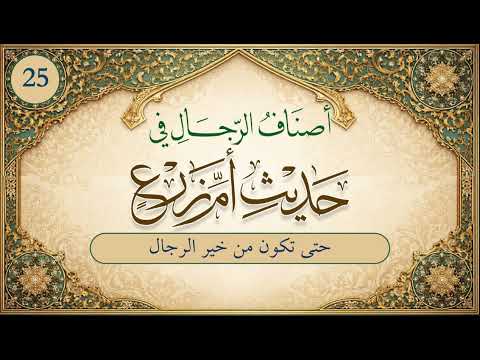
This final episode of the series on the Hadith of Umm Zar‘ explains the types of men and urges the husband to be among the best of men toward his family. The speaker begins with following the example of the Prophet ﷺ in his treatment of his wives, and stresses that a man's goodness should appear first with his household, then offers practical advice on good character, treating the wife with the same kindness shown to others, and avoiding what damages married life. The speaker cites Ibn Uthaymeen and other scholars in this context.
Key takeaways
Follow the example of the Prophet ﷺ in his treatment of his wives, which can only be achieved by learning his conduct with them through books of hadith.
A man's goodness begins with his family, as the Prophet ﷺ said: "The best of you are those who are best to their families, and I am the best of you to my family."
Good character is a significant part of religion; one who worships Allah well but has bad manners with people may be among the bankrupt on the Day of Judgment.
Apply the etiquette of good dealing with people, such as a cheerful face, smiling and bringing joy, to one's wife just as to others.
Spending on and kindness to one's family is an act of worship for which the husband is rewarded, and a permissible act becomes rewarded through a good intention.
Supplicating for one's wife in her absence, especially in prostration, as shown by the Prophet's ﷺ supplication for ‘Aishah, may Allah be pleased with her.
Beware of unrestrained gazing at women and comparing one's wife with others, as both can lead to corruption in married life.
Questions & answers
What is the goodness of a man according to the Prophet's ﷺ hadith?
The Prophet ﷺ said: "The best of you are those who are best to their families, and I am the best of you to my family." The speaker noted that a man's goodness should appear first with those closest to him.
Is good character with the wife required in the same way as with others?
The speaker affirms that family members have the greatest right to good character, as they are with him in ease and hardship, and warns against being good-mannered with outsiders while harsh with one's family.
What should a husband beware of in his married life?
The speaker warns against two things: unrestrained gazing at women, and comparing what one sees or hears with one's wife, as both can drive a couple apart.
How can a wife be a source of reward for her husband?
The speaker cited the Prophet's ﷺ teaching that spending on one's family is charity, and that the husband is rewarded for the joy he brings his wife, regarding her as a continuing charity through his good treatment of her.
Auto-generated from the lesson transcript; the lesson itself is the reference.
Transcript
Machine translation — may contain errors
0:00In the name of Allah, the Most Gracious, the Most Merciful.
0:03Categories of men.
0:08Regarding the hadith of Umm Zar‘.
0:16So that you may be among the best of men.
0:21My dear brother, the husband.
0:23This is the conclusion of our Ramadan series.
0:26On the explanation and reflection of the hadith of Umm Zar‘.
0:29In clarifying the categories of men.
0:31I have made these quick pieces of advice for myself and for you.
0:34May Allah make me and you.
0:37Among the best of men to their wives.
0:41Firstly, Allah has commanded us to follow.
0:44His Prophet, peace be upon him.
0:47For He said: "There has certainly been for you in the Messenger of Allah.
0:50An excellent pattern."
0:52And part of this following.
0:54Is following the way he treated his wives.
0:58And this following of the Prophet, peace be upon him, cannot be realized.
1:02Except through our knowledge of his biography with his wives.
1:06This means that we should read extensively the hadiths.
1:10Related to the biography of the Prophet, peace be upon him.
1:13With his wives.
1:15From the books of hadith.
1:17And from the books that have specifically collected these hadiths.
1:20Such as the book *Husn al-Uswah*.
1:23*Fima Thabata ‘an Allah wa Rasulihi fi al-Niswa* (The Best Example: Regarding What Has Been Authenticated from Allah and His Messenger Concerning Women).
1:27By Siddiq Hasan Khan.
1:29And the book.
1:31*Mawsu‘at Ahadith al-Mar’ah fi al-Kutub al-Sittah* (Encyclopedia of Hadiths Concerning Women in the Six Books).
1:35By ‘Adil al-Hamad.
1:37Secondly.
1:38The Prophet, peace be upon him, described.
1:41His life with his wives in a general description.
1:44For he said:
1:45"The best of you is the best of you to his family.
1:48And I am the best of you to my family."
1:51Narrated by al-Tirmidhi.
1:53Ibn ‘Uthaymin, may Allah have mercy on him, said:
1:55"If there is goodness in you.
1:57Then place it with those closest to you.
2:00And let them be the first to benefit from this goodness."
2:04This is the opposite of what some people do today.
2:07You find him ill-mannered with his family.
2:10But well-mannered with others.
2:12This is a grave error.
2:15Your family is more deserving of your good conduct.
2:18Treat them with the best of character.
2:20Because they are the ones who are with you.
2:22Night and day.
2:24In private and in public.
2:26If something befalls you, they suffer with you.
2:29If you are happy, they rejoice with you.
2:31And if you are sad, they grieve with you.
2:34So let your treatment of them.
2:36Be better than your treatment of strangers.
2:39For the best of people is the best of them to his family.
2:44Thirdly, my dear brother, the husband.
2:47In order to achieve excellence in your treatment of your family.
2:51You must adhere to these matters.
2:54First.
2:55Strive against your soul to adorn yourself with noble character.
2:59By reflecting on the hadith of Umm Zar‘.
3:02We find that everyone whom his wife praised.
3:05She praised for his good character.
3:07And everyone whom his wife criticized.
3:09She criticized for his poor character.
3:12This means that the most important issue you should attend to.
3:16After attending to your religion.
3:18Is your character.
3:20That is why he, peace be upon him, said:
3:23"If someone whose religion and character you are pleased with proposes to you.
3:27Then marry him off."
3:29Narrated by al-Tirmidhi.
3:31Character is part of the religion.
3:33But the Prophet, peace be upon him.
3:36Emphasized it because there are people who perform their worship to Allah well.
3:41Yet they are ill-mannered with people.
3:44And these are among the bankrupt losers on the Day of Resurrection.
3:48He, peace be upon him, said:
3:51"The bankrupt one of my Ummah is the one who comes on the Day of Resurrection with prayer, fasting, and zakat.
3:57But he comes having insulted this one, slandered that one.
4:01Consumed the wealth of this one, shed the blood of that one, and struck this one.
4:06So this one is given from his good deeds, and that one is given from his good deeds.
4:10And if his good deeds are exhausted before what is due from him is settled.
4:15Then their sins are taken and cast upon him.
4:18Then he is cast into the Fire."
4:20So do not be one of them, my dear brother, the husband.
4:23Second, apply all the hadiths regarding good treatment of people to your wife.
4:29Some believe that the hadiths urging good treatment of people.
4:35Such as a cheerful face and smiling.
4:38Bringing joy to a Muslim.
4:41Helping people in all its forms.
4:44And striving to care for widows and the needy.
4:47Some believe that this applies to everyone.
4:50Except for the wife and the household.
4:53This is a grave error.
4:55Which, if you fall into it, my dear brother, the husband.
4:58You miss out on many good deeds.
5:01And you miss out on happiness in your home and with your wife.
5:06Reflect on the good deeds that come to you from these actions.
5:10The Messenger of Allah, peace be upon him, said:
5:15"That you leave your heirs wealthy.
5:18Is better than that you leave them dependent, begging from people.
5:23And you will not spend any expenditure seeking thereby the Face of Allah.
5:28But you will be rewarded for it, even for what you place in the mouth of your wife."
5:33Narrated by al-Bukhari.
5:35And the Messenger of Allah, peace be upon him, said:
5:39"And in the intimate act of any of you is a charity."
5:42They said: "O Messenger of Allah.
5:44Does one of us fulfill his desire and have a reward in it?"
5:49He said: "Do you see, if he placed it in a forbidden act.
5:53Would he have a sin in it?"
5:55Likewise, if he places it in the lawful, he has a reward.
6:01Narrated by Muslim.
6:03These hadiths, my dear brother, the husband.
6:06Inform you of the volume of good deeds that come to you.
6:10Because of your gentle treatment of your wife.
6:13And imagine the volume of happiness that will overwhelm her heart with this treatment.
6:18Which is part of the joy you bring to her.
6:22Third.
6:24Consider your wife a continuous charity for you.
6:27And a door of goodness whose reward does not cease.
6:32And to achieve this point.
6:35Apply this hadith to your wife.
6:38And I will place the word "your wife" in small text.
6:41So that the meaning becomes clear to you.
6:44On the authority of ‘Umar that a man came to the Prophet, peace be upon him.
6:48And said: "O Messenger of Allah.
6:51Which of the people is most beloved to Allah?
6:54And which of the deeds is most beloved to Allah?"
6:57The Messenger of Allah, peace be upon him, said:
7:01"The most beloved of people to Allah.
7:03Is the most beneficial of them to people—to your wife.
7:07And the most beloved of deeds to Allah.
7:09Is a joy you bring to a Muslim.
7:12To your wife.
7:14Or you relieve him of a distress.
7:16Or her.
7:18Or you pay off a debt for him.
7:20Or for her.
7:22Or you drive away hunger from him.
7:24Or from her.
7:26And that I walk with a brother of mine for a need.
7:29Or with my wife.
7:31Is more beloved to me than that I seclude myself in this mosque for a month."
7:36Meaning the mosque of Medina.
7:38"And whoever restrains his anger toward his wife.
7:42Allah will conceal his faults.
7:44And whoever suppresses his rage toward his wife.
7:47Even though he could have acted upon it, he refrained.
7:50Allah will fill his heart with hope on the Day of Resurrection.
7:54And whoever walks with a brother—with his wife.
7:59For a need until he establishes it for her.
8:02Allah will make his feet firm on the day when feet slip."
8:06Narrated by al-Tabarani in *al-Kabir*.
8:09Fourth.
8:11Pray for her in her absence.
8:13Especially during your prostration.
8:15Supplication for people.
8:17Does not come except from a loving heart.
8:20And I believe that you, my dear brother, the husband.
8:23Love your wife.
8:25So have you prayed for her in her absence?
8:27Or in your prayer?
8:29On the authority of ‘A’ishah, may Allah be pleased with her.
8:31That she said:
8:33"When I saw from the Prophet, peace be upon him.
8:36A good mood.
8:38I said: 'O Messenger of Allah.
8:40Pray to Allah for me.'"
8:42So he said:
8:44"O Allah, forgive ‘A’ishah.
8:46Her past sins.
8:48And her future ones.
8:50What she kept secret and what she made public."
8:52So ‘A’ishah laughed.
8:54Until her head fell into her lap.
8:56From laughter.
8:58The Messenger of Allah, peace be upon him, said to her:
9:02"Does my supplication please you?"
9:04She said:
9:06"And why would your supplication not please me?"
9:08He said:
9:10"By Allah, it is my supplication for my Ummah.
9:12In every prayer."
9:14Narrated by Ibn Hibban.
9:16Fifth.
9:18Stay away from the spoilers.
9:20Of marital life.
9:22The spoilers of marital life.
9:25Are many.
9:27But I warn you, my dear brother, the husband.
9:29Against two things.
9:31The first.
9:33Casting glances at the faces of women.
9:35This looking.
9:37Will not end except with the fear of Allah.
9:39And the fear of His punishment.
9:41Otherwise, the faces
9:43of beautiful women are endless;
9:45for every time you look at one woman,
9:47another appears with the best
9:49of what she has to offer.
9:51Especially since Satan beautifies
9:53the forbidden for you,
9:55while making the lawful seem repulsive to you.
9:57Looking at what is forbidden
9:59is among the sins that may cause separation
10:01between you and your wife.
10:03The Prophet, peace and blessings of Allah be upon him, said:
10:05"No two people are brought together
10:07and then separated
10:09except by a sin
10:11committed by one of them."
10:13Narrated by Ahmad.
10:15The second point:
10:17Comparing what you see
10:19or hear with your own wife.
10:21This is one of the most dangerous things
10:23for your heart and your mental state,
10:25because you will never be content
10:27with what you have,
10:29and it is the beginning of problems with your wife.
10:31It may well be that the cause
10:33of the divorce of Umm Zar'
10:35was what Abu Zar' fell into
10:37by casting his gaze upon other women
10:39and making comparisons between
10:41what he saw and his wife,
10:43which is a sin that caused separation
10:45between them.
10:48In conclusion,
10:50I ask Allah to grant you happiness, dear brother,