Part of Tafsir al-Tabari (the series is complete) · Lesson 101 of 308

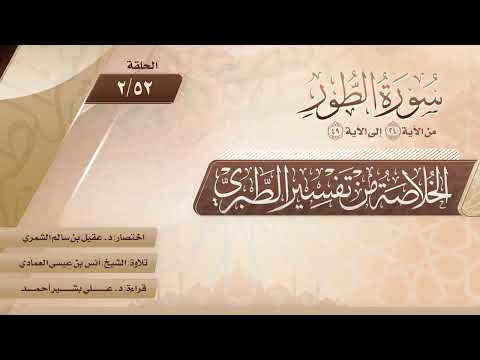
Conclusion from Al-Tabari’s interpretation | Episode (52-2) | Surat Al-Tur | Verses from (24) to (49)

◉ 160 views ⏱ 10:17 Translated audio — English
0:000:00

Lesson timeline

  1. 00:00 Believers in Paradise and their questions about the worldly life
  2. 01:00 Believers' fear of God's punishment in the world
  3. 02:04 God's response to the claim that he is a poet
  4. 03:05 The challenge to the disbelievers to produce a similar Quran
  5. 04:12 Denial that people were created from nothing
  6. 05:13 Refuting the disbelievers' false claims and arguments
  7. 06:13 Questioning disbelievers about payment and attributing daughters to God
  8. 07:14 Glorifying God above shirk and the punishment of the disbelievers
  9. 08:15 Punishment of disbelievers in this world and before the Day of Judgment
  10. 09:16 Patience with God's decree and remembrance through prayer

Lesson summary

In this episode of Tafsir al-Tabari, Dr. Aqil bin Salim al-Shammari explains verses 24 to 49 of Surat al-Tur. The verses describe the state of the people of Paradise, who ask one another about their lives in this world, fearing Allah's punishment and thanking Him for His grace. They then address the claims of the disbelievers about the Prophet ﷺ and the Quran, such as calling him a soothsayer, a madman, or a poet, and explain that their own reason does not command them to say such things. The verses also present evidence against their claims and for the Oneness of Allah, and conclude with a warning of punishment and a command to be patient and to glorify Allah.

Key takeaways

  • The lesson describes the bliss of the people of Paradise and their questioning about their state in the world, along with their gratitude to Allah for His grace and their rescue from the Fire.
  • The people of Paradise were, in this world, fearful of Allah's punishment and sincere in their devotion to Him, associating nothing with Him.
  • The Prophet ﷺ is consoled that he is neither a soothsayer nor a madman nor a poet, and that Allah will not forsake him.
  • The false claims of the disbelievers are refuted, as their reason does not command them to say them, and they are described as a people who have transgressed against their Lord.
  • Evidence is given against them: they were not created from nothing, nor did they create the heavens and the earth, so they have no grounds to be arrogant toward faith.
  • Allah punishes the disbelievers in this world before the Day of Resurrection, such as the punishment of the grave, hunger, and calamities, though most of them do not know this.
  • The lesson commands patience with the decree of one's Lord, glorifying Allah with His praise at the times of prayer, and trust that Allah protects His Prophet ﷺ.

Questions & answers

What is the meaning of Allah's words: So remind, for you, by the grace of your Lord, are not a soothsayer or a madman?

The sheikh explains that the meaning is: So remind, O Muhammad, for by the grace of Allah you are neither a soothsayer nor a madman, but you are the Messenger of Allah, and Allah will not forsake you.

Why did Allah say: Or do you ask them for a payment, so they are burdened with debt?

According to the explanation, the meaning is: do you ask them for a reward or compensation from their wealth for calling them to the Oneness of Allah? They are burdened by the weight of the debt and cannot respond to you.

What punishment do disbelievers receive before the Day of Resurrection?

The sheikh mentions that it includes the punishment of the grave, hunger, and the calamities that befall them in their persons, their wealth, and their children, though most of them do not know this.

What did the Prophet ﷺ receive commands about at the end of these verses?

He was commanded to be patient with his Lord's decree and to convey His messages, and to glorify Allah with His praise when he rises, at night, and as the stars set; the sheikh explains this as referring to the prayers.

Auto-generated from the lesson transcript; the lesson itself is the reference.

Qur’an verses cited in this lesson

  • At-Tur 52:26 — Saying: Lo! of old, when we were with our families, we were ever anxious;
  • At-Tur 52:28 — Lo! we used to pray unto Him of old. Lo! He is the Benign, the Merciful.
  • At-Tur 52:30 — Or say they: (he is) a poet, (one) for whom we may expect the accident of time?
  • At-Tur 52:35 — Or were they created out of naught? Or are they the creators?
  • At-Tur 52:36 — Or did they create the heavens and the earth? Nay, but they are sure of nothing!
  • At-Tur 52:38 — Or have they any stairway (unto heaven) by means of which they overhear (decrees). Then let their listener produce some warrant manifest!
  • At-Tur 52:39 — Or hath He daughters whereas ye have sons?
  • At-Tur 52:42 — Or seek they to ensnare (the messenger)? But those who disbelieve, they are the ensnared!
  • At-Tur 52:43 — Or have they any god beside Allah? Glorified be Allah from all that they ascribe as partner (unto Him)!
  • At-Tur 52:44 — And if they were to see a fragment of the heaven falling, they would say: A heap of clouds.
  • At-Tur 52:45 — Then let them be (O Muhammad), till they meet their day, in which they will be thunder-stricken,
  • At-Tur 52:46 — A day in which their guile will naught avail them, nor will they be helped.
  • At-Tur 52:48 — So wait patiently (O Muhammad) for thy Lord's decree, for surely thou art in Our sight; and hymn the praise of thy Lord when thou uprisest,
  • At-Tur 52:49 — And in the night-time also hymn His praise, and at the setting of the stars.

Verses are matched automatically against the Qur’an text; some mentions may be missed. English: Pickthall.

Transcript

Machine translation — may contain errors
0:00 In the name of Allah, the Most Gracious, the Most Merciful.
0:05 A summary of the Tafsir of al-Tabari.
0:08 Abridged by Dr. 'Aqil ibn Salim al-Shammari.
0:13 Surah al-Tur.
0:18 In the name of Allah, the Most Gracious, the Most Merciful.
0:23 "And there will circulate among them boys for them, as if they were pearls well-protected."
0:32 Young servants will circulate among these people in Paradise, as if they were pearls in their whiteness and clarity, protected within their shells; they are the purest and clearest in their whiteness.
0:46 "And they will approach one another, inquiring of each other."
0:53 “Saying: Lo! of old, when we were with our families, we were ever anxious;” (52:26)
1:00 "Saying, 'Indeed, we were before among our people fearful [of punishment]. So Allah conferred favor upon us and protected us from the punishment of the Scorching Fire.'"
1:07 “Lo! we used to pray unto Him of old. Lo! He is the Benign, the Merciful.” (52:28)
1:18 Some of these believers in Paradise will approach others, asking one another about their state.
1:24 It has been said that this will occur upon their resurrection from their graves.
1:29 They will say to one another, "O people, we were previously among our families in the worldly life, fearful of the punishment of Allah, dreading that He might punish us."
1:39 "But Allah favored us with His grace and saved us from the punishment of the Fire."
1:44 "Indeed, we used to worship Him in the world, sincere to Him in religion, associating nothing with Him."
1:51 "Indeed, He is the Kind to His servants, the Merciful to His creation."
1:57 "So remind, for you are not, by the favor of your Lord, a soothsayer or a madman."
2:04 “Or say they: (he is) a poet, (one) for whom we may expect the accident of time?” (52:30)
2:11 "Or do they say, 'A poet for whom we await a misfortune of time'?"
2:19 Remind, O Muhammad, those to whom you have been sent, and admonish them.
2:24 You are not, by the favor of Allah upon you, a soothsayer who practices divination, nor are you a madman.
2:29 Rather, you are the Messenger of Allah, and Allah will not forsake you.
2:34 Instead, the polytheists say, "He is a poet; we await for him the accidents of time," hoping to be rid of him through death or some calamity.
2:43 Say, O Muhammad, to these polytheists, "Wait and be patient, for I am with you among those who wait."
2:49 I am with you among those who wait until the command of Allah comes to pass regarding you.
3:05 Do the minds of these polytheists command them to say to Muhammad, peace be upon him, "He is a poet"?
3:13 Their minds do not command them to do so.
3:16 Rather, they are a people who have transgressed against their Lord.
3:19 They have exceeded what was permitted to them and what they were commanded, moving from faith to disbelief.
3:40 Or do these polytheists say,
3:43 "Muhammad invented this Qur'an and fabricated it"?
3:47 They have lied in what they said.
3:49 Rather, they do not believe, so they refuse to accept the truth that has come to them from their Lord.
3:55 Let them, then, bring forth a Qur'an like that which Muhammad, peace be upon him, has brought.
4:04 If they are truthful in their claim that Muhammad, peace be upon him, invented and fabricated it.
4:12 “Or were they created out of naught? Or are they the creators?” (52:35)
4:17 "Or were they created by nothing, or are they the creators [of themselves]?"
4:25 Were these polytheists created without fathers or mothers?
4:30 They are like inanimate objects, not comprehending any argument.
4:33 It has also been said: Were they created for no purpose, or are they the creators of this creation?
4:40 “Or did they create the heavens and the earth? Nay, but they are sure of nothing!” (52:36)
4:42 It is for this reason that they do not obey the command of Allah, nor do they desist from what He has forbidden them.
4:48 For the Creator is the one who possesses the authority to command and forbid.
4:51 They did not create the heavens and the earth.
4:54 Yet they do not believe in the warning of Allah.
4:57 Nor in what has been prepared for the people of disbelief in terms of punishment in the Hereafter.
5:02 "Or do they have the depositories of your Lord, or are they the controllers [of them]?"
5:09 “Or have they any stairway (unto heaven) by means of which they overhear (decrees). Then let their listener produce some warrant manifest!” (52:38)
5:13 “Or have they any stairway (unto heaven) by means of which they overhear (decrees). Then let their listener produce some warrant manifest!” (52:38)
5:21 Do these deniers of the signs of Allah possess the depositories of your Lord, O Muhammad?
5:27 They are turned away from the truth because they feel no need for it.
5:30 Or are they the tyrants, the arrogant ones who exalt themselves against Allah?
5:35 Or do they have a stairway upon which they climb to the heaven to listen to the revelation?
5:40 So they claim that they heard from Allah that what they are upon is the truth?
5:45 If they claim that,
5:48 Then let the one who claims to have heard that bring a proof demonstrating that it is the truth.
5:54 “Or hath He daughters whereas ye have sons?” (52:39)
5:59 "Or do you ask of them a payment, so they are by debt burdened?"
6:07 "Or have they [knowledge of] the unseen, so they write [it] down?"
6:13 "Is the bounty of daughters for your Lord and for you the sons?"
6:17 Or do you ask these polytheists to whom We have sent you, O Muhammad,
6:22 For a reward or compensation from their wealth for the monotheism of Allah to which you invite them?
6:28 They are so burdened by the weight of the debt you have placed upon them that they cannot respond to you.
6:33 Or do they possess knowledge of the unseen?
6:36 So they write it down for the people, informing them of whatever they wish and telling them whatever they desire.
6:44 “Or seek they to ensnare (the messenger)? But those who disbelieve, they are the ensnared!” (52:42)
6:51 “Or have they any god beside Allah? Glorified be Allah from all that they ascribe as partner (unto Him)!” (52:43)
7:02 Rather, these polytheists, O Muhammad, desire to plot against you and the religion of Allah.
7:07 They are the ones who are plotted against and deceived.
7:10 So trust in Allah and proceed with what you have been commanded.
7:14 Or do they have a deity worthy of worship other than Allah?
7:18 Exalted is Allah, far above their polytheism and their worship of others.
7:24 “And if they were to see a fragment of the heaven falling, they would say: A heap of clouds.” (52:44)
7:30 "And if they were to see a fragment from the sky falling, they would say, '[It is but] clouds heaped up.'"
7:35 If these polytheists see a piece of the sky falling,
7:40 They say, "This is a cloud heaped up, one part upon another."
7:44 They do not turn away from the denial they are upon.
7:48 Because Allah has decreed that they will not believe.
7:53 “Then let them be (O Muhammad), till they meet their day, in which they will be thunder-stricken,” (52:45)
8:00 “A day in which their guile will naught avail them, nor will they be helped.” (52:46)
8:08 So leave these polytheists, O Muhammad,
8:11 Until they meet their day in which they will be destroyed.
8:15 That is at the first blowing of the Trumpet.
8:18 A day when their plotting will not avail them anything.
8:21 Nor will it avert from them anything of the punishment of Allah.
8:25 And no helper will aid them, nor will they be able to seek retribution from those who punish and chastise them.
8:46 And indeed, for those who disbelieve in Allah, there is a punishment from Allah before the Day of Resurrection.
8:52 Such as the punishment of the grave.
8:53 And the hunger and calamities that afflict them in their persons, their wealth, and their children.
8:59 But most of them do not know that they will taste that punishment.
9:06 “So wait patiently (O Muhammad) for thy Lord's decree, for surely thou art in Our sight; and hymn the praise of thy Lord when thou uprisest,” (52:48)
9:11 “So wait patiently (O Muhammad) for thy Lord's decree, for surely thou art in Our sight; and hymn the praise of thy Lord when thou uprisest,” (52:48)
9:16 “And in the night-time also hymn His praise, and at the setting of the stars.” (52:49)
9:24 And be patient for the decision of your Lord, O Muhammad, which He has decreed for you.
9:28 And convey His messages.
9:30 For you are under Our eyes; We see you and We see your work.
9:34 And We surround and protect you.
9:37 So no one who intends evil against you from among the polytheists shall reach you.
9:41 And exalt [Allah] with praise of your Lord when you arise from your sleep.
9:45 This refers to the midday nap.
9:48 It specifically refers to the Dhuhr prayer.
9:50 And from the night, exalt your Lord, O Muhammad, through prayer and worship.
9:55 This refers to the Maghrib and Isha prayers.
9:58 And at the time when the stars retreat for setting as the day approaches.
10:02 By this, we mean the Fajr prayer.