budoorzahera launched in 2026 to carry the light of knowledge to every heart, in every language. Every lesson is available in the original audio with a full synced transcript, translated into fifteen other languages, with translated-audio listening available for a number of them.
You can copy any line of the transcript while listening, download the full text in multiple formats (TXT · SRT · VTT), or share a lesson with someone you care about in one tap. We ask God to make this work beneficial.
4192audio lessons
59complete series
16world languages
Error log
An automatic log of the most recent errors the app ran into on your device — copying and sending it to us helps a lot when troubleshooting a problem.
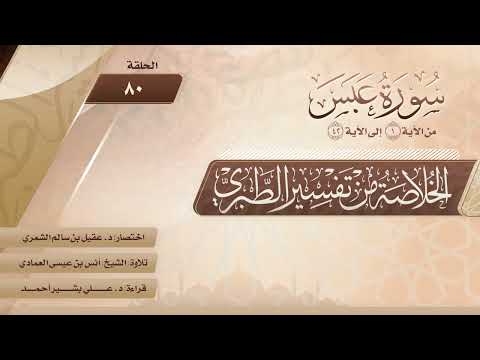
In this episode of his abridged Tafsir al-Tabari, Dr. Aqil bin Salim al-Shamr explains Surah Abasa. He begins with the rebuke the Prophet ﷺ received for frowning at the blind man who came to him striving and fearing, while attending to the one who thought himself self-sufficient. He then explains that the Quran is a reminder, honored and purified, carried by the noble angel scribes. The explanation moves to the creation of man from a drop of semen, the facilitation of his path, his death and resurrection, and then to man's reflection on his food, as Allah sends rain that produces grain, grapes, olives, dates and fruit. It concludes with the horrors of the Day of Resurrection and the contrasting faces of the believers and the disbelievers.
Key takeaways
A reminder that the Quran is a message through which whoever wills among Allah's servants may be admonished.
An exhortation to give attention to the believer who fears Allah, and not to be occupied with those who consider themselves self-sufficient.
Reflection on man's origin from a drop of semen, his measured creation, the facilitation of his path, his death and his resurrection.
Contemplation of Allah's favor in sending rain to grow grain, grapes, olives, date palms, fruit and fodder for people and livestock.
An explanation of the horrors of the Day of Judgment, when a person flees from his closest relatives because each is preoccupied with his own state.
The distinction between faces on that day: the believers' faces are bright, laughing and joyful, while the disbelievers' faces are covered with dust and darkness.
Questions & answers
What is the reason for the rebuke of the Prophet ﷺ in Surah Abasa?
According to the explanation, Allah rebuked the Prophet ﷺ for frowning at the blind man who came to him striving and fearing, and for attending to one who thought himself self-sufficient in his wealth, hoping he would embrace Islam.
What is meant by al-abb in the verse 'and fruit and abban'?
The lesson explains that fruit refers to what people eat from the fruit of trees, while abban refers to what livestock eat of grass and plants; others said it refers to moist fruits.
What do the bright faces and the dusty faces refer to on the Day of Resurrection?
Bright faces belong to the believers, who are joyful and laughing because of the bounties Allah has given them. Faces covered with dust and darkness belong to the disbelievers, the wicked ones.
Why does a person flee from his brother, mother, father and children on the Day of Resurrection?
The lesson explains that each person will be occupied with his own matter, which will suffice him and distract him from others. Some said he flees out of fear of being held to account for the wrongs and obligations between him and them.
Auto-generated from the lesson transcript; the lesson itself is the reference.
Qur’an verses cited in this lesson
'Abasa 80:3 — What could inform thee but that he might grow (in grace)
'Abasa 80:7 — Yet it is not thy concern if he grow not (in grace).
'Abasa 80:8 — But as for him who cometh unto thee with earnest purpose
'Abasa 80:18 — From what thing doth He create him?
'Abasa 80:19 — From a drop of seed. He createth him and proportioneth him,
'Abasa 80:22 — Then, when He will, He bringeth him again to life.