budoorzahera launched in 2026 to carry the light of knowledge to every heart, in every language. Every lesson is available in the original audio with a full synced transcript, translated into fifteen other languages, with translated-audio listening available for a number of them.
You can copy any line of the transcript while listening, download the full text in multiple formats (TXT · SRT · VTT), or share a lesson with someone you care about in one tap. We ask God to make this work beneficial.
4192audio lessons
59complete series
16world languages
Error log
An automatic log of the most recent errors the app ran into on your device — copying and sending it to us helps a lot when troubleshooting a problem.
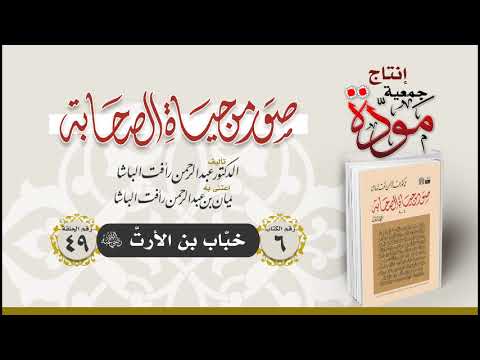
This lesson narrates the story of the Companion Khabbab ibn al-Aratt رضي الله عنه, who was sold as a boy and later became a skilled sword-maker in Makkah. He embraced Islam early and suffered severe persecution from his mistress Umm Anmar and her brother Sibaa', yet he endured the torture in the valley of Makkah. He then migrated to Madinah, lived under the care of the Prophet ﷺ and the rightly-guided caliphs, and feared being held accountable for the wealth he had gained. The lesson concludes with the praise of Ali ibn Abi Talib رضي الله عنه for him.
Key takeaways
Patience in the face of harm for the sake of faith: Khabbab رضي الله عنه endured severe torture and did not abandon his religion.
Boldness in declaring the truth: he openly announced his Islam in Makkah without fear of a tribe or clan protecting him.
Honesty and excellence in work: these qualities earned him people's trust and drew customers to his swords.
Caution regarding wealth and fear of accountability: Khabbab رضي الله عنه feared that his remaining wealth might be a reward for his deeds, as the lesson explains.
Praise for one who embraced Islam willingly, migrated obediently and lived striving, as Ali ibn Abi Talib رضي الله عنه said of him.
A lesson in transformation: a slave who was sold became, after Islam, one of the honored Companions respected by the caliphs.
Questions & answers
Who was Khabbab ibn al-Aratt رضي الله عنه?
He was a Companion who embraced Islam in Makkah. In his early life he was a boy sold in the slave market, then became a skilled sword-maker known for trustworthiness and excellent craftsmanship.
How was Khabbab ibn al-Aratt رضي الله عنه tortured in Makkah?
Sibaa' ibn Abd al-Uzza and his people tortured him in the valley of Makkah. They stripped him of his clothes, dressed him in iron armour, withheld water, and placed heated stones on his back until the fat of his shoulders melted.
What did Khabbab رضي الله عنه fear about his wealth?
He feared being held accountable for it and punished because of it. On his deathbed he said that his companions had passed away without receiving their rewards in this world, while he had gained wealth he feared might be the reward of his deeds.
What did Ali ibn Abi Talib رضي الله عنه say about Khabbab?
He said: May Allah have mercy on Khabbab. He embraced Islam willingly, migrated obediently, and lived striving, and Allah will not waste the reward of one who does good deeds.
Auto-generated from the lesson transcript; the lesson itself is the reference.
Transcript
Machine translation — may contain errors
0:00In the name of Allah, the Most Gracious, the Most Merciful.
0:15Mawaddah Association is pleased
0:18to present to you snapshots from the lives of the Companions,
0:22by 'Abd al-Rahman Ra'fat al-Basha,
0:25may Allah have mercy on him.
0:27Khabbab ibn al-Aratt, may Allah be pleased with him.
0:47Umm Anmar al-Khuza'iyyah set out for the slave market in Makkah,
0:51intending to buy herself a young male servant
0:55who could serve her and whose labor she could exploit.
0:58She began closely inspecting the faces of the slaves offered for sale,
1:02until her choice settled upon a boy who had not yet reached puberty.
1:06She saw in his robust health and the marks of desert nobility upon his face
1:11that which enticed her to purchase him.
1:13She paid his price and set off with him.
1:16While they were on their way,
1:18Umm Anmar turned to the boy and asked,
1:21"What is your name, boy?"
1:23He replied,
1:24"Khabbab."
1:26She asked,
1:27"And what is your father's name?"
1:29He said,
1:30"Al-Aratt."
1:31She asked,
1:32"And where are you from?"
1:34He said, "From Najd."
1:36She remarked,
1:37"So you are an Arab, then?"
1:39He replied, "Yes,
1:40from the tribe of Banu Tamim."
1:42She asked,
1:43"And who brought you into the hands of the slave dealers in Makkah?"
1:47He explained,
1:48"An Arab tribe raided our settlement,
1:51drove off the livestock, captured the women,
1:54and seized the children.
1:56I was among the boys taken.
1:59Then I kept passing from hand to hand
2:02until I was brought to Makkah
2:04and ended up in your hands."
2:06Umm Anmar placed her young slave with a blacksmith in Makkah
2:10to learn the craft of sword-making.
2:13It was not long before the young boy mastered the trade and acquired complete proficiency in it.
2:18When Khabbab grew stronger and reached robust manhood,
2:23Umm Anmar rented a shop for him,
2:26purchased tools for him,
2:28and began exploiting his skill in crafting swords.
2:32It was only a short time before Khabbab became famous in Makkah,
2:37and people began flocking to buy his swords
2:40because of the honesty, truthfulness, and craftsmanship he displayed.
2:45Despite his youth, Khabbab
2:48possessed the mind of a mature man and the wisdom of elders.
2:52Whenever he finished his work and was alone with his thoughts,
2:56he would often reflect upon that pagan society
3:00that was steeped in corruption from head to toe.
3:05He was appalled by the dense ignorance and blind misguidance
3:09that had enveloped the life of the Arabs,
3:11of which he himself was one of the victims.
3:14He used to say to himself, "This dark night must surely come to an end."
3:19He wished for his life to be prolonged
3:22so that he might see with his own eyes the demise of darkness and the birth of light.
3:26Khabbab did not have to wait long,
3:29for word soon reached him that a ray of light
3:32had shone forth from the mouth of a youth from Banu Hashim,
3:36named Muhammad ibn 'Abdillah.
3:39So he went to him and listened to his message,
3:41and its radiance dazzled him and its light overwhelmed him.
3:45He extended his hand to the Prophet,
3:47testifying that there is no god but Allah
3:50and that Muhammad is His servant and His Messenger.
3:53Thus he became the sixth person to embrace Islam on the face of the earth,
3:57to the extent that it was said a time passed when Khabbab represented one-sixth of Islam.
4:03Khabbab did not conceal his Islam from anyone,
4:06and news of his conversion soon reached Umm Anmar.
4:09She flew into a furious rage
4:12and gathered her brother, Siba' ibn 'Abd al-'Uzza,
4:15joined by a group of youths from the Khuza'ah tribe,
4:18and they all marched toward Khabbab.
4:21They found him busily engaged in his work.
4:23Siba' approached him and said,
4:26"We have received news about you that we could not believe."
4:29Khabbab asked, "And what is that?"
4:32Siba' said, "It is rumored that you have apostatized and followed the youth of Banu Hashim."
4:37Khabbab replied calmly,
4:40"I have not apostatized; rather, I have believed in Allah alone, without any partner,
4:44renounced your idols,
4:46and testified that Muhammad is the servant of Allah and His Messenger."
4:50No sooner had Khabbab's words struck the ears of Siba' and those with him
4:54than they set upon him, beating him with their hands,
4:58kicking him with their feet,
5:01and pelting him with whatever hammers and iron scraps they could reach,
5:06until he collapsed to the ground unconscious,
5:09bleeding profusely.
5:12The news of what transpired between Khabbab and his mistress spread through Makkah like wildfire,
5:18and the people were astonished by Khabbab's audacity.
5:21They had never heard before
5:23of anyone following Muhammad and standing among the people to declare his Islam
5:28with such openness and defiance.
5:31The elders of Quraysh were shaken by Khabbab's stance,
5:34for it had never crossed their minds that a blacksmith like Umm Anmar's slave—
5:39who had no clan to protect him
5:41and no tribal allegiance to defend or harbor him—
5:44would have the boldness to rebel against their authority,
5:48openly revile their gods,
5:50and mock the religion of their forefathers.
5:54They realized that this day would be followed by grave consequences.
5:58And Quraysh was not mistaken in its expectations,
6:01for Khabbab's boldness inspired many of his peers to proclaim their Islam,
6:07and they began openly declaring the word of truth, one after another.
6:11The leaders of Quraysh gathered at the Ka'bah,
6:14led by Abu Sufyan ibn Harb,
6:17al-Walid ibn al-Mughirah,
6:19and Abu Jahl ibn Hisham.
6:21They conferred regarding the affair of Muhammad,
6:23concluding that his matter was escalating day by day
6:28and hour by hour.
6:30So they resolved to eradicate the disease before it spread beyond control,
6:34deciding that every tribe should set upon its own followers of his,
6:39torturing them until they recanted their religion or died.
6:44The burden of torturing Khabbab fell upon Siba' ibn 'Abd al-'Uzza and his people.
6:50When the midday heat intensified and the sun's rays scorched the ground,
6:56they would take him out to the stony valley of Makkah,
6:58strip off his clothes,
7:00dress him in iron coats of armor,
7:02and deprive him of water.
7:04When exhaustion reached its absolute limit,
7:07they would come to him and ask,
7:09"What do you say about Muhammad?"
7:11He would reply, "He is the servant of Allah and His Messenger,
7:15who brought us the religion of guidance and truth
7:17to bring us out from darkness into light."
7:20Thereupon they would beat and punch him relentlessly,
7:23then say to him,
7:25"And what do you say about al-Lat and al-'Uzza?"
7:27He would say, "Two deaf, dumb idols
7:31that can neither harm nor benefit."
7:34So they would bring red-hot stones
7:37and press them against his back,
7:39holding them there until his own body fat melted to quench them.
7:43Umm Anmar was no less cruel to Khabbab than her brother Siba'.
7:48She saw the Messenger of Allah, peace and blessings of Allah be upon him, passing by Khabbab's shop and speaking with him,
7:54which drove her to madness.
7:57She began coming to Khabbab day after day,
8:00taking a red-hot piece of iron from his furnace
8:03and placing it upon his head until his scalp smoked
8:07and he fell unconscious,
8:08while he continued to pray against her and her brother Siba'.
8:12When the Messenger, peace be upon him, gave permission
8:16to his Companions to migrate to Madinah,
8:19Khabbab prepared to depart.
8:22However, he did not leave Makkah
8:24until Allah answered his supplication against Umm Anmar.
8:29She was afflicted with a headache the likes of which had never been heard of in severity,
8:34causing her to howl from the intensity of the pain like a dog.
8:39Her sons sought medical treatment for her everywhere,
8:43but they were told that there was no cure for her pain
8:48except to regularly cauterize her head with fire.
8:51So she resorted to cauterizing her head with red-hot iron,
8:55enduring burning pain that made her forget the agony of her headache.
9:00In Madinah, under the care of the Ansar, Khabbab tasted the sweetness of rest
9:04of which he had been deprived for so long.
9:07His eyes were delighted by his proximity to his Prophet, peace and blessings of Allah be upon him,
9:12without anything to trouble him or disturb his peace.
9:17He fought alongside the noble Prophet at Badr,
9:20fighting under his banner,
9:22and marched with him to Uhud.
9:24There Allah delighted his eyes with the sight of Siba' ibn 'Abd al-'Uzza,
9:28the brother of Umm Anmar,
9:30meeting his death at the hands of the Lion of Allah,
9:33Hamzah ibn 'Abd al-Muttalib.
9:35His life was extended
9:37until he lived through the reigns of the four Rightly Guided Caliphs,
9:42living under their care, highly esteemed and renowned.
9:46One day during his caliphate, he visited 'Umar ibn al-Khattab,
9:50who elevated his seat
9:52and brought him very close, saying to him,
9:55"No one is more deserving of this assembly than you, except Bilal."
9:59Then he asked him about the worst torture he had endured at the hands of the polytheists,
10:03but Khabbab felt too shy to answer.
10:06When 'Umar insisted, Khabbab pulled his cloak back from his spine,
10:10and 'Umar recoiled in horror at what he saw,
10:12asking, "How did this happen?"
10:15Khabbab replied,
10:17"The polytheists lit a fire of firewood for me until it became glowing embers,
10:21then they stripped off my clothes
10:24and dragged me across it,
10:26until the flesh fell from my backbones,
10:29and nothing extinguished that fire except the fluid that oozed from my body."
10:34Khabbab became wealthy in the latter part of his life after a long period of poverty,
10:39acquiring gold and silver beyond what he had ever dreamed of.
10:43Yet he disposed of his wealth in a manner no one could imagine:
10:48he placed his dirhams and dinars in a known spot in his house,
10:52accessible to those in need among the poor and destitute.
10:56He did not tie it securely,
10:59nor did he lock it away,
11:01so they would come to his home and take whatever they wished,
11:05without asking or seeking permission.
11:08Even so,
11:10For he feared that he would be held to account for that wealth,
11:13and that he might be punished on its account.
11:15A group of his companions narrated, saying:
11:18"We entered upon Khabbab during the illness from which he died,
11:21and he said, 'There are eighty thousand dirhams in this spot.
11:26By Allah, I never tied its bag closed,
11:29nor did I ever turn away a beggar from it.'
11:32Then he wept.
11:34So they asked him, 'What makes you weep?'
11:36He replied, 'I weep because my companions have passed away
11:41without receiving any part of their reward in this world,
11:45whereas I have survived
11:47and received this wealth,
11:49which I fear may be the reward for those deeds of mine.'"
11:54And when Khabbab departed to the mercy of his Lord,
11:57the Commander of the Faithful, 'Ali Ibn Abi Talib (may Allah be pleased with him), stood at his grave
12:03and said: "May Allah have mercy on Khabbab.
12:06He embraced Islam willingly,
12:09emigrated obediently,
12:11and lived as a striver in the cause of Allah.
12:13And Allah will never cause the reward of those who do good to be lost."
12:18"May Allah have mercy on Khabbab.
12:20He embraced Islam willingly,
12:22emigrated obediently,
12:24and lived as a striver in the cause of Allah."