budoorzahera launched in 2026 to carry the light of knowledge to every heart, in every language. Every lesson is available in the original audio with a full synced transcript, translated into fifteen other languages, with translated-audio listening available for a number of them.
You can copy any line of the transcript while listening, download the full text in multiple formats (TXT · SRT · VTT), or share a lesson with someone you care about in one tap. We ask God to make this work beneficial.
4192audio lessons
59complete series
16world languages
Error log
An automatic log of the most recent errors the app ran into on your device — copying and sending it to us helps a lot when troubleshooting a problem.
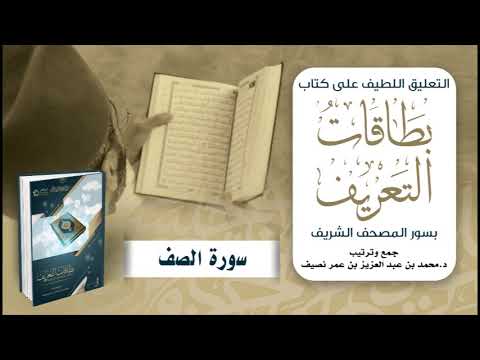
In this installment of the series Al-Ta'liq Al-Latif, the lecturer presents three observations on Surah As-Saff: first, a correction to how the opening of the surah is described so that it fits the book's own method; second, the surah's connection to the preceding Al-Mumtahanah, where purifying the hearts from allegiance to disbelievers comes before fighting them; and third, the dating of its revelation and the multiple narrations of its cause. He notes that the cause of revelation mentioned in the book is incomplete, and that the surah was revealed all at once.
Key takeaways
The surah opens with a declarative sentence, and it belongs among the surahs that begin with glorification (tasbih), a correction of the wording used in the book, in line with the book's own method.
The opening with glorification covers types of praise such as tasbih, tahmid and tabrik, so the surah is classed among those that begin with tasbih.
The variation in opening formulas is explained not merely by chronological sequence but by the fit of each formula to the setting (maqam) of each surah.
Purification comes before adornment: cleansing the hearts from allegiance to disbelievers precedes fighting them, which is the link between As-Saff and the preceding surah.
The cause of revelation cited in the book is incomplete; the full narration shows the Prophet ﷺ recited the whole surah, and that it was revealed in one go.
Multiple narrations of the cause help pin down the date of revelation by gathering the chains and noting names of Companions, events and places.
Authentic causes of revelation are drawn from the book cited by Dr. Usama al-Humaydan, and other causes exist that were not included because they did not meet the book's conditions.
Questions & answers
How is the opening of Surah As-Saff described in this explanation?
The lecturer says the surah opens with a declarative sentence and is among the surahs beginning with tasbih, since types of praise such as tasbih, tahmid and tabrik fall under this category, consistent with the book's method.
What is the connection between Surah As-Saff and Surah Al-Mumtahanah before it?
The lecturer explains that Al-Mumtahanah commands purifying the hearts from allegiance to disbelievers, and this purification precedes the fighting discussed in As-Saff: purification (takhliyah) comes before adornment (tahliyah).
Was Surah As-Saff revealed all at once?
Yes, according to the full narration the lecturer cites, the Prophet ﷺ recited the entire surah, indicating it was revealed in one go.
Why are multiple narrations of the cause of revelation useful?
Gathering the chains can mention Companions whose timelines are known, or events and places, which helps determine the date of revelation precisely with knowledge of the biography of the Prophet ﷺ.
Auto-generated from the lesson transcript; the lesson itself is the reference.
Qur’an verses cited in this lesson
Al-Hadid 57:1 — All that is in the heavens and the earth glorifieth Allah; and He is the Mighty, the Wise.
Verses are matched automatically against the Qur’an text; some mentions may be missed. English: Pickthall.
Transcript
Machine translation — may contain errors
0:00In the name of Allah, the Most Gracious, the Most Merciful.
0:30"The Graceful Commentary
0:32on the Book of Introductory Profiles
0:35to the Surahs of the Noble Qur'an"
0:38by Dr. Muhammad ibn 'Abd al-'Aziz ibn 'Umar Nassif,
0:42may Allah preserve him.
0:44Surah al-Saff.
0:46In the name of Allah, the Most Gracious, the Most Merciful.
0:48Praise be to Allah, Lord of the worlds,
0:50and may peace and blessings
0:52be upon the Seal of the Prophets and Messengers,
0:55and upon all his family and Companions.
0:57We continue with our graceful commentary
0:59on the introductory profiles,
1:01and we have arrived at Surah al-Saff.
1:03I have three observations regarding it.
1:06The first observation
1:08concerns what was mentioned about the opening of the surah.
1:10He stated that it opens
1:12with a declarative sentence,
1:14and that it is among the surahs that begin
1:17with glorification (tasbih).
1:19In truth,
1:21this is not consistent
1:23with the methodology of the book
1:25as established earlier in Surah al-Isra'
1:27and in the introduction of the book.
1:29If you look at the beginning of the book,
1:31on pages fourteen and fifteen,
1:33you will find a lengthy citation
1:35from Imam al-Suyuti
1:37explaining the various types of surah openings.
1:39What he mentioned
1:41is a fine scholarly effort (ijtihad),
1:43though it may be contested in certain aspects.
1:45However, if one adheres
1:47throughout the book, as noted there,
1:49to what Imam al-Suyuti mentioned,
1:51then consequently,
1:54the most precise phrasing here,
1:56which is appropriate and consistent
1:58with what preceded in Surah al-Isra',
2:00is to say:
2:02"It opens with a sentence
2:04of praise (thanā'),"
2:06which is one of the categories mentioned
2:08in *Al-Itqan*.
2:10Thus, we should say: "It opens with a sentence of praise,
2:12and it is among the surahs
2:14that begin with glorification," because praise
2:16encompasses various forms, as previously noted:
2:18among them is tasbih (glorification),
2:20tahmid (praise), and tabrik (exaltation of blessings).
2:22Therefore, it is among the surahs that begin with tasbih,
2:24so it should read:
2:26"It opens with a declarative sentence [of praise],
2:28and it is among the surahs that begin with tasbih."
2:30It may also be added
2:32that it opens with a verb
2:34in the past tense.
2:36If you return to that same passage,
2:38you will find an explanation
2:40for that on page
2:43fourteen
2:45specifically.
2:47I mentioned page fourteen,
2:49or page fifteen,
2:51where this quotation appears:
2:53"Glorification is an expression reserved exclusively for Allah;
2:55thus, He began with the verbal noun (masdar)
2:57in [the Surah of] the Children of Israel (Bani Isra'il),"
2:59meaning in Surah al-Isra', where He said, "Exalted is He
3:01who took His Servant by night..."
3:03He stated: "Because it is the root form;
3:05the root of derived words
3:07is the verbal noun"—
3:09although this is actually a contested linguistic issue.
3:11He continued: "Then with the past tense in al-Hadid and al-Hashr,
3:13because it is the earlier of the two timeframes;
3:15for we have the past tense
3:17and we have the present tense,
3:19and of the two, the past is prior."
3:21Thus, He began with al-Hadid and al-Hashr.
3:23He continued: "Then with the present/imperfect tense in al-Jumu'ah
3:25and al-Taghabun,"
3:27meaning the timeframe of the present and the future.
3:29Then he stated: "Then with the imperative form in al-A'la,"
3:31and the imperative pertains to the future.
3:33He explained: "In order to encompass
3:35this word from all its grammatical facets."
3:37While what he mentioned
3:39is subtly insightful in itself,
3:41it is not the most precise explanation
3:43for such stylistic variation.
3:45Rather, this variation is grounded in
3:47contextual suitability.
3:49For each surah has its own context
3:51and its own core purpose,
3:53and the grammatical form arrives
3:55perfectly suited to that context.
3:57I have devoted specialized research to this,
3:59including a study
4:01dedicated specifically to these
4:03openings featuring glorification,
4:05detailing the distinctions
4:07between them and the appropriateness of each
4:09to its specific context,
4:11while considering the verse in its entirety.
4:13“All that is in the heavens and the earth glorifieth Allah; and He is the Mighty, the Wise.” (57:1)
4:15Thus,
4:17the formulation varies
4:19across the entire verse,
4:21which is
4:23a delightful topic of study
4:25indeed,
4:27and one that requires
4:29deep reflection.
4:31As for the second
4:33observation,
4:35it concerns what was mentioned
4:37regarding the thematic placement of the surah.
4:39It was noted therein
4:41regarding its correlation with al-Mumtahanah
4:43that it commands
4:45fighting in Allah's cause.
4:47In truth, this matter
4:49is very important.
4:51As scholars of spiritual purification always say:
4:53"Purging impurities precedes adorning with virtues (al-takhliyah qabl al-tahliyah)."
4:55It is essential
4:57first to purify
4:59hearts from every
5:01sentiment
5:03that does not please Allah, the Exalted and Glorified,
5:05which includes
5:08loyalty to the disbelievers
5:10and taking them as close allies.
5:12Thus, the fighting mentioned in al-Mumtahanah—
5:14the preceding surah—
5:16purifies the hearts of the believers
5:18from this taint.
5:20And it is a taint that directly affects
5:22what is addressed in this surah,
5:24for the believers fighting
5:26in unified ranks and in solidarity
5:28requires beforehand,
5:30or necessitates prior to it, the cleansing of their hearts
5:32and their purification
5:34from the impurities of allegiance to disbelievers.
5:36Thus, between the two surahs, there is
5:38a clear thematic harmony and mutual reinforcement.
5:40As I said, this relates to the principle of purging
5:42occurring before
5:44adorning.
5:46Fighting the disbelievers is an act of adornment,
5:48but prior to it, the heart must be purged
5:50of these impurities.
5:52As for the third
5:54observation,
5:56it concerns what was stated regarding the chronological order of the surah's revelation,
5:58where it was stated at the end:
6:00"And its multiple revelation narratives
6:02may help in
6:04dating its revelation."
6:06Regarding its multiple revelation narratives:
6:08when we consult the occasion of revelation (sabab al-nuzul),
6:10we find only a single occasion.
6:12Before I conclude this point,
6:14I wish to make a brief digression and say:
6:16the occasion of revelation mentioned
6:18is incomplete.
6:20If you refer to the *Musnad* of Ahmad,
6:22you will find it in full,
6:24and in its completion, it states that the entire surah
6:26was revealed,
6:28contrary to the apparent meaning of this text.
6:30For the Messenger of Allah (peace be upon him) recited to us:
6:32"Whatever is in the heavens and whatever is on the earth glorifies Allah..."
6:34up to His words: "...most hateful in the sight of Allah,"
6:36and then the rest of the narration mentions that he
6:38completed the entire surah.
6:40This has a significant bearing
6:42on its revelation,
6:44as it was revealed all at once.
6:46Consequently, if its date of revelation is identified,
6:48whether approximately or precisely,
6:50it encompasses every single one of its verses.
6:52Returning to the multiple narratives of its revelation:
6:54how can there be multiple narratives when we have
6:56only one occasion?
6:58This comes down to two matters:
7:00first, that this single occasion has
7:02multiple transmission chains (riwayat),
7:04which can be helpful, because by compiling them,
7:06mention might be made of one
7:08of the Companions whose date
7:10of accepting Islam is known, or
7:12the date of his martyrdom, and so forth.
7:14This aids us in achieving precise
7:16a meticulous compilation of the transmission chains.
7:18Some names may be mentioned,
7:20or certain events or places,
7:22which, through our knowledge of the Seerah, aid us
7:24in determining the precise dating
7:26of revelation. And we say "may",
7:28because this comprehensive research has not yet been conducted,
7:30so one might arrive,
7:32after collecting these narrations,
7:34at a precise determination
7:36of the date of revelation.
7:38Furthermore, regarding the multiplicity of narrations from another perspective,
7:40of course, only one occasion of revelation was mentioned here,
7:42but there are other reasons
7:44mentioned in other books.
7:46I have only restricted myself—as I have explained
7:48on multiple occasions
7:50and in the book itself—
7:52to the book *Al-Sahih min Asbab al-Nuzul*
7:54by Shaykh Dr. Issam Al-Humaydan,
7:56which is the adopted source in this work.
7:58Other narrations of reasons for revelation have also been reported
8:00that likewise aid in knowing
8:02the precise date of revelation.
8:04Thus, the narrations
8:06regarding the occasion itself are numerous,
8:08and they help; and there are other narrations
8:10not mentioned here because they do not meet the criteria of
8:12the book, which are also helpful.
8:14I will conclude with this much regarding Surah As-Saff,
8:16and I ask Allah
8:18to illuminate my heart and yours,
8:20and my path and yours,
8:22through the Magnificent Qur'an.
8:24May Allah send blessings upon our Prophet Muhammad,