budoorzahera launched in 2026 to carry the light of knowledge to every heart, in every language. Every lesson is available in the original audio with a full synced transcript, translated into fifteen other languages, with translated-audio listening available for a number of them.
You can copy any line of the transcript while listening, download the full text in multiple formats (TXT · SRT · VTT), or share a lesson with someone you care about in one tap. We ask God to make this work beneficial.
4192audio lessons
59complete series
16world languages
Error log
An automatic log of the most recent errors the app ran into on your device — copying and sending it to us helps a lot when troubleshooting a problem.
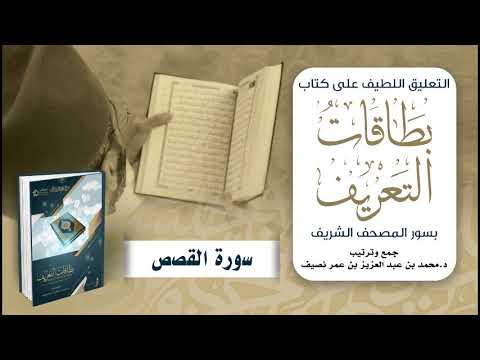
In this episode of the commentary on Bitaqat al-Ta'reef bi-Suwar al-Mushaf al-Sharif, the sheikh examines Surah al-Qasas through three points related to the science of thematic connections (munasabat). The first point concerns the surah's connection to the previous one, al-Naml, and to al-Shu'ara', since it details the story of Musa (peace be upon him) mentioned in both, and the three are known as al-Tawasin. The sheikh explains that these connections are a matter of scholarly reasoning rather than consensus, and cites al-Suyuti's view in Tanasuq al-Durar that each surah elaborates on what precedes it. The second point is that occasions of revelation help in grasping connections, and the third point is the internal linkage within the surah through the repetition of the word 'return' (radd).
Key takeaways
The connection of Surah al-Qasas to al-Naml and al-Shu'ara' is evident in its elaboration of the story of Musa (peace be upon him) mentioned in both.
The surahs al-Shu'ara', al-Naml and al-Qasas are called al-Tawasin, and they share a similar opening.
The science of munasabat is a matter of scholarly reasoning and not consensus, and even a slight connection may be considered.
Al-Suyuti in Tanasuq al-Durar holds that a surah generally elaborates on what precedes it, a view that requires further study of his book.
Occasions of revelation help in understanding connections, as a verse may seem distant until its cause of revelation is known.
The science of connections does not rely on a single factor; it may draw on language, rhetoric, the chronology of revelation and other considerations.
The repeated word 'return' in the surah, as in the verse 'Indeed, We will return it to you', links its beginning to its end and shows the coherence of its structure.
Questions & answers
What is the relationship between Surah al-Qasas and the two surahs before it?
The sheikh explains that Surah al-Qasas relates to al-Naml and al-Shu'ara' because it details and expands the story of Musa (peace be upon him) mentioned in them, and the three are known as al-Tawasin.
Is the science of connections between surahs agreed upon by scholars?
No. The sheikh clarifies that connections between surahs are not a matter of scholarly consensus but of reasoned judgment, and even a slight connection may be considered.
How do occasions of revelation help in understanding a connection?
The sheikh notes that some verses may seem unrelated to their context until their cause of revelation is known; once it is known that one verse was revealed about Abu Talib and another about some Jews who embraced Islam, the connection becomes clear.
What links the beginning of Surah al-Qasas to its end?
The sheikh points out the repetition of the word 'return': the verse 'Indeed, We will return it to you' at the start is connected to the verse 'Indeed, He who has ordained the Qur'an for you will return you to a place of return' near the end, as explained by al-Suyuti and al-Biqa'i.
Auto-generated from the lesson transcript; the lesson itself is the reference.
Qur’an verses cited in this lesson
Al-Qasas 28:53 — And when it is recited unto them, they say: We believe in it. Lo! it is the Truth from our Lord. Lo! even before it we were of those who surrender (unto Him).
Al-Qasas 28:54 — These will be given their reward twice over, because they are steadfast and repel evil with good, and spend of that wherewith We have provided them,
Verses are matched automatically against the Qur’an text; some mentions may be missed. English: Pickthall.
Transcript
Machine translation — may contain errors
0:00In the name of Allah, the Most Gracious, the Most Merciful.
0:03A gentle commentary
0:32on the book of identification cards
0:35for the images of the Noble Qur'an,
0:38by Dr. Muhammad ibn 'Abd al-'Aziz ibn 'Umar Nasif,
0:42may Allah preserve him.
0:44Surah al-Qasas.
0:46In the name of Allah, the Most Gracious, the Most Merciful. Praise be to Allah,
0:48and may prayers and peace be upon the Messenger of Allah.
0:51We continue with our gentle commentary
0:53on the identification cards
0:55for the images of the Noble Qur'an
0:57by Muhammad ibn 'Umar Nasif,
0:59now with Surah al-Qasas.
1:01I have three observations regarding it,
1:04all of which will be connected
1:06to the science of thematic coherence (munasabat).
1:08The first observation
1:10concerns the placement of the Surah,
1:12which I have previously stated
1:14aims to clarify the relationship of the Surah
1:16to the one preceding it.
1:18He says here that its coherence
1:20with An-Naml and Ash-Shu'ara'
1:22lies in its detailed elaboration
1:24of the story of Musa, peace be upon him,
1:26which is mentioned in both of them.
1:29Thus, the coherence here is not
1:31related only to the preceding Surah,
1:33which is An-Naml,
1:35but to the two preceding Surahs:
1:37Ash-Shu'ara' and An-Naml.
1:39These three Surahs—
1:41Ash-Shu'ara', An-Naml, and Al-Qasas—
1:43are called the "Tawasin."
1:45They are united by the similarity in their opening,
1:47even if the similarity is complete between Al-Qasas,
1:49Ash-Shu'ara', and An-Naml,
1:51[all starting with] "Ta-Sin" without a "Mim."
1:53Here, I would like to speak
1:55about what some brothers mentioned.
1:57One asked me, saying:
1:59"Do these thematic coherences have
2:01a fixed rule
2:03that is consistent?"
2:05Although I have pointed
2:07to something of this before, there is no harm
2:09in repeating it.
2:11I say, firstly,
2:13these thematic coherences
2:15are not a matter
2:17of consensus among scholars;
2:19they are a matter of ijtihad (scholarly exertion),
2:21and one may be satisfied
2:23with the slightest connection.
2:26Furthermore, this specific connection—
2:28a connection that Al-Suyuti saw
2:30in his book *Tanasuq al-Durar*—
2:32is consistent throughout the Qur'an,
2:34[the idea] that a Surah elaborates on what preceded it.
2:36This requires research;
2:38meaning, the book *Tanasuq al-Durar*
2:40by Al-Suyuti needs
2:42to be examined for the general rules
2:44he mentioned,
2:46and to verify those rules
2:48by looking
2:50at the Qur'an.
2:53In truth, he mentioned
2:55subtle points that deserve study,
2:57among them this [notion] that every Surah elaborates
2:59on what preceded it.
3:01He did not present the argument just like that;
3:03rather, he provided multiple proofs
3:05scattered throughout his book
3:07for this matter.
3:09The second observation:
3:11what helps in understanding thematic coherence
3:13is the study of the reasons for revelation (asbab al-nuzul).
3:16We have two reasons in this Surah
3:18that may help in dating the revelation.
3:20Of course, not
3:22the dating of the entire Surah,
3:24because it was revealed—
3:26or the two reasons were revealed in verses close to each other,
3:28almost within the same period.
3:30However, [this applies to] some verses of the Surah.
3:32Therefore, we say it is better to say
3:34that it indicates the dating of
3:36the revelation of some verses of the Surah;
3:38this is more precise.
3:41They are two reasons that may help in dating the revelation,
3:44but if you reflect upon them,
3:46you will find they also help in thematic coherence. For the first reason for revelation:
3:51﴾And We have conveyed the word to them so that they might remember. Those to whom We gave the Book before it, they believe in it. And when it is recited to them, they say...﴿
3:56[The verses continue] regarding spending from what We have provided, until it says: ﴾Indeed, you do not guide whom you love.﴿
4:00“And when it is recited unto them, they say: We believe in it. Lo! it is the Truth from our Lord. Lo! even before it we were of those who surrender (unto Him).” (28:53)
4:04“These will be given their reward twice over, because they are steadfast and repel evil with good, and spend of that wherewith We have provided them,” (28:54)
4:08Abu Talib, and the preceding verses were revealed regarding some of the Jews who
4:15accepted Islam, the connection becomes clear. Thus, the science of thematic coherence does not rely on
4:19one thing alone. It may rely on language,
4:23it may rely on
4:28rhetoric, it may rely on the history of revelation, it may rely on...
4:33Therefore, we find among the sources of Imam Al-Tabari in the coherences he
4:36mentions are the reports (athar) he narrates from the Tabi'un, which indicates that this
4:41science is authentic—the science of thematic coherence. And it came in the reasons for revelation after
4:48mentioning the first reason,
4:54and there is evidence indicating that this was before the Hijrah.
5:01Meaning, the identification of this incident was reported. This was reported, and though I have not verified
5:05it, some have strengthened it, as in the *Seerah Dhahabiyyah*.
5:10However, it needs further examination. Its absence does not harm [the argument], in the sense that
5:15the fact that the first verses speak about people who believed even though they were
5:23distant, and the verses that follow are about Abu Talib—who was
5:26very close to the Prophet, peace be upon him, and did not believe—means the connection
5:30is established. But if it is proven that this was before the Hijrah, it is useful
5:34also for dating the revelation. So, this is the second observation,
5:38which is that the reasons for revelation assist in the science of thematic coherence. The third
5:44and final issue is regarding the sections of the Surah. You notice in the
5:48last two lines of the second part of the Surah, there is a reminder to the
5:55Prophet, peace be upon him, of the blessing of the Qur'an with the promise
6:00of a return to a place of return: ﴾Indeed, He who imposed the Qur'an upon you will return you to a place of return.﴿
6:04This "return" is connected to the beginning of the Surah, as explained by Al-Suyuti
6:09and Al-Biqa'i, may Allah have mercy on them all. Therefore, you find at the beginning
6:18of the Surah: ﴾Indeed, We will return him to you,﴿ then He said: ﴾So We returned him to his mother.﴿
6:21Allah returned Musa after he left in fear to Madyan;
6:28Allah returned him to Egypt as a righteous prophet and caller, and granted him victory over
6:35Pharaoh. Thus, the "return" is repeated in the Surah,
6:40in wording and in meaning.
6:45Therefore, it can be added here in the third line of the
6:49first section: "Then the mention of the situation of the mother of Musa, the picking up by
6:53the family of Pharaoh, and returning him to her"—meaning returning Musa to her.
6:58Then the maturation and establishment of Musa, then the journey to Madyan, then
7:02the sending of Musa, peace be upon him, and his discourse, then his return
7:07to Egypt—this sentence can be added—and the calling of
7:10Pharaoh and his destruction. Why did I say it is appropriate to mention
7:17the word "return"? To draw attention to the connection between the beginning of the Surah,
7:21the first section, and the end of the second section. And this connection
7:28is not of the type of connection we spoke about before;
7:30this is a connection between the parts of the Surah, and this
7:35is clearer than the connection between the Surah and the one preceding it.
7:39For the Surah and the one preceding it, as I said, scholars differed;
7:42a number of scholars stated that one should not be preoccupied
7:45with it, while some were interested in it. The connection there
7:49is subtle and light, perhaps based on the slightest association. But
7:53this one, which is inside the Surah, is very precise,
7:56clearer, with manifest wording and precise matters.
8:02I ask Allah to grant me and you success in what He loves and is pleased with, and that He
8:06gives us understanding of His Book and makes it a proof for us, not a proof
8:09against us. And may Allah send prayers upon our Prophet Muhammad and upon
8:11his family and all his companions. Praise be to Allah, Lord of the Worlds.