budoorzahera launched in 2026 to carry the light of knowledge to every heart, in every language. Every lesson is available in the original audio with a full synced transcript, translated into fifteen other languages, with translated-audio listening available for a number of them.
You can copy any line of the transcript while listening, download the full text in multiple formats (TXT · SRT · VTT), or share a lesson with someone you care about in one tap. We ask God to make this work beneficial.
4192audio lessons
59complete series
16world languages
Error log
An automatic log of the most recent errors the app ran into on your device — copying and sending it to us helps a lot when troubleshooting a problem.
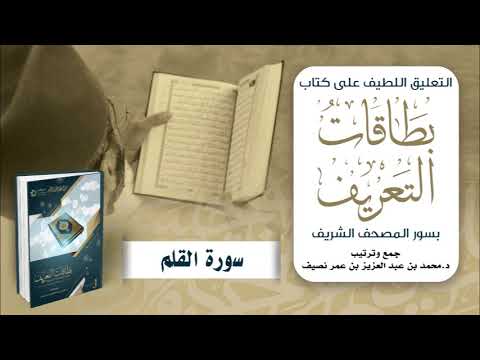
In this commentary the sheikh examines Surah Al-Qalam from three angles: its order of revelation, its placement in the Mushaf, and its sections. He explains that the well-known ordering attributed to Jabir ibn Zayd conflicts with the established early revelation of Surah Al-Muddaththir, and that the surah's debates with the disbelievers do not fit its being the second revealed, although some of it may have come early and the rest later. He also shows how it relates to the preceding Surah Al-Mulk, and affirms that connections between surahs are a broad field for reflection. Finally, he corrects several errors in the book's numbering of sections and in the start of the second part.
Key takeaways
The well-known ordering places Surah Al-Qalam as the second revealed, after Surah Al-Alaq, an opinion attributed to Jabir ibn Zayd in the popular narration.
The earlier revelation of Surah Al-Muddaththir is a established fact that makes this ordering problematic, according to the sheikh.
The surah contains debates with the disbelievers, such as Allah's words, "Ask them which of them will stand surety for that," which does not suit its being among the earliest revelations; some of it may have come early and the rest later.
Surah Al-Qalam is the sixty-eighth in the Mushaf, and its link to the preceding Surah Al-Mulk lies in the ending of Al-Mulk, which mentions the water of the garden's people vanishing, reflecting that sovereignty belongs to Allah who removes it from whom He wills.
Both surahs contrast the people of truth with the people of falsehood and describe the traits of each group.
The connections between surahs are varied and numerous, and this is a broad field open to reflection.
The surah is divided into two parts, and the sheikh notes that the second part begins at verse 42, with some section markers in the book needing correction.
Questions & answers
Where does Surah Al-Qalam stand in the order of revelation according to the sheikh?
The sheikh notes that the popular ordering makes it the second revealed after Al-Alaq, but this conflicts with the established early revelation of Al-Muddaththir, and its debates with the disbelievers do not suit such early placement.
What is the link between Surah Al-Qalam and Surah Al-Mulk?
The sheikh explains that the end of Al-Mulk describes the destruction of the garden's water, which fits the theme that sovereignty belongs to Allah, who removes it from whomever He wills.
What comparisons appear in Surah Al-Qalam?
The surah compares the people of truth with the people of falsehood, describing the qualities of each group, a theme that recurs in Surah Al-Mulk.
Auto-generated from the lesson transcript; the lesson itself is the reference.
Qur’an verses cited in this lesson
Al-Mulk 67:30 — Say: Have ye thought: If (all) your water were to disappear into the earth, who then could bring you gushing water?
Al-Qalam 68:41 — Or have they other gods? Then let them bring their other gods if they are truthful
Verses are matched automatically against the Qur’an text; some mentions may be missed. English: Pickthall.
Transcript
Machine translation — may contain errors
0:00In the name of Allah, the Most Gracious, the Most Merciful.
0:03A brief commentary
0:32on the book *Identification Cards*
0:35*for the Surahs of the Noble Qur'an*,
0:38by Dr. Muhammad ibn Abdul Aziz ibn Umar Nassif,
0:42may Allah preserve him.
0:44Surah al-Qalam.
0:46In the name of Allah, the Most Gracious, the Most Merciful.
0:47All praise is due to Allah, the Lord of all creation,
0:49and may peace and blessings
0:50be upon his brothers among the prophets and messengers,
0:52and upon all his family and companions.
0:54We continue our brief commentary on the *Identification Cards*,
0:57and we have arrived at Surah al-Qalam,
1:00for which we have three points of discussion.
1:02The first point pertains to the chronological order of the Surah's revelation.
1:06He said: "It is counted as the second after al-'Alaq and before al-Muzzammil."
1:11It has been frequently noted that this count is based on the well-known narration from Jabir ibn Zayd,
1:18and that within this text transmitted
1:22from this Tabi'i, there is significant scrutiny required,
1:26which I have pointed out in numerous places throughout this book,
1:29including this very place.
1:32He said, and regarding this:
1:34There is an evident issue with this chronological ordering
1:37and a contradiction to what has been authentically established concerning the revelation of al-Muddaththir.
1:40For we know that the Prophet, peace and blessings of Allah be upon him,
1:42after the beginning of al-'Alaq was revealed to him,
1:45returned to the Mother of the Believers, Khadijah,
1:48and then after that,
1:50verses from Surah al-Muddaththir were revealed;
1:52thus it was the second in order of revelation.
1:54So this contradicts something that is firmly and clearly established.
1:58Then he stated: "Along with its containment of debate with the disbelievers,
2:03which indicates a relatively later period of revelation."
2:06Likewise, when we look at the content
2:08of this Surah, we find polemics and debates with the disbelievers,
2:12such as the Almighty's saying: "Ask them which of them will guarantee that?"
2:15“Or have they other gods? Then let them bring their other gods if they are truthful” (68:41)
2:18And this is not consistent with it being the second surah revealed,
2:26even though it might be said that some of it was revealed second,
2:32and the rest of it was revealed at other times.
2:35However, the initial objection remains: al-Muddaththir
2:38is what followed Surah al-'Alaq, or the beginning of Surah al-'Alaq.
2:44As for the rest of the text written here—
2:48"and it is the second according to all narrations,
2:50so perhaps what is meant is part of it," and so forth—
2:53this is not part of the original book;
2:55rather, it appeared here by mistake.
2:59As for the second point, it concerns the placement of the Surah in the Mushaf.
3:02He said: "It is the sixty-eighth in the order of the Mushaf,
3:07and its correlation with Surah al-Mulk
3:10is that the conclusion of the latter corresponds to the fate of the companions of the garden mentioned in this one."
3:15At the end of that surah,
3:18“Say: Have ye thought: If (all) your water were to disappear into the earth, who then could bring you gushing water?” (67:30)
3:23and this story corresponds
3:25to that conclusion in the sense that all dominion belongs to Allah, Glorified and Exalted be He,
3:30and He strips it away from whomever He granted it to
3:33whenever He wills, Glorified and Exalted be He.
3:37And the recurrent phrase "and among its thematic links,"
3:41across many surahs,
3:45indicates that these thematic links are diverse and manifold.
3:50Therefore, you will also find that in this Surah
3:54there is a contrast between the people of truth and the people of falsehood,
3:57parallels both in Surah al-Qalam
4:00and in Surah al-Mulk.
4:09It is as though the one who walks fallen on his face possesses the traits
4:12mentioned in Surah al-Qalam,
4:15whereas the one who walks upright on a straight path
4:18embodies: "And indeed, you are of a great moral character."
4:20Then He said: "So do not obey the deniers,"
4:22up to His saying: "And do not obey every worthless swearer,
4:25scorner, going about with malicious slander."
4:27These are also among the thematic correlations,
4:30and correlations are a vast field
4:35that offers wide scope for reflection and contemplation.
4:38As for the third and final point,
4:41it concerns the thematic sections of the Surah,
4:43containing several typographic errors and missing details.
4:47He said: "It is divided into two parts, the first of them..."
4:50meaning it is more accurate to say "the first of the two parts."
4:54Then he said: "As for the first part..."
4:57until he said: "In it are three passages."
5:00Then only the numbers 1 and 17 were written;
5:03only two numbers were printed
5:07even though there are three passages,
5:08and the starting verse numbers for all passages ought to have been placed.
5:11The third passage begins at verse thirty-five,
5:14so this number should be added.
5:17I have mentioned before that the word "then"
5:20indicates the beginning of a new passage.
5:22If you read what is written under this,
5:24you find: "Then the story of..." which begins from verse 17;
5:29"Then a return to the comparison between the two groups,"
5:32which is in the last line of the first part.
5:35This word "Then" ought to be bolded
5:37so that it stands out,
5:39and it begins from verse thirty-five.
5:41This marks the return to the comparison between the two groups,
5:43and we add the phrase "along with debate with the disbelievers."
5:48Then he said: "As for the second part..."
5:50In reality, the second part begins from verse forty-two,
5:53because the first part extends from verse one to verse forty-one,
5:56just as is outlined in the book's charts.
5:58Here it was written: "As for the second part, from verse eighteen,"
6:01which is an error;
6:02it is from verse forty-two
6:04to verse fifty-two.
6:09At the conclusion of this second part,
6:11he said: "Ending with exposing the futility of the disbelievers' plots
6:16and praising..."
6:18the Qur'an as being a reminder for all the worlds.
6:21That is, there is an addition and an edit
6:23to make the text more eloquent with rhymed prose:
6:29"Ending with exposing the futility of the disbelievers' plots,
6:32and praising the Qur'an as a reminder for all the worlds."
6:36I would also like to point out a related note: regarding the overall theme of the Surah, he said "by contemplating its paragraphs," whereas it should accurately be "by contemplating its two main parts."
6:48I will suffice with this; and may Allah send blessings upon our Prophet Muhammad and upon all his family and companions, and all praise is due to Allah, the Lord of all creation.