Part of Concepts of Ahl as-Sunnah (series completed) · Lesson 248 of 1251

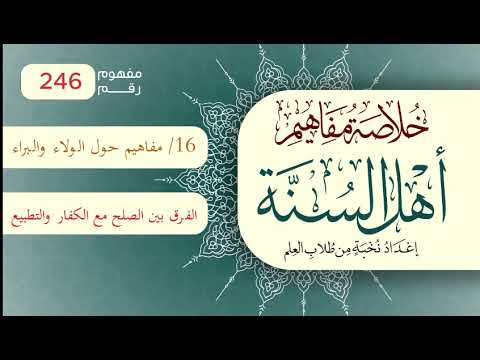
Summary of Sunni concepts | Concept (246) | The difference between reconciliation with infidels and normalization with them

◉ 91 views ⏱ 5:34 Original audio (Arabic)
Translated audio isn't available for this lesson yet — playing the original Arabic recording. The transcript below is fully translated.
0:000:00

Lesson summary

The lesson explains the difference between a permissible peace treaty with an enemy disbeliever at war and normalization with the Jews, which the speaker considers a betrayal of the religion and the Muslim nation. A lawful peace is a temporary agreement concluded by a Muslim ruler after consultation, when he sees a benefit for the Muslims or a repelling of harm, and it does not turn the enemy into a friend nor grant him permanent residence. The speaker argues that normalization grants a occupier a permanent right to Muslim lands and suspends jihad, and he rejects comparing it to the Prophet's ﷺ treaties with Quraysh or with the Jews of Madinah.

Key takeaways

  • A permissible peace with a disbelieving enemy at war is temporary and governed by weighing benefits against harms.
  • Only a Muslim ruler submitting to his Lord's law may conclude it, after consulting the people of binding and loosing.
  • Such a peace does not turn the disbeliever from enemy into friend, nor turn disavowal of him into allegiance.
  • According to the speaker, normalization with the Jews recognizes an occupier's permanent right to Muslim lands, which contradicts the objectives of the Shariah.
  • The speaker holds that normalization undermines the creed of loyalty and disavowal, which he regards as the foundation of monotheism.
  • He warns that normalization opens the door to economic, media and educational control and to the spread of corruption.
  • The lesson argues that the Prophet's ﷺ treaties with Quraysh and with the Jews of Madinah are not valid evidence for today's normalization, given the different circumstances.

Questions & answers

What is the difference between making peace with disbelievers and normalizing relations with them?

The sheikh explains that a permissible peace is a temporary agreement made by a Muslim ruler to serve the Muslims' interests or repel harm, and it does not change the reality of enmity. Normalization, by contrast, grants the disbelieving occupier a permanent right to Muslim lands.

Is peace with an enemy disbeliever at war permissible?

The sheikh says it is permissible under conditions: the Muslim ruler, after consultation with the people of binding and loosing, judges that it achieves a benefit for the Muslims or repels harm from them. It is temporary until the Muslims are strong, and then the treaty is renounced.

Do the Prophet's ﷺ treaties with Quraysh or the Jews of Madinah justify normalization today?

The sheikh argues this comparison is invalid. The Prophet's ﷺ treaty with Quraysh was temporary, and his covenant with the Jews of Madinah was made while they were under Islamic rule; when they betrayed it, he expelled them. Today's regimes, in his view, differ in circumstances.

Auto-generated from the lesson transcript; the lesson itself is the reference.

Qur’an verses cited in this lesson

  • Al-Ma'idah 5:82 — Thou wilt find the most vehement of mankind in hostility to those who believe (to be) the Jews and the idolaters. And thou wilt find the nearest of them in affection to those who believe (to be) those who say: Lo! We are Christians. That is because there are among them priests and monks, and because they are not proud.

Verses are matched automatically against the Qur’an text; some mentions may be missed. English: Pickthall.

Transcript

Machine translation — may contain errors
0:00 A summary of the concepts held by the Ahl al-Sunnah.
0:08 The distinction between making peace with the disbelievers and normalizing relations with them.
0:12 The permissible peace with a warring disbelieving enemy.
0:17 It is that which is concluded by a Muslim leader who submits to the Sharia of his Lord.
0:22 When he deems it necessary, after consulting with the people of authority, the scholars, and the wise.
0:27 That it achieves a benefit for the Muslims or wards off an evil from them.
0:32 It is a temporary peace, intended only until the Muslims gain strength.
0:36 Then, he shall cast their treaty back to the disbelieving enemy.
0:40 Then they fight them so that the religion may be entirely for Allah.
0:44 It is a peace governed by the weighing of interests and harms and the fiqh of balancing priorities.
0:50 It is not a permanent peace.
0:53 Nor does it grant the disbeliever any right to a permanent presence in the lands of the Muslims.
0:58 Nor does the disbeliever, through this peace, transform from an enemy into a friend.
1:02 Nor does the enmity toward them transform into allegiance.
1:06 Rather, enmity and disavowal toward them remain, even while the peace treaty is in effect.
1:12 As for the normalization with the disbelieving Jews that is being proposed today,
1:16 That is a different matter entirely, having no relation to peace in the aforementioned sense.
1:21 It is a betrayal of the religion of Islam and the Muslim Ummah for the following reasons:
1:27 First, because it constitutes an acknowledgment of the disbelieving occupier’s right to permanent ownership of Muslim lands.
1:37 This contradicts the objectives of the Sharia and the foundations of Islam.
1:41 Because it involves the suspension of the rite of Jihad in the path of Allah, the Almighty and Majestic.
1:47 Second, because it demolishes the doctrine of loyalty and disavowal (al-wala’ wa-l-bara’),
1:51 Which is the foundation of "There is no god but Allah."
1:54 For it replaces love, brotherhood, and peace with the Jews in place of enmity and disavowal of them and their disbelief.
2:02 It compels ruling regimes to silence anyone who declares their enmity and hatred toward them.
2:08 And it purges educational curricula and media of everything that points to this enmity,
2:14 Which Allah, the Almighty and Majestic, has explicitly stated in His Book.
2:19 “Thou wilt find the most vehement of mankind in hostility to those who believe (to be) the Jews and the idolaters. And thou wilt find the nearest of them in affection to those who believe (to be) those who say: Lo! We are Christians. That is because there are among them priests and monks, and because they are not proud.” (5:82)
2:26 Third, because it is a contract of humiliation and disgrace, in which the enemy is the superior party.
2:33 It is the enemy that dictates its conditions to the Muslims and dominates their countries.
2:39 And everyone remains in a state of permanent submission to them.
2:43 Fourth, normalization allows the Jews to enter Muslim countries,
2:49 To manipulate their economies, media, and education,
2:53 And to seize control of the nation’s resources through investment and the spread of usury.
2:58 It allows them to occupy the country’s administrations and turn the children of the Muslims into humiliated employees under their control.
3:06 Fifth, opening the country to them allows them to spread vice and corruption in the land.
3:13 For the Jews have never settled in a land without corrupting its morals and its economy.
3:19 Sixth, normalization provides aid to the Jews against the mujahideen in Palestine,
3:25 And serves to liquidate the Jihad there.
3:28 In this, there is support for the disbelievers against the Muslims.
3:32 And this is one of the nullifiers of Islam.
3:36 How, then, can it be said after all of this,
3:40 That normalization with the Jews is a legitimate peace,
3:43 To be measured against the peace the Prophet, peace and blessings of Allah be upon him, made with the disbelievers of Quraysh,
3:48 Or with the Jews in Medina?
3:51 The Prophet’s peace with Quraysh was only temporary.
3:55 And his treaty with the Jews in Medina was not,
3:58 Except while they were under the rule and control of Islam.
4:02 They were inhabitants of the city before he, peace be upon him, arrived.
4:07 Yet, despite this, they betrayed the Messenger, peace be upon him,
4:12 And violated the treaty through this betrayal.
4:15 This is their habitual way.
4:17 So he expelled them from it.
4:19 Furthermore, how can the permanent normalization of contemporary regimes with the Jews be compared,
4:24 When these regimes reject the Sharia of Allah and refuse to rule by it,
4:28 And have suspended the rite of Jihad,
4:30 To the Prophet’s temporary peace with them?
4:35 He was the one who submitted to the Sharia of his Lord and followed His command,
4:39 Struggling in His path.
4:42 His peace with them was only until he gained the strength to confront them,
4:46 At which point he cast their treaties back to them and fought them.
4:50 Normalization, in reality, is humiliation and a betrayal of the Muslims,
4:54 A selling of their homelands to the disbelievers,
4:57 And an endorsement of their presence there.
4:59 It is a demolition of the doctrine of Tawhid, which is based on loyalty to Allah alone,
5:04 And disavowal of polytheism and its people, whether they be Jews or Christians,
5:08 Or any other sect that associates partners with Allah the Exalted.
5:12 Whoever seeks to remove the enmity toward the disbelievers,
5:15 Without calling them to Islam and bringing them into it,
5:19 Is merely seeking to alter the religion of Allah that Muhammad, peace be upon him, brought,
5:25 And to introduce a new religion.
5:28 A summary of the concepts held by the Ahl al-Sunnah.