
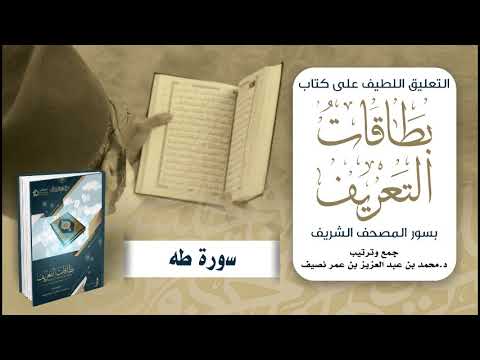
Le joli commentaire sur le livre de cartes identifiant les sourates du Saint Coran | D. Mohammed Nassif | Sourate Taha
Résumé de la leçon
In this episode of the series of gentle commentary on the book « Bitaqat al-ta'rif bi-suwar al-Mushaf al-Sharif », Sheikh Dr. Muhammad Nusayf examines three points concerning the opening of Surat Ta-Ha and its occasions of revelation. He shows that the book follows al-Suyuti's classification of the openings of the surahs, and that « Ta-Ha » is not among the disjointed letters (huruf muqatta'a) by consensus, since there is disagreement about it; al-Tabari favoured that its meaning is « O man ». He then explains that the disjointed letters should not all be treated alike in affirming that they belong to that category. Finally, he clarifies that the book does not mention a cause of revelation for the surah, and that this differs from saying « I did not find one »; the author, Dr. Isam al-Humaydan, did not accept the cause of revelation reported at its beginning and therefore did not mention it.
Points clés
- Al-Suyuti's classification of the openings of the surahs into ten types, among them the disjointed letters, which the book follows.
- « Ta-Ha » is not among the disjointed letters by consensus, as there is a known disagreement about its meaning.
- Al-Tabari favoured that the meaning of « Ta-Ha » is « O man », which is what the researcher should adopt.
- The disjointed letters are not all equal in affirming that they belong to that category; some openings, such as Surat Qaf and Nun, require a particular consideration.
- The difference between the author's saying « he did not mention a cause of revelation for it » and his saying « I did not find one for it »: the former means adopting a specific source, not a categorical negation.
- Dr. Isam al-Humaydan did not accept the cause of revelation reported at the beginning of the surah, so he did not mention it in his authenticated book of causes of revelation.
- A student of the causes of revelation should begin with al-Humaydan's book to form a good understanding, then broaden his reading in other books and add what is established for him.
Questions et réponses
Is « Ta-Ha » one of the disjointed letters?
The Sheikh explains that « Ta-Ha » is not one of the disjointed letters by consensus; it is a matter of disagreement, and al-Tabari favoured that its meaning is « O man ».
What is the meaning of « Ta-Ha » according to al-Tabari?
Al-Tabari chose that it means « O man », which is the preference the Sheikh mentioned.
Does Surat Ta-Ha have a cause of revelation?
The book does not mention a cause of revelation for it, and Dr. Isam al-Humaydan did not accept the cause of revelation reported at its beginning, so he did not mention it.
How can a student of the causes of revelation proceed after al-Humaydan's book?
He should first read al-Humaydan's book to gain a good understanding, then broaden his reading in other causes-of-revelation books and add what he finds established or suitable as evidence.
Résumé généré automatiquement à partir de la transcription ; la leçon elle-même fait foi.